Equipment Manufacturing R&D Workforce Drops Sharply from 409 in 2016 to 91 in 2020
Government Plans 96 Trillion KRW Offshore Wind Project by 2030... Rapid Expansion Increases Dependence on Foreign Products
[Sejong=Asia Economy Reporter Kwon Haeyoung] Although the government is accelerating the deployment of offshore wind power as part of its energy transition efforts, the number of research personnel has been decreasing every year, falling short of 100. Given the already high dependence on foreign wind power equipment from Europe and other countries, there are concerns that if the government continues to push for rapid deployment of wind power without investing in technology development to enhance industrial competitiveness, it could become a 'second solar power' that only enriches foreign companies.
According to the '2020 New and Renewable Energy Industry Statistics Survey Results' announced on the 20th by the Korea Energy Agency's New and Renewable Energy Center, the number of research personnel in wind power equipment manufacturing companies?including blades, power generation systems, power conversion devices, structural materials, and other parts and equipment?was 91, a 34% decrease from 138 the previous year.
In 2016, the number of research personnel in wind power equipment reached 409, but it has been shrinking steadily: 352 in 2017, 271 in 2018, 138 in 2019, and 91 in 2020. The number of wind power equipment businesses decreased from 30 in 2016 to 25 in 2020, and investment dropped from 51.9 billion KRW to 24 billion KRW during the same period. Although annual sales increased from 1.1643 trillion KRW to 1.9202 trillion KRW over the past four years, concerns have been raised that government subsidies and other funds are not being used for technology development to enhance the competitiveness of the domestic wind power industry, which is likely to widen the technology gap with overseas companies in the future.
According to the Energy Agency, if the technology level of advanced countries related to wind power is set at 100, for example, domestic technology for turbine systems is only at 74. While 8-megawatt (MW) turbines have been commercialized overseas and 10 MW or larger turbines are currently under development, domestically, 5 MW turbines are at the commercialization stage, and 8 MW turbines that have already been commercialized abroad are still under development.
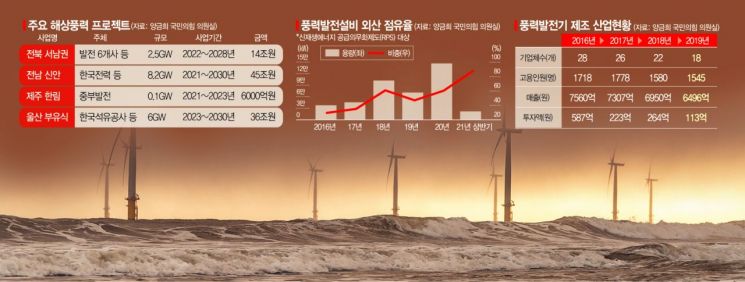
This leads to increased dependence on foreign products. The localization rate of wind power equipment is estimated to be 34% for core components such as generators and converters, and 50% for turbines. For this reason, the market share of foreign products in wind power equipment expanded from 29.6% in 2016 to 60.5% in 2020 and 87.8% in the first half of 2021. The government's decision to increase subsidies for offshore wind power operators using more than 50% domestic components reflects concerns about this reality.
What is even more worrisome is that the domestic wind power industry ecosystem is still in its early stages, and active investment in technology development is not taking place, while the government alone is pressing the accelerator on expanding wind power. The government plans to promote offshore wind projects equivalent to the output of 17 nuclear power plants by 2030. A total of 95.6 trillion KRW will be invested in this project alone, raising concerns that, like Chinese solar panels, the benefits will be handed over entirely to European wind power equipment companies.
Professor Son Yanghoon of the Department of Economics at Incheon National University said, "Even if investments are made in wind power projects and technology development, it is difficult to gain competitiveness, so companies are not investing. If wind power is deployed too quickly without the industry ecosystem maturing, we could lose our market to European companies. Therefore, it is necessary to adjust the pace of wind power deployment considering the domestic industrial conditions."
© The Asia Business Daily(www.asiae.co.kr). All rights reserved.