Attracting Innovative Companies and Creating Youth Jobs
Four Urban Convergence Special Zones Selected Including Gwangju
Need for Interdepartmental Cooperation and Integrated Support
Related Laws Pending... Project Difficulties Expected
A plan to create 'Urban Convergence Special Zones' to attract innovative companies and young talent to non-capital metropolitan downtown areas has been announced, but difficulties are expected due to the lack of legal grounds. Voices are emerging that multi-ministerial cooperation and integrated support based on law are necessary for Urban Convergence Special Zones to attract startups and venture companies and transform into a 'second Pangyo.'
Earlier, the Ministry of Land, Infrastructure and Transport announced the Urban Convergence Special Zone creation plan for national balanced development and prevention of local extinction at the National Balanced Development Committee plenary session in September 2020. The plan involves the government and local governments focusing support on the downtown areas of regional large cities to create innovative hub spaces where industry, housing, and culture are concentrated. Modeled after the Pangyo Techno Valley in Gyeonggi Province, it aims to equip the region with complex infrastructure to attract companies and talent and provide various supports and incentives for corporate relocation.
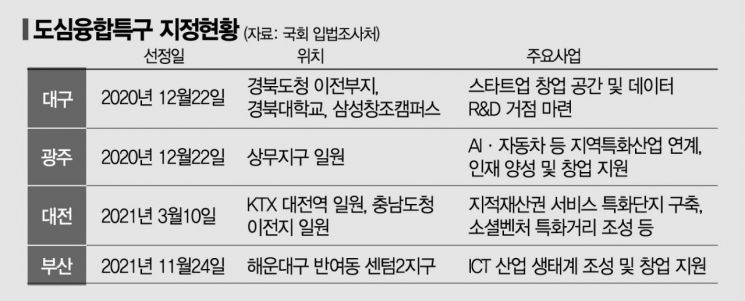
As of January, the National Balanced Development Committee has selected four sites in Daegu, Gwangju, Daejeon, and Busan as pilot projects for Urban Convergence Special Zones. In Ulsan, competition between Ulju-gun and Jung-gu for designation has heated up so much that the designation has been postponed, making it a hot issue. In Gwangju, plans have been announced to develop various infrastructures such as startup spaces, housing, hospitals, and sports centers in the designated Sangmu district special zone. Gwangju City has set a goal to provide conditions within the special zone by 2025 where residents can enjoy life, work, and leisure all together.
However, the problem is that legal grounds for Urban Convergence Special Zones have not yet been established. In May last year, the 'Special Act on the Creation and Promotion of Urban Convergence Special Zones' (sponsored by Assemblyman Kang Jun-hyun of the Democratic Party) was submitted to the National Assembly but is currently pending in the Land, Infrastructure and Transport Committee. The bill stipulates that the government or local governments can support infrastructure installation costs such as roads, railways, and communication facilities necessary for the creation of the special zones, and provide tax reductions on corporate tax, income tax, and other taxes and charges for resident companies.
With the delay in passing the bill, the government has been unable to present concrete plans related to the creation and support of the special zones. To develop non-capital regions as innovation hubs and attract companies, it is necessary to connect various support projects and resources scattered across different ministries, not only the Ministry of Land, Infrastructure and Transport as the main ministry. Additionally, it is a situation where the government and local governments must work together to discover unique projects for each special zone to differentiate them and to respond to adverse effects such as the decline of surrounding areas caused by the creation of the special zones.
Kim Ye-seong, a legislative researcher of the Land, Maritime and Ocean Team at the National Assembly Legislative Research Office, stated, "To form an innovative hub where industry, housing, and culture converge, multi-ministerial support is necessary, including the Ministry of Land, Infrastructure and Transport, Ministry of Economy and Finance, and Ministry of SMEs and Startups, so the enactment of a special law specialized for this is needed." He added, "Support measures are fragmented by ministry, making it difficult to secure a central coordinating force," and suggested, "For Urban Convergence Special Zones to succeed, a system must be established to coordinate various support projects from each ministry and private sector participation from the planning stage, budget securing, and operation process."
© The Asia Business Daily(www.asiae.co.kr). All rights reserved.