Average Competition Rate in Seoul Area 6.0 to 1, Non-Capital Area 3.4 to 1
Highest Regular Admission Competition Rate for Newly Opened Korea Electric Power University This Year
[Asia Economy Reporter Han Jinju] The competition rate for the 2022 academic year regular admissions increased compared to last year, but the gap in competition rates between universities in Seoul and non-metropolitan areas widened further.
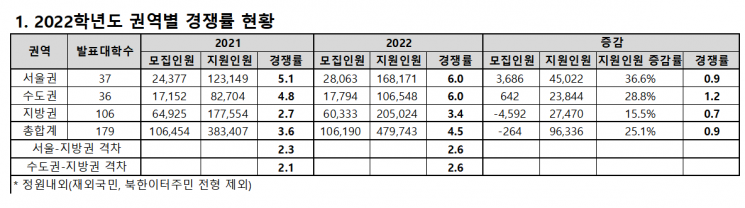
On the 4th, Jongno Academy analyzed the regular admission competition rates of 179 universities and found that the average competition rate for 37 universities located in Seoul was 6.0 to 1, while non-metropolitan universities had a rate of 3.4 to 1. Last year, the competition rates for Seoul and non-metropolitan universities were 5.1 to 1 and 2.7 to 1 respectively, indicating that the gap in competition rates has also increased.
In particular, the number of applicants to Seoul universities increased by 36.6% (45,022 people) from 123,149 to 168,171 compared to the previous year. The number of applicants to non-metropolitan universities increased by only 15.5% (27,470 people) from 177,554 to 205,024.
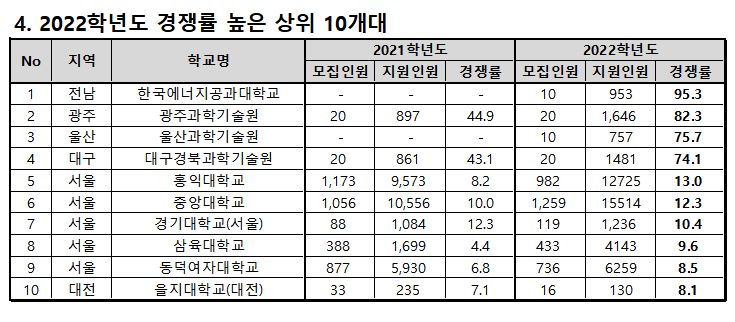
The highest competition rate in regular admissions was recorded by Korea Energy Engineering University (HanJeonGongDae) at 95.3 to 1. Next were Gwangju Institute of Science and Technology at 82.3 to 1, Ulsan National Institute of Science and Technology at 75.7 to 1, and Daegu Gyeongbuk Institute of Science and Technology at 74.1 to 1.
Among general universities, Hongik University had the highest competition rate at 13.0 to 1, ranking fifth overall among all universities. Following were Chung-Ang University at 12.3 to 1, Kyonggi University (Seoul) at 10.4 to 1, Samyook University at 9.6 to 1, and Dongduk Women’s University at 8.5 to 1.
A total of 19 schools had fewer applicants than the number of regular admission slots. Among them, 16 were non-metropolitan, 2 were metropolitan, and 1 was located in Seoul. These include Daegu Arts University, Gyeongju University, Jungwon University, Seoul Jangsin University, Kwangshin University, and Gwangju Women’s University.
The overall increase in competition rates for regular admissions is attributed to the rise in the number of CSAT (College Scholastic Ability Test) takers compared to last year, while the number of early admission transfers decreased. The number of early admission transfers decreased by 5,039 compared to the previous year across 198 universities. Additionally, students who had planned to apply to junior colleges instead applied upward to four-year universities, contributing to the rise in competition rates.
Lim Seong-ho, CEO of Jongno Academy, explained, "The gap between universities in Seoul and those in provincial areas is not narrowing, and polarization among provincial universities is also occurring significantly. In provincial areas, special universities such as Korea Energy Engineering University, regional flagship national universities, second campuses of prestigious Seoul universities, and pharmacy schools are driving the rise in competition rates, but unpopular universities inevitably face under-enrollment."
© The Asia Business Daily(www.asiae.co.kr). All rights reserved.