Opposition to Government Differential Pricing by Use and Expansion Plan for the Dairy Promotion Association Board of Directors
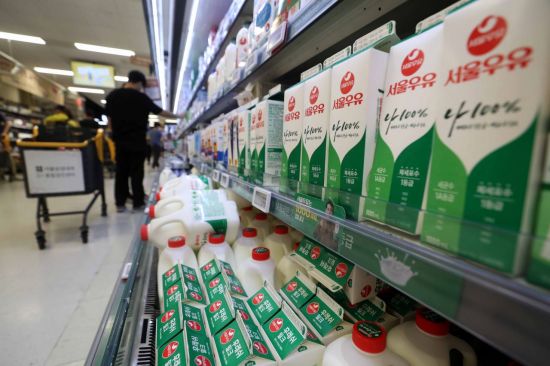 On October 15th, a customer selecting products at the milk section of a large supermarket in Seoul. Photo by Mun Ho-nam munonam@
[Sejong=Asia Economy Reporter Moon Chaeseok] The government proposed differentiating the price system between drinking milk (milk for drinking) and processed milk (milk used for cheese, etc.) and increasing the number of members with decision-making authority in the Dairy Promotion Association from 15 to 23. In response, producers (dairy farmers) have announced a "full-scale struggle against the government" and strongly opposed the proposal. With the government's plan to reform the price system within the year falling through, tensions between both sides are showing signs of escalating into a prolonged conflict.
On the 30th, the Ministry of Agriculture, Food and Rural Affairs announced a policy to increase total production from the existing 2.05 million tons (t) to 2.22 million tons (t), adjusting production volumes to 1.87 million tons for drinking milk, 310,000 tons for processed milk, and 40,000 tons for quota-exceeding milk. Currently, the raw milk price is uniformly applied at 1,100 KRW per liter (ℓ) regardless of whether it is drinking or processed milk, but going forward, the price for processed milk will be lowered to 900 KRW per liter. The price for quota-exceeding milk will remain at 100 KRW per liter as before.
Additionally, the government proposed increasing the number of board members of the Dairy Promotion Association from 15 to 23, aiming to add more neutral figures such as academics, lawyers, and accountants. Currently, the board requires two-thirds attendance to convene, and if seven of the 15 members from the producers’ side are absent, the board cannot even be held. Kwon Jae-han, Director of Food Industry Policy at the Ministry of Agriculture, Food and Rural Affairs, urged, "Both dairy farmers and dairy companies should not focus only on immediate profits but thoroughly consider a desirable dairy industry to be passed on to future generations."
In response, dairy farmers expressed their "complete opposition" immediately after the ministry’s announcement. They judged that farmers’ voices were not reflected in sales reduction and raw milk price decisions. They strongly opposed the government’s improvement plan, arguing that it would not stabilize dairy farmers’ income but rather grant dairy companies a free pass to reduce quotas, which would lead to increased imports and a decline in self-sufficiency rates, contrary to the government’s intentions. They also voiced opposition to the organizational restructuring and demanded the withdrawal of the decision-making system improvement plan through amendments to the articles of association. They called for the deletion of the existing convening conditions and advocated for strengthening the voting conditions.
Lee Seung-ho, President of the Korea Dairy and Beef Cattle Association, and Maeng Gwang-ryeol, Chairman of the National Dairy-related Cooperative Heads Council, stated, "We absolutely cannot accept the government’s plan, which does not reflect the voices of dairy farmers at all." They added, "Pushing forward the government’s plan for differentiated pricing by use through amendments to the articles of association that disregard producers’ bargaining rights is an abuse of authority in violation of civil law and the Dairy Promotion Act by the government itself. We will conduct both rational struggles against the political sphere and strong struggles against the government."
© The Asia Business Daily(www.asiae.co.kr). All rights reserved.
![Clutching a Stolen Dior Bag, Saying "I Hate Being Poor but Real"... The Grotesque Con of a "Human Knockoff" [Slate]](https://cwcontent.asiae.co.kr/asiaresize/183/2026021902243444107_1771435474.jpg)
















