First Publication of China's Export Control White Paper
Like the Diesel Exhaust Fluid Shortage Crisis,
Domestic Economy Can Be Hit Anytime
Battery Industry Also Faces Crisis... China Dominates Market for Essential Minerals Such as Lithium and Nickel
Lithium Compound Production Highest Worldwide
Prices Soar 420% Compared to Early This Year
Rising Raw Material Prices Are the Top Difficulty for Domestic Exporters
This Year, Raw Material Purchasing Costs Increased by an Average of 18.6% Compared to Last Year
Government Responds but Faces Criticism for 'Lack of Proactive Measures'
[Sejong=Asia Economy Reporter Joo Sang-don] While a diesel exhaust fluid crisis unfolded domestically last month due to China's export controls on urea, Europe experienced a magnesium shortage. Chinese companies reduced magnesium production due to power shortages, delivering a direct blow to Europe. A government official said, "Although the items differ, the entire world is under China's sphere of influence."
With China publishing a white paper on export controls, it has laid the groundwork to actively pursue resource weaponization, leaving the global community unable to relax. If supply disruptions occur for 'Made in China' products, many countries, including South Korea, which heavily depend on Chinese raw materials, will inevitably suffer a direct hit.
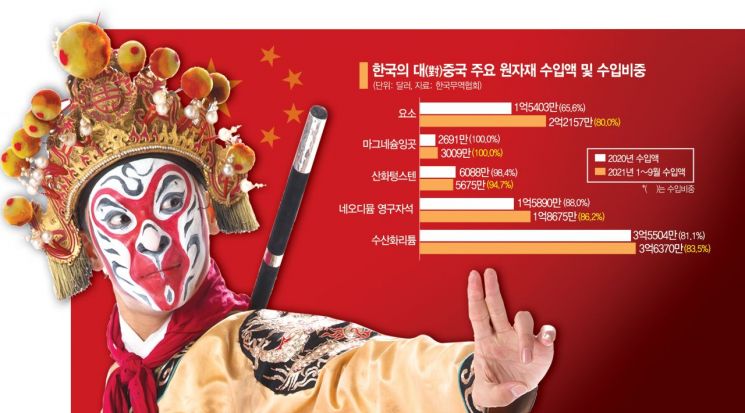
◇China Reveals Intent to Weaponize Resources= China's resource weaponization poses a significant threat to South Korea's economy, which has a high dependence on raw materials from China. According to the Korea International Trade Association, as of January to September this year, there are 1,850 raw material items with over 80% import share from China. Like the recent urea shortage, these could strike our economy at any time.
Besides urea, imports of magnesium ingots?essential raw materials for producing aluminum alloys used in automotive bodies, vehicle seat frames, and aircraft parts for weight reduction?are 100% dependent on China. Tungsten oxide, used in medical devices and semiconductor manufacturing by utilizing photocatalytic and luminescent properties, has a 94.7% dependence on China. Hydroxide lithium, a core material for secondary batteries, is imported 83.5% from China.
The battery industry, considered the second semiconductor, is also at the mercy of 'Made in China' supply dependence. China has acquired mines in its own territory, South America, and Africa, dominating the market for essential battery minerals such as lithium, nickel, cobalt, manganese, and graphite. Particularly, more than half of the world's lithium reserves are located in Bolivia and Chile. Although China's domestic lithium reserves account for less than 10%, it produces the most lithium compounds globally. If Chinese processors sharply raise lithium prices, others have no choice but to follow. According to the Korea Resource Information Service, the price of lithium carbonate, a benchmark for lithium prices, was 252.50 yuan per kilogram (about 47,000 KRW) as of the previous day, soaring 204 yuan or 420.6% from 48.50 yuan on January 4.
Professor Kang Cheon-gu, invited professor at Inha University's Department of Energy and Resources Engineering, said on the 30th, "China has already weaponized rare earths and other rare minerals and is expanding this scope to various raw materials, including urea export controls. The export control white paper indicates that the previously sporadic measures will be unified into a government-level directive to strengthen weaponization."
◇Yellow Light for Korean Exports in the New Year= The sharp rise in raw material prices could act as a downside risk to the currently favorable Korean export trend. According to the '2022 Q1 Export Industry Business Outlook Survey' conducted by the Korea International Trade Association, the most frequently cited export difficulty for companies in Q1 next year was 'rising raw material prices' (26.1%), up 1.8 percentage points from the Q4 outlook. A trade association official said, "We expect Korean exports to continue their favorable trend next year, but risks include deteriorating export profitability due to rising raw material prices, high maritime freight rates, and the spread of the Omicron variant."
Additionally, a survey conducted by the Korea Economic Research Institute on the 19th of last month targeting major export industries among the top 500 domestic companies revealed that key export companies reported an average 18.6% increase in raw material purchasing prices compared to the previous year. Rising raw material prices are thus leading to increased costs for export companies.
Damage from China's resource weaponization is also appearing in various countries besides South Korea. European countries that experienced magnesium supply shortages have a 95% dependence on China. Magnesium is used either directly or as a key component of aluminum to reduce the weight of finished vehicles.
Our government is also preparing for risks related to raw material supply from China. Recently, the government held a task force (TF) meeting on key economic security items to discuss the 'Selection of Key Economic Security Items.' Following a discussion on selecting about 100 key economic security items on the 10th, this meeting aimed to expand the target industries and scope to select about 200 key items. For 20 priority management items such as magnesium, neodymium, and tungsten, as well as diesel exhaust fluid, the government plans to create customized measures based on a 'menu' of responses including diversification of third-country import sources, expansion of domestic production bases, strategic stockpiling by government and private sectors, and securing substitutes.
Experts criticize the government for not taking proactive measures, as seen in Japan's export regulations and the recent diesel exhaust fluid crisis. Professor Kang said, "Although the government has prepared measures to ensure stable raw material supply, effective measures are still lacking. Even if resource development is not pursued, the government urgently needs to diversify import sources for key raw materials."
© The Asia Business Daily(www.asiae.co.kr). All rights reserved.
![Clutching a Stolen Dior Bag, Saying "I Hate Being Poor but Real"... The Grotesque Con of a "Human Knockoff" [Slate]](https://cwcontent.asiae.co.kr/asiaresize/183/2026021902243444107_1771435474.jpg)















