Ministry of Employment and Labor Announces 2020 Nationwide Union Organization Status
Democratic Labor Union at 1.134 Million... Even Including 45,000 Members of JeonGyoJo, Still Surpassed
Unionization Rate at 14.2%... Workplaces with Fewer Than 30 Employees Only 0.2%
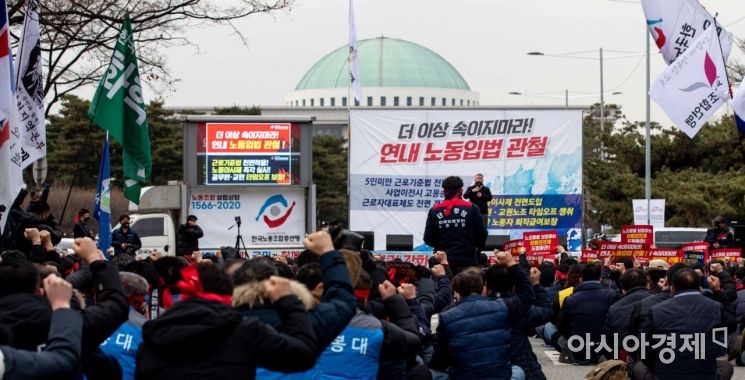 On the 14th, members of the Korean Federation of Trade Unions held a rally near the Industrial Bank of Korea in Yeouido, Seoul, urging the acceptance of seven demands, including the full application of the Labor Standards Act and the immediate implementation of the labor director system. Photo by Jinhyung Kang aymsdream@
[Sejong=Asia Economy Reporter Moon Chaeseok] The total number of union members under the Federation of Korean Trade Unions (FKTU) surpassed 1.15 million as of the end of last year, reclaiming its position as the top trade union federation after three years. The Korean Confederation of Trade Unions (KCTU) also increased its membership by more than 100,000 compared to the previous year, boosted by approximately 45,000 members from the Korean Teachers and Education Workers Union (KTU), which had its illegal union status revoked by the Ministry of Employment and Labor following a Supreme Court ruling in September last year. However, KCTU still ceded the top spot to FKTU.
According to the "2020 National Union Organization Status" data released by the Ministry of Employment and Labor on the 30th, the number of FKTU members was counted at 1,153,863 as of the end of last year, making it the largest among domestic upper-level organizations. KCTU had 1,134,056 members, which was 19,807 fewer than FKTU. FKTU's membership increased by 12.3% from 1,027,229 the previous year, while KCTU's membership grew by 8.5% from 1,044,910. The Ministry of Employment and Labor announces the national union organization status every year at the end of the year. The union organization status is based on the number of members reported by individual unions at the end of the previous year according to the Labor Union Act and is compiled by the Korea Labor Institute.

FKTU had lost its position as the top trade union federation to KCTU for two consecutive years in 2018 and 2019 based on the union membership numbers announced by the Ministry of Employment and Labor. Although it was expected that the gap between the two federations would widen last year due to the inclusion of about 45,000 KTU members who were previously illegal unions in 2019, FKTU instead reclaimed the top spot. While KCTU leaders had anticipated and realized the "1.1 million KCTU era" including KTU members as of the end of last year, FKTU's membership increased at a greater rate.
FKTU stated, "On the surface, the increase seems to be influenced by eight unions within the Samsung Group joining the Korean Metal Workers' Union Federation (KMWUF) last year and the rise in public sector positions in social industry service fields such as railroads and cleaning. However, more importantly, due to the government's statistical compilation method that only reflects reported union members, and given that KCTU has many industrial unions while FKTU has many enterprise-level unions, the reporting rate tends to be lower for KCTU. Encouraging these enterprise-level union members to report seems to have significantly contributed to the results."
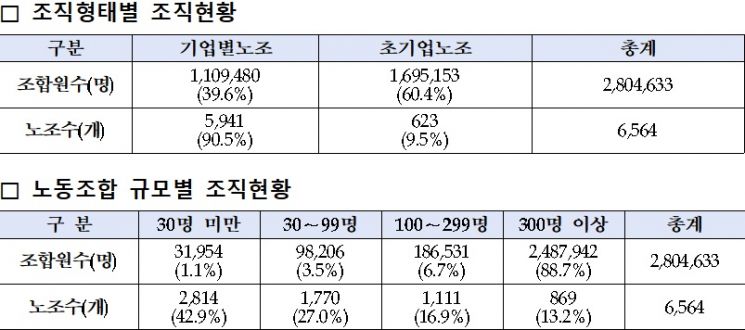
As of last year, FKTU had 2,506 unions, while KCTU had 374. By organizational type, members belonging to industrial unions such as sectoral unions (1,695,153 members) outnumbered those in enterprise-level unions (1,109,480 members). In other words, FKTU's structure, with organizations scattered nationwide, naturally results in a lower membership reporting rate compared to KCTU. Regardless of the reporting rate, FKTU expects to widen the membership gap with KCTU by the end of next year through the integration of public sector federations and the incorporation of the Civil Servants' Federation.
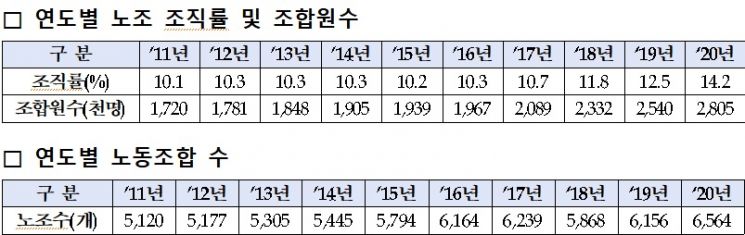
The total number of union members, including the two major federations and unions without upper-level organizations, was 2.805 million as of the end of last year, an increase of 265,000 (10.4%) from 2.54 million the previous year. Since the Moon Jae-in administration, the total number of union members has rapidly increased every year after surpassing 2 million for the first time at the end of 2017 (2.089 million). The labor community interprets this as largely influenced by policies actively promoting the conversion of non-regular workers in the public sector to regular positions under the banner of a "labor-respecting society." The unionization rate in the public sector rose sharply from 63.2% in 2017 to 69.3% last year, a 6.1 percentage point increase, while the private sector unionization rate only rose from 9% to 11.3%, a 2.3 percentage point increase during the same period.
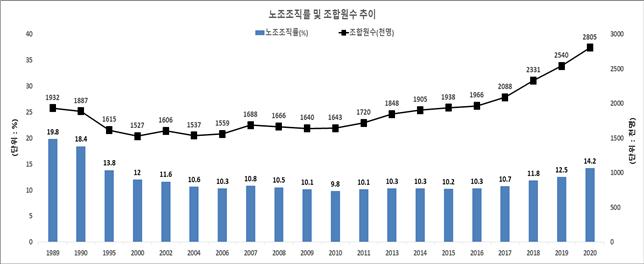
The unionization rate, which is the proportion of union members among all workers, remained at 14.2% as of the end of last year. Although this is higher than 11.8% in 2018 and 12.5% in 2019, statistics show that the majority of workers are still in blind spots regarding labor rights protection. Looking at unionization rates by workplace size, workplaces with 300 or more employees had a rate of 49.2%, but those with 100-299 employees had 10.6%, 30-99 employees had 2.9%, and workplaces with fewer than 30 employees had only 0.2%. The concentration of unions in some large corporations is cited as a major cause of the severe dual structure (polarization) in the labor market.
© The Asia Business Daily(www.asiae.co.kr). All rights reserved.
![Clutching a Stolen Dior Bag, Saying "I Hate Being Poor but Real"... The Grotesque Con of a "Human Knockoff" [Slate]](https://cwcontent.asiae.co.kr/asiaresize/183/2026021902243444107_1771435474.jpg)

















