Assemblyman Yoon Young-seok Reveals 'Korean Green Taxonomy Proposal Korea Hydro & Nuclear Power Review Opinions'
KHNP: "A Key Means to Achieve Carbon Neutrality and NDC... Emits as Little Greenhouse Gas as Wind Power"
"Smaller Power Plant Footprint Benefits Forest and Farmland Conservation"
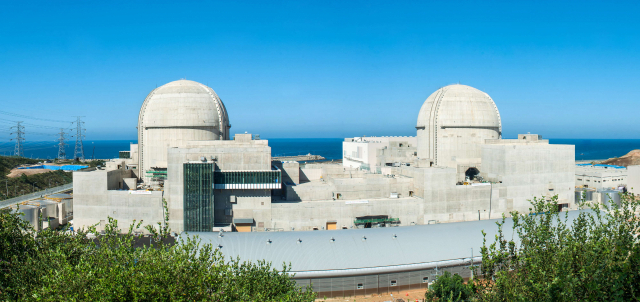
[Sejong=Asia Economy Reporter Joo Sang-don] Korea Hydro & Nuclear Power (KHNP) recently submitted an opinion letter to the government emphasizing that "nuclear power emits as little carbon throughout its lifecycle as wind power" and advocating for the inclusion of nuclear power in the Korean Green Taxonomy (K-Taxonomy).
On the 29th, Yoon Young-seok, a member of the People Power Party, disclosed the 'KHNP Review Opinion on the Korean Green Taxonomy (Draft)' received from the Ministry of Environment.
The government began developing the K-Taxonomy last year, forming an expert committee and producing a first draft in February, followed by a fourth and final draft in August. The final draft is scheduled to be announced this month after collecting feedback from related agencies.
After the government released the fourth draft, KHNP submitted an opinion letter to the Ministry of Environment requesting two options: 1) to include nuclear power in the K-Taxonomy, and 2) to decide on nuclear inclusion by referencing the European Union (EU) case in the future. KHNP presented nine reasons supporting the inclusion of nuclear power in the K-Taxonomy.
First, KHNP emphasized that "nuclear power is an ultra-low carbon energy source with very low lifecycle carbon emissions." According to the emission factor table from the Intergovernmental Panel on Climate Change (IPCC), nuclear power emits 12g of CO2 per 1kWh of electricity generated throughout its lifecycle, which is among the lowest alongside wind power (11?12g). In comparison, solar power emits 27?48g, liquefied natural gas (LNG) 490g, and coal 820g of CO2.
KHNP also noted that nuclear power plants require a smaller footprint, which is advantageous for conserving forests and farmland. While a 1MW nuclear facility requires 528㎡, solar power needs 15,617㎡ and onshore wind power 5,000㎡, which are 30 times and 9 times larger than nuclear, respectively. Considering capacity factors, solar and wind require 169 times and 37 times more area than nuclear, respectively.
KHNP pointed out that uranium supply for nuclear power is easy to secure, contributing significantly to national energy security. Uranium is convenient to store and transport, is not concentrated in specific countries, and accounts for less than 1% of energy import costs. Additionally, fuel costs constitute only about 10% of nuclear power generation costs, making it a "quasi-domestic energy" source with much lower fuel cost dependency compared to other power sources.
Furthermore, KHNP highlighted that small modular reactors (SMRs) currently under development can fundamentally eliminate radiation risks by ensuring the highest safety standards and can provide flexible operation (load-following) to complement the intermittency of renewable energy sources that cannot generate power during calm or nighttime periods. They also noted that using nuclear power for hydrogen production in the hydrogen economy era offers advantages in terms of economic feasibility, flexibility, and energy security.
KHNP also argued that including nuclear power in the K-Taxonomy is essential to secure competitiveness in nuclear power exports. The taxonomy defines green economic activities and determines whether financing through green funds is possible. Large asset holders like the National Pension Service, with assets of 850 trillion won, plan to use the K-Taxonomy for investment decisions starting next year, which could make it difficult for the nuclear industry to attract investment. Excluding nuclear power from the green classification could lead to financing challenges and negatively impact overseas nuclear power orders.
KHNP requested consideration of the fact that major countries classify nuclear power as a green and non-fossil energy source. According to KHNP, the EU is reviewing the inclusion of nuclear power in its taxonomy, the United States is considering including nuclear power in clean energy standards, Russia includes nuclear power, and China classifies nuclear power as clean energy and is expanding the share of non-fossil fuels (including nuclear power).
Rep. Yoon criticized, "KHNP requested the government to include nuclear power in the K-Taxonomy, but the Ministry of Environment plans to announce the K-Taxonomy excluding nuclear power this month. While the international community is classifying nuclear power as 'green energy,' South Korea's nuclear phase-out policy has become an ideology rather than a rational choice."
© The Asia Business Daily(www.asiae.co.kr). All rights reserved.
![Clutching a Stolen Dior Bag, Saying "I Hate Being Poor but Real"... The Grotesque Con of a "Human Knockoff" [Slate]](https://cwcontent.asiae.co.kr/asiaresize/183/2026021902243444107_1771435474.jpg)















