As Korea Enters an 'Aged Society,' Issues with Elderly Driver Traffic Accidents Highlighted
In 2019, Elderly Driver Fatal Accidents Accounted for 46% of Total
Decline in Stopping Time and Reaction Speed... 'Defensive Driving' Becomes Difficult
Social Issues Also in Japan's 'Super-Aged Society'... Various Systems Established
Domestic 'License Surrender Rate' Still Low at 1-2%
Experts Say "Not Only System Improvement but Also Road Traffic Facilities Must Be Improved"
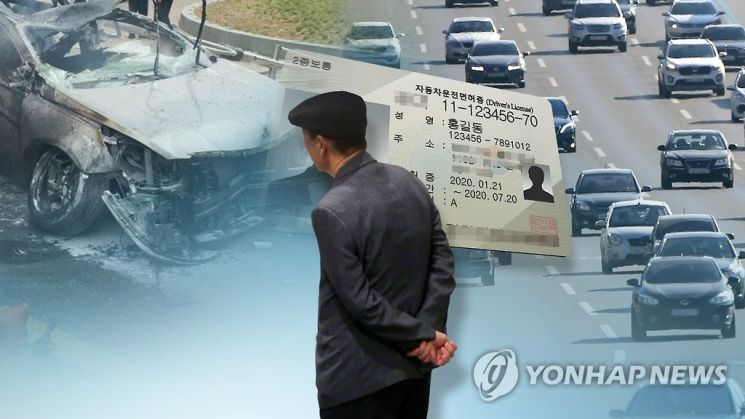 Frequent traffic accidents involving elderly drivers are emerging as a social issue. [Image source=Yonhap News]
[Asia Economy Reporter Lim Juhyung] #A, a social worker (59) living in Bucheon, Gyeonggi Province, drives a car to commute on weekdays. Although this has been a routine for several years, recently A hesitates to take the wheel. This is because A personally feels a decline in vision due to aging. He said, "Even with glasses, sometimes I can't clearly see the numbers on signs. At those times, I get scared to hold the steering wheel," adding, "I don't know how much longer I can keep driving my own car."
As Korea enters an aging society, the issue of 'elderly drivers' is gradually coming to the forefront. The elderly, whose physical functions such as vision and reflexes begin to decline, find it difficult to respond to sudden situations while driving, which can lead to serious accidents. Advanced countries like Japan, which have already become super-aged societies, have established related systems. Voices are emerging domestically that preparations must be made for the upcoming era of elderly drivers.
◆Elderly drivers with declining physical functions... more vulnerable to traffic accidents
According to Statistics Korea, as of last year, Korea's total population was 51.78 million. Among them, about 8.13 million (15.7%) are classified as 'elderly' aged 65 or older. Korean society has long exceeded the United Nations (UN) standard for an aging society (14%).
As the country's average age rises, the elderly population actively participating in social activities has also greatly increased. Accordingly, the number of 'elderly drivers' who drive daily is also on the rise.
According to the National Police Agency's data, as of 2015, the number of licensed drivers aged 65 or older was 2,294,058. This number steadily increased over the past five years, reaching 3,582,667 elderly licensed drivers as of August last year.
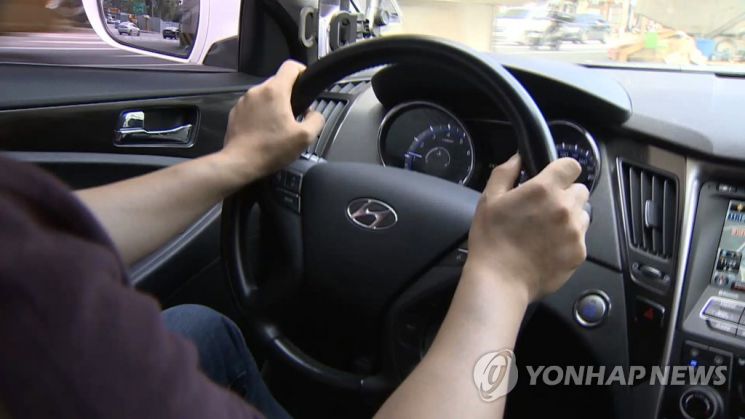 According to a study by the Korea Transport Institute, individuals aged 65 and older begin to experience declines in both object recognition ability and reaction speed compared to younger age groups. / Photo by Yonhap News
Elderly drivers are problematic because their ability to respond to sudden situations is relatively lower compared to younger drivers.
A 2018 report by the Korea Transport Institute titled 'Measures to Reduce Traffic Accidents Involving Elderly Drivers' found that 'static visual acuity,' the ability to recognize stationary objects, typically begins to decline from age 40. By their 60s, static visual acuity drops to about 80% of that of people in their 30s.
The time it takes to perceive and react to moving objects is also about 20% longer for the elderly compared to younger people. This means that the ability to identify specific objects while driving and respond defensively diminishes.
◆Elderly drivers account for 46% of traffic accident fatalities
According to the Road Traffic Authority's traffic accident analysis system, the number of traffic accidents caused by drivers aged 65 or older increased from 23,063 in 2015 to 33,239 in 2019. This is an increase of about 144% over four years.
In particular, in 2019, fatalities from traffic accidents involving elderly drivers accounted for about 46% of all traffic accident deaths. This is nearly three times the proportion of the elderly population in Korea (15.7%).
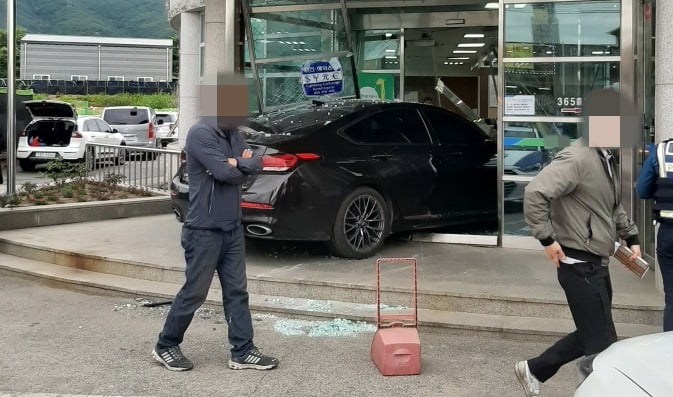 At around 1:35 p.m. on the 21st, a passenger car driven by an octogenarian in Pocheon-si, Gyeonggi Province, rushed toward a bank building, injuring one customer. / Photo by Yonhap News
Traffic accidents involving elderly drivers can pose a significant threat not only to the drivers themselves but also to surrounding citizens. For example, in May in Pocheon, Gyeonggi Province, a car driven by an elderly driver in his 80s crashed into a bank, injuring one customer.
The driver claimed the vehicle suddenly accelerated. However, the police suspect that driving inexperience due to old age is more likely and are analyzing the vehicle's accident data recorder to investigate the exact cause.
On April 30, in Seocho-gu, Seoul, a vehicle driven by an elderly driver in his 80s crashed into a nearby hair salon, resulting in one death. During the incident, the vehicle hit three motorcycles and one car, and a female customer in her 30s inside the salon was pinned under the vehicle and seriously injured. The customer later died while being transported to the hospital for treatment.
◆Japan, a 'super-aged society,' has already established related systems
In Japan, which experienced aging earlier than Korea, traffic accidents involving elderly drivers are known as a major social problem. About 28% of Japan's total population is elderly, already surpassing the super-aged society standard (20%).
Accordingly, elderly drivers are very common in Japan, and there have been reports of elderly drivers driving in the wrong direction or suddenly losing consciousness, causing major accidents.
For example, according to local Japanese media such as 'NHK,' on the 9th (local time), at an intersection in Aichi Prefecture, a car driven by a man in his 70s struck children. Ten children were transported to the hospital for treatment, and the driver fell into a critical unconscious state.
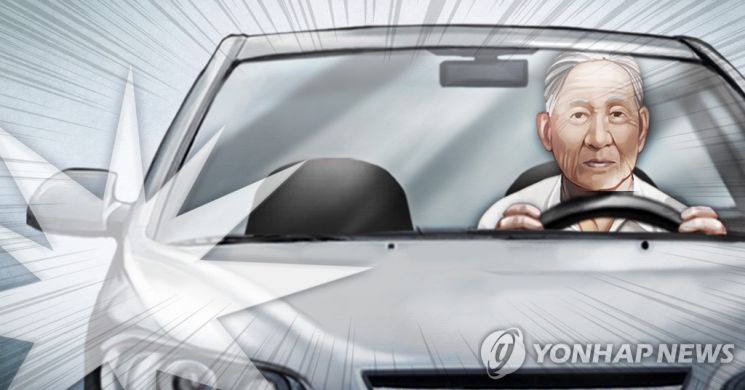 In Japan, a "super-aged society" where about 28% of the total population are elderly, traffic accidents involving elderly drivers are also one of the serious social issues. / Photo by Yonhap News
According to the 'Traffic Safety White Paper' published last year by the Japanese Cabinet Office, the number of deaths caused by traffic accidents involving drivers aged 75 or older in the past 10 years reached 4,463.
As a result, Japan has already established various systems to prevent traffic accidents involving elderly drivers. Last year, it institutionalized a 'special driver's license for elderly drivers.' Under this system, drivers aged 75 or older must undergo a cognitive function test by medical professionals when renewing their driver's license. If the test indicates poor memory or judgment, they must obtain a separate medical certificate to renew their license.
Additionally, Japan supports driving lessons by experts to raise awareness of safe driving and to allow elderly drivers to self-assess their visual and cognitive abilities. Campaigns encouraging voluntary surrender of driver's licenses by the elderly are also actively underway.
◆Experts: Driving ability evaluation and traffic facility improvements needed to guarantee driving rights
Domestically, the government and local governments operate a 'license surrender system for elderly drivers,' which encourages voluntary surrender of driver's licenses by elderly drivers. Elderly drivers aged 65 or older who voluntarily surrender their driver's license receive a prepaid transportation card or local currency worth 100,000 won once.
However, the license surrender rate remains somewhat low. According to data obtained by Rep. Park Sanghyuk of the Democratic Party from the National Police Agency in August last year, as of the first half of last year, 42,175 elderly drivers surrendered their licenses, representing a surrender rate of about 1.2%. Even if this doubles by the second half, it is not significantly different from the 2.2% rate in 2019, a year earlier.
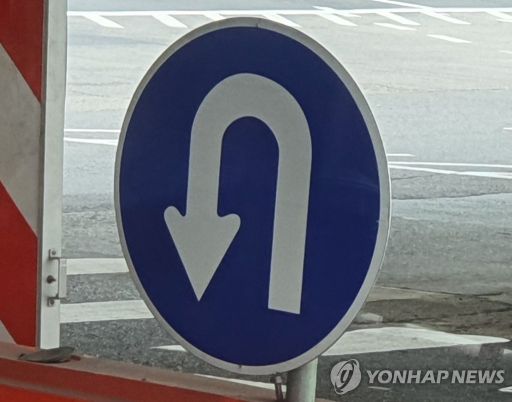 There are calls for improvements to road traffic facilities, such as enlarging the font size on road signs to accommodate the vision of elderly drivers. The photo shows a 'U-turn' sign. / Photo by Yonhap News
Experts advise that not only the system but also road traffic facilities should be improved considering the safety of elderly drivers.
Kim Byungkwan, a research fellow at the Transportation and Logistics Research Center of the Gyeonggi Research Institute, said, "The demand for passenger car travel by the elderly is expected to continue increasing. While education and system improvements to prepare for this are important, efforts to improve road facilities considering elderly drivers who want to drive themselves are also necessary."
He added, "From a visual function perspective, it is desirable to enlarge the appropriate font size of road signs, enhance nighttime lighting functions, or install separate lighting facilities. Installing guide signs such as lane-use pavement markings and directional signs before entering intersections is also an important factor."
He continued, "It is important to guarantee the mobility and driving decision rights of elderly drivers. There is a need to apply an appropriate system that evaluates the driving ability of elderly drivers and guarantees their driving decision rights accordingly."
© The Asia Business Daily(www.asiae.co.kr). All rights reserved.
![Clutching a Stolen Dior Bag, Saying "I Hate Being Poor but Real"... The Grotesque Con of a "Human Knockoff" [Slate]](https://cwcontent.asiae.co.kr/asiaresize/183/2026021902243444107_1771435474.jpg)

















