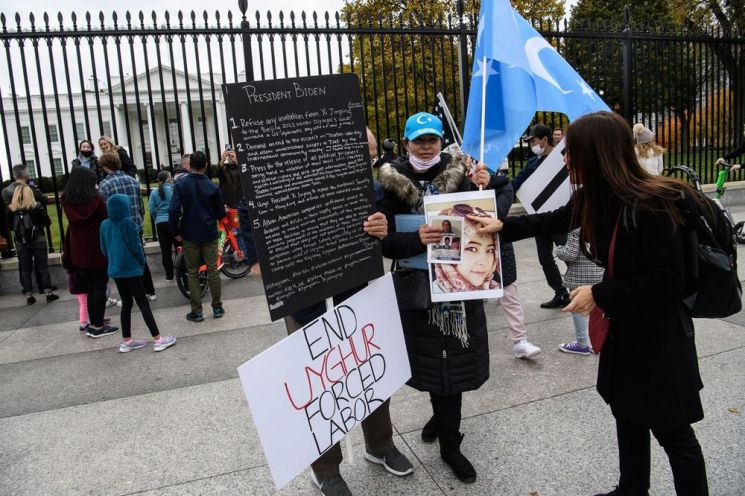
[Asia Economy Reporter Jo Yujin] The Biden administration in the United States has imposed a series of sanctions on Chinese government agencies and companies, accusing them of using biotechnology for human rights abuses and military purposes. Following the diplomatic boycott of the Beijing Winter Olympics due to human rights violations in China, the U.S. has also passed legislation banning imports of products from Xinjiang, concretizing efforts to strengthen the encirclement of China.
According to Bloomberg and other sources on the 16th (local time), the U.S. Department of Commerce’s Bureau of Industry and Security (BIS) added 34 Chinese institutions and companies, including 11 research institutes under the Chinese Academy of Military Sciences’ Institute of Military Medicine, to the export control list. The U.S. Department of Commerce stated that these institutions were involved in the development of weapons, including brain control, for the purpose of suppressing human rights of Uyghurs in Xinjiang and for military objectives.
The U.S. Department of Commerce did not specify exactly what weapons involving brain control are, but foreign media reported that biotechnology is being used for military purposes such as brain control and targeted genetic attacks.
A U.S. Department of Commerce official told Bloomberg that China has been confirmed to have illegally collected DNA from a wide range of Uyghur residents aged 12 to 65 in the Xinjiang Autonomous Region and used facial recognition technology to detain and persecute them.
Commerce Secretary Gina Raimondo also emphasized, "Biotechnology and medicine are intended to save lives, but China is using this technology to control its citizens and suppress and control religious and ethnic minorities," adding, "The United States cannot allow its technology to be used for acts contrary to national security."
On the same day, the U.S. Department of the Treasury announced on its website that it would add eight Chinese companies to its investment blacklist, including DJI, the world’s largest commercial drone manufacturer; facial recognition software companies Kuangsc Technology and Winchung Technology; supercomputer manufacturer Sugwang; artificial intelligence company Etu Technology; and cloud computing company Leon Technology.
Brian Nelson, a senior official in the U.S. Treasury Department’s Office of Terrorism and Financial Intelligence, pointed out, "Private companies in China’s defense and surveillance technology sectors are actively cooperating with the Chinese government’s efforts to suppress religious and ethnic minorities."
Following the House of Representatives, the Senate held a plenary session on the same day and unanimously passed the "Uyghur Forced Labor Prevention Act," which bans imports of products made in the Xinjiang region due to concerns over forced labor. Once signed into law by President Biden, the U.S. Customs and Border Protection (CBP) will prohibit all goods coming from Xinjiang without exception.
Human rights abuses have emerged as a key irritant in U.S.-China relations, which have already been strained over the Hong Kong National Security Law, the Taiwan Strait, and navigation issues in the South China Sea and East China Sea. The U.S. is leveraging human rights and democratic values to strengthen alliances in the Indo-Pacific region, leading an international diplomatic boycott of the Beijing Winter Olympics and focusing on expanding the anti-China front.
China has strongly opposed these moves by the U.S., calling them interference in internal affairs. Chinese President Xi Jinping harshly criticized the U.S. during a summit with Russian President Vladimir Putin on the 15th, stating, "Certain forces are arbitrarily interfering in internal affairs under the pretext of democracy and human rights, brutally trampling on international law and recognized norms of international relations."
© The Asia Business Daily(www.asiae.co.kr). All rights reserved.
![Clutching a Stolen Dior Bag, Saying "I Hate Being Poor but Real"... The Grotesque Con of a "Human Knockoff" [Slate]](https://cwcontent.asiae.co.kr/asiaresize/183/2026021902243444107_1771435474.jpg)















