Expectations for Additional Securing of Domestic and International Maintenance Volume
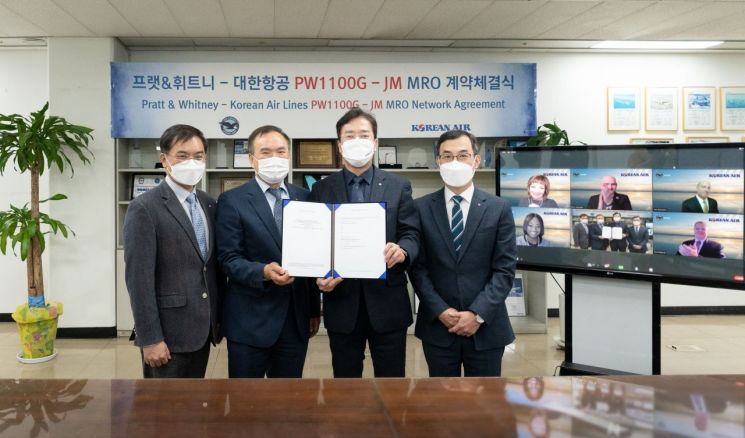 (From left) Jo Young, Manager of Maintenance Planning Department at Korean Air; Hwang Injong, Head of Maintenance Headquarters at Korean Air; Lee Sugeun, Vice President of Operations Division at Korean Air; and Kim Gwang-eun, Chief of Engine Maintenance Factory at Korean Air, are taking a commemorative photo after signing a contract to join the next-generation GTF engine maintenance cooperation group through a non-face-to-face video conference with Pratt & Whitney officials on the 16th.
[Asia Economy Reporter Dongwoo Lee] Korean Air announced on the 17th that it has signed a membership agreement to join the next-generation GTF engine maintenance partnership with Pratt & Whitney (P&W), a global aircraft engine manufacturer.
Korean Air explained that the contract was conducted through a non-face-to-face video conference involving company officials such as Lee Su-geun, Vice President of Korean Air's Operations Division, and Tom Pelland, Executive Director of Pratt & Whitney.
With this membership in the Pratt & Whitney GTF engine maintenance partnership, Korean Air will receive advanced maintenance technology along with maintenance volume. Korean Air plans to secure full disassembly, assembly, and testing capabilities for the PW1100G-JM engine and start the first maintenance intake for this engine in the third quarter of 2023, aiming to attract additional domestic and international engine maintenance volume.
The 'PW1100G-JM', the main engine of the Airbus 320neo model that Korean Air will introduce in the future, is also included in the GTF engine series. The PW1100G-JM engine is an eco-friendly engine that improves efficiency and reduces carbon emissions compared to previous models. Currently, about 1,100 units are in operation worldwide, with over 10,000 orders and commitments secured from around 80 airlines.
Pratt & Whitney's GTF engine is evaluated to lead the future commercial aircraft market by maximizing efficiency through a geared design that rotates the engine at optimal speeds.
Korean Air's membership in the GTF engine maintenance partnership is regarded as recognition of its world-class engine maintenance technology accumulated over time. The company operates the only private aircraft engine maintenance facility in Korea and has performed maintenance on approximately 4,600 of its own aircraft engines since starting medium-level maintenance work on Boeing 707 aircraft engines in 1976. Since 2004, it has also successfully secured and delivered maintenance projects for about 190 engines from other airlines.
Korean Air plans to continuously expand its presence in the global aircraft engine maintenance, repair, and overhaul (MRO) market through this contract and strategic cooperation with engine manufacturers. By shifting domestic airline engine MRO demand, which previously relied on overseas outsourcing, to domestic facilities, the company aims to prevent foreign currency outflow, create jobs through MRO business expansion, and actively contribute to the development of the domestic aviation industry.
Korean Air stated, "Following the establishment of the world's largest commercial aircraft engine test facility in Yeongjongdo, Incheon in 2016, we plan to further solidify our position in the engine MRO industry by building a cutting-edge aircraft engine maintenance cluster through the expansion of our latest engine maintenance factory."
© The Asia Business Daily(www.asiae.co.kr). All rights reserved.
![Clutching a Stolen Dior Bag, Saying "I Hate Being Poor but Real"... The Grotesque Con of a "Human Knockoff" [Slate]](https://cwcontent.asiae.co.kr/asiaresize/183/2026021902243444107_1771435474.jpg)















