Demand, Supply, and Expectations 'Triple Burden'... Growth Rate Forecasted at 5.3% Next Year
China's Fiscal and Financial Policies Likely to Focus on Employment
[Asia Economy Beijing=Special Correspondent Jo Young-shin] As forecasts predict a sharp decline in China's economic growth momentum next year, employment issues are expected to become a major concern in Chinese society.
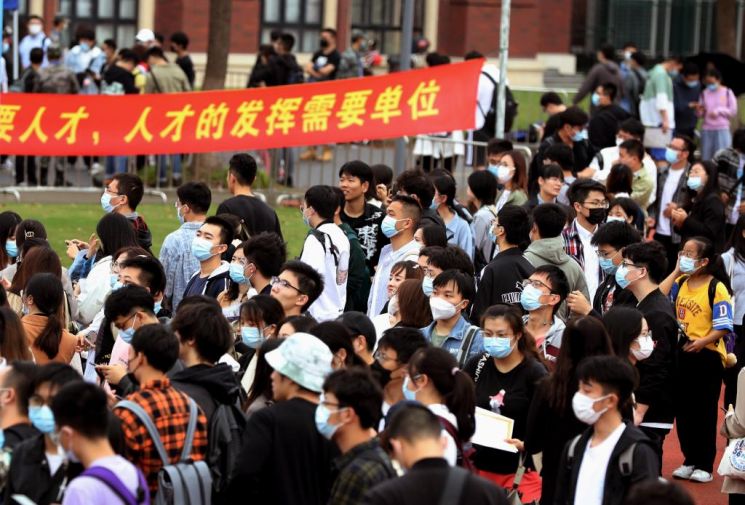
In particular, Chinese experts point out that youth employment issues, including over 10 million university graduates, and employment problems of Nonggongmin (rural-origin urban migrant workers) may surface.
On the 16th, the state-run Xinhua News Agency published an analytical article stating that employment stability is crucial to achieving the economic growth goal of "advancing steadily" mentioned at the Central Economic Work Conference, and macroeconomic policies should be developed with a focus on employment.
Citing data from the National Bureau of Statistics, Xinhua reported that China's nationwide unemployment rate from January to November was 5%, meeting the annual target, and positively analyzed the 2021 employment market. This represents an improvement of 0.2 percentage points and 0.1 percentage points compared to 2020 and 2019, respectively. Xinhua also added that a total of 12.07 million new jobs were created this year.
However, Xinhua expressed concerns about next year. The Chinese leadership diagnosed at the Central Economic Work Conference that the Chinese economy faces three pressures: "demand contraction," "supply shocks," and "weakened expectations," indicating a challenging economic situation next year.
Indeed, the forecast for China's economic growth rate next year is bleak. The Chinese Academy of Social Sciences projects a 5.3% growth rate for next year. The forecasts from 14 Chinese investment banks (IBs) range from a minimum of 4.4% to a maximum of 5.6%. The dominant view is that China's growth rate this year will be around 8%. This implies that next year's growth rate could be halved depending on circumstances.
Lian Ping, Chief Researcher at Zhixin Investment, said, "Downward economic pressure is directly linked to employment," adding, "Employment stability must be the top priority of next year's macroeconomic policy."
The analytical article on employment issues by the state media is interpreted as due to the correlation between Gross Domestic Product (GDP) and employment multiplier. It is estimated that approximately 2.2 million jobs are created per 1% of China's GDP. When the growth rate falls, employment inevitably declines. Xinhua pointed out the need to support industries with high employment creation (labor-intensive industries). At the same time, it emphasized employment flexibility.
Citing experts, Xinhua noted that the unstable employment population in China reaches 200 million and stressed the need for flexible employment policies for them.
It also stated that the current population employed by Chinese companies is 600 million and that fiscal policies such as tax reductions and employment subsidies are necessary to ensure their stable employment.
Measures for university graduates and Nonggongmin were also urged. The number of university graduates in China next year is estimated to reach 10.76 million.
Chief Researcher Lian said, "The biggest structural problem is that university graduates cannot get the jobs they want, and small and medium-sized manufacturing enterprises cannot find university graduates," adding, "Urgent measures must be taken to minimize the gap between the two sides."
Employment of Nonggongmin, which reaches 290 million, is also a problem. Nonggongmin are not only linked to poverty issues but also serve as the backbone of the rural economy.
Professor Yuan Fenggan of Chongqing Academy of Social Sciences advised, "It is necessary to strengthen public services in large cities to ensure stable employment for Nonggongmin, while also enhancing vocational training for them to move beyond simple labor."
China's employment issues are closely related to President Xi Jinping's concept of common prosperity (a society where everyone lives well), leading to a dominant expectation that next year's Chinese government fiscal and financial policies will focus on employment.
© The Asia Business Daily(www.asiae.co.kr). All rights reserved.
![Clutching a Stolen Dior Bag, Saying "I Hate Being Poor but Real"... The Grotesque Con of a "Human Knockoff" [Slate]](https://cwcontent.asiae.co.kr/asiaresize/183/2026021902243444107_1771435474.jpg)















