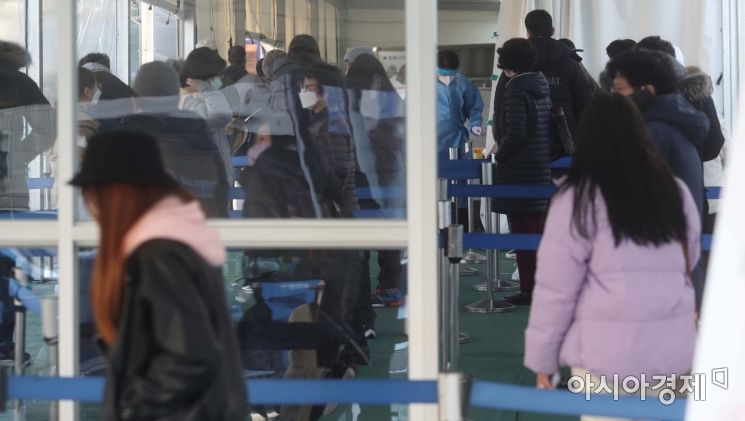
 On the 8th, when the number of new COVID-19 cases exceeded 7,000, the temporary screening clinic set up in the plaza of Cheongnyangni Station in Seoul's Dongdaemun-gu was crowded with citizens seeking testing. Photo by Moon Honam munonam@
[Asia Economy Reporter Koo Chae-eun] The Democratic Party of Korea established a 'COVID-19 Situation Room' within the party on the 8th in response to the serious spread of COVID-19 cases exceeding 7,000 and the Omicron variant. The purpose is to actively respond to quarantine measures by maintaining an organic communication network with the government. An external advisory group, including Professor Lee Jae-gap of Hallym University’s Department of Infectious Diseases, was also formed.
Shin Hyun-young, a member of the Democratic Party’s presidential election campaign committee and head of the COVID-19 Situation Room, said at the party headquarters on the same day, “New confirmed cases have exceeded 7,000, and the upward trend is expected to continue for the time being. South Korea cannot be free from the global pandemic alongside the Omicron variant. It is time to temporarily pause the phased return to normal life.”
Shin said, “We have established a hotline with the quarantine authorities to monitor the situation in real time, provide accurate information, and communicate with medical sites to secure hospital beds and establish a global home treatment system. We will also prepare medical personnel support budgets boldly and continuously, and work on supplementing institutional shortcomings regarding compensation for losses of small business owners and self-employed individuals.”
Professor Baek Soon-young, an emeritus professor of microbiology at Catholic University who joined the advisory group, pointed out the government’s responsibility, saying, “Although quarantine measures were well implemented, there were regrettable aspects over the past two years. There were missed timings when quarantine needed to be strengthened, and despite the expectation that severe cases could increase following the phased return to normal life in November, the damage caused by easing quarantine was significant.” He added, “Living treatment centers or home treatment should be transferred, but due to these circumstances, epidemiological investigations cannot keep up, causing delays in responding to the spread of Omicron.”
Professor Baek said, “Creating temporary hospital beds through budget allocation and providing meticulous care for medical staff are necessary to overcome the crisis. For a successful winter, voluntary participation in quarantine by the public is essential.”
Professor Lee Jae-gap said, “The current medical system requires at least 3 to 4 weeks to be reorganized and for the third vaccination to be administered. How we endure the next month will be a very important time for managing severe patients and deaths.”
© The Asia Business Daily(www.asiae.co.kr). All rights reserved.
![Clutching a Stolen Dior Bag, Saying "I Hate Being Poor but Real"... The Grotesque Con of a "Human Knockoff" [Slate]](https://cwcontent.asiae.co.kr/asiaresize/183/2026021902243444107_1771435474.jpg)















