Zhou Quanyuan's 'McKinsey Logic Skills Class'

“Our company has achieved over 20% growth in sales revenue for three consecutive years and is a healthy and stable high-tech enterprise.”
The first part of the above sentence is based on fact, and the latter part is a conclusion. Let’s assume this information is factual. What if you were offered an investment opportunity? Would you invest? Be cautious. There are at least ten hidden pitfalls involved.
First, distinguish between revenue and profit. When revenue grows by 20%, you need to examine what the actual profit is. If profit data is not disclosed, there is a high possibility that the actual figures are not favorable.
A 20% increase in revenue may seem impressive at first glance. However, in an era of rapid overall economic growth, compared to other industries, a 20% revenue growth might not even reach the industry average.
The baseline number should also be considered. Startups generally have low initial revenue, so expressing growth as a percentage can appear very large. Therefore, the absolute value of revenue must be examined.
Cash flow also deserves attention. Even if revenue grows rapidly, if accounts receivable are long overdue or the company depends on a single customer, cash flow pressure will be significant, and in some cases, there may be concerns about bankruptcy.
If a company’s debt surges, even with increased revenue, liabilities may exceed total assets. Overall revenue might increase due to price discounts, but this may not be beneficial in the long term. It is important to closely examine the company’s large-scale promotional activities.
You should also consider the possibility of substitution by other products. Even if a company’s revenue has grown for three consecutive years, a substitute product may emerge in the fourth year, potentially leading to losses.
Government policies must also be reviewed. It is important to carefully observe whether the government announces new policies to regulate and restructure the relevant industry. If large corporations simultaneously enter the same field, fierce competition may ensue. Understanding whether this is the case is crucial.
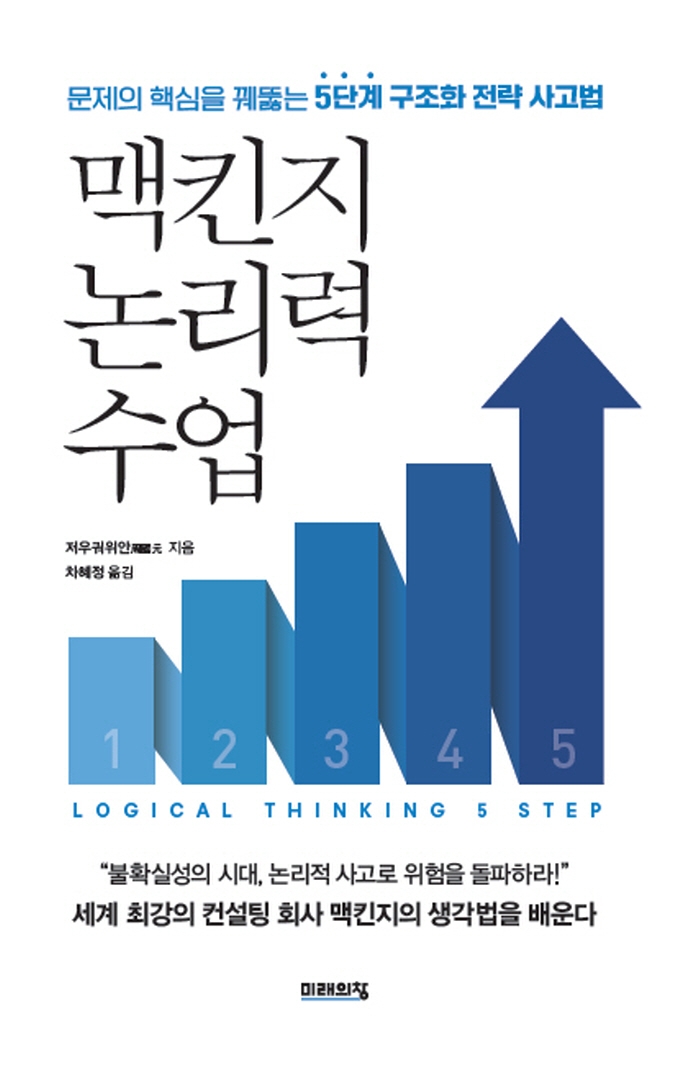
How does this sound? Don’t the numbers that initially seemed attractive now appear to be full of gaps that require verification? Even within the conclusion of “healthy and stable growth,” there are many uncertainties. This is the first of McKinsey’s four principles of logical thinking, which emphasizes basing conclusions on facts represented by numbers, and is the core of Zhou Guoyuan’s book McKinsey Logical Thinking Class (Mirae N Publishing). It is also the starting point for defining problems, structuring them, proposing and testing hypotheses, and drawing conclusions.
(McKinsey Logical Thinking Class | Written by Zhou Guoyuan | Translated by Cha Hyejeong | Mirae N Publishing | 16,000 KRW)
© The Asia Business Daily(www.asiae.co.kr). All rights reserved.
![Clutching a Stolen Dior Bag, Saying "I Hate Being Poor but Real"... The Grotesque Con of a "Human Knockoff" [Slate]](https://cwcontent.asiae.co.kr/asiaresize/183/2026021902243444107_1771435474.jpg)
















