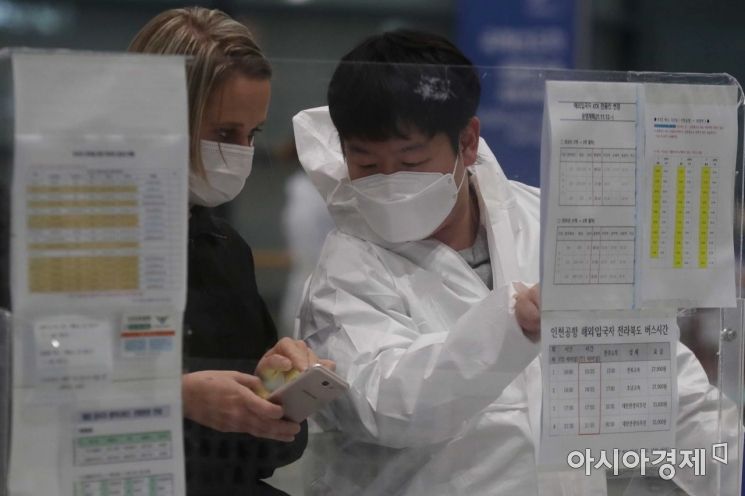
 On the 30th, amid ongoing concerns about the COVID-19 Omicron variant, overseas arrivals are receiving transportation guidance at Terminal 1 of Incheon International Airport. Photo by Mun Ho-nam munonam@
[Asia Economy Reporter Dongwoo Lee] Domestic low-cost carriers (LCCs), which had hoped for a recovery in international flights by the end of the year, are facing concerns that their losses may widen in the fourth quarter due to the unexpected challenge of the novel coronavirus variant 'Omicron.' As Omicron spreads and countries worldwide lock down again, travel sentiment has been dampened by passengers postponing or canceling flight reservations.
According to financial information firm FnGuide on the 5th, the estimated operating profits for major domestic LCCs in the fourth quarter of this year are -65.9 billion KRW for Jeju Air, -43.4 billion KRW for Jin Air, and -36.1 billion KRW for T'way Air. It is expected that the companies will continue to post losses for eight consecutive quarters since the spread of COVID-19 last year.
Most major LCCs have accumulated losses up to the third quarter of this year, resulting in capital erosion. In response, Jeju Air secured approximately 206.6 billion KRW through a capital reduction without compensation and a paid-in capital increase, thus overcoming its liquidity crisis. Jin Air and Air Busan also raised 123.8 billion KRW and 227.1 billion KRW respectively through paid-in capital increases.
The problem is that the financial stability of the LCC industry may deteriorate again as the expected timing for international flight recovery is delayed due to the spread of Omicron.
Unlike full-service carriers (FSCs), which have successfully turned a profit by focusing on cargo transport after COVID-19, LCCs with a smaller share of cargo transport urgently need the recovery of international flights to normalize their operations.
The LCC industry anticipates that if the Omicron spread prolongs, quarterly losses amounting to hundreds of billions of KRW will be unavoidable next year as well. The financial sector expects operating losses to continue in the first quarter of next year, with Jeju Air at -46.3 billion KRW, Jin Air at -29.6 billion KRW, and T'way Air at -29.0 billion KRW.
Plans to resume international flights in line with the year-end transition to 'With Corona' (gradual return to normal life) are also uncertain.
Jeju Air postponed the operation of the Busan-Saipan route from the 1st to the 15th of this month, and Jin Air has begun internal review on whether to suspend the Incheon-Bangkok route scheduled for the 24th.
Jin Air initially planned to operate in the form of a joint charter flight, but passenger demand is reportedly falling short of expectations. The company is closely monitoring the situation regarding the scheduled flights on the 15th for the Incheon-Kota Kinabalu and Incheon-Chiang Mai routes due to the increase in COVID-19 cases. Air Busan also planned to operate the Busan-Saipan route within this year but is currently reviewing internally whether to suspend it.
An LCC industry official said, "Concerns are growing that travel sentiment domestically and internationally may shrink again due to the spread of the Omicron virus," adding, "We are carefully monitoring government quarantine guidelines and local conditions to ensure there are no disruptions to the planned international flight operations."
© The Asia Business Daily(www.asiae.co.kr). All rights reserved.
![Clutching a Stolen Dior Bag, Saying "I Hate Being Poor but Real"... The Grotesque Con of a "Human Knockoff" [Slate]](https://cwcontent.asiae.co.kr/asiaresize/183/2026021902243444107_1771435474.jpg)















