- Significant Expansion of Financial Support for Infants and Toddlers to Overcome Low Birthrate
- From Next Year, 'First Meeting Voucher' as Birth Support Payment per Newborn
- New Infant Allowance of 300,000 KRW per Month up to Age 2, Increased to 500,000 KRW by 2025
- Child Allowance of 100,000 KRW per Month Extended from Under Age 7 to Under Age 8 by One Year

[Asia Economy Reporter Kim Bong-su] To overcome low birth rates and aging population, financial support for childbirth will be significantly expanded starting next year. From January next year, newborns will receive a voucher worth 2 million KRW per child and a monthly infant allowance of 300,000 KRW. After 2025, the infant allowance will increase to 500,000 KRW per month. The age eligibility for the child allowance, currently paid at 100,000 KRW per month, will also be extended by one year from under 7 years old to under 8 years old.
On the afternoon of the 2nd, the National Assembly passed bills including the Child Allowance Act, the Framework Act on Low Birth Rate and Aging Society, the National Basic Livelihood Security Act, and the Child Welfare Act, which contain these provisions. Notably, financial support for childbirth to address low birth rates has been greatly increased.
First, a nationwide version of the newborn birth support fund, which was previously implemented individually by local governments, has been created. The revised Framework Act on Low Birth Rate and Aging Society includes the “First Meeting Voucher,” which provides a voucher worth 2 million KRW per child born on or after January 1 next year. The purpose is to reduce the initial childcare burden on families giving birth and to strengthen the state’s responsibility for child-rearing.
With the amendment to the Child Allowance Act, an “infant allowance” will be newly established from January 1 next year for children under 2 years old. For children born after this date, a monthly payment of 300,000 KRW will be provided until they turn 2 years old, increasing by 50,000 KRW annually to reach 500,000 KRW per month from 2025. This can be received not only in cash but also as vouchers for childcare and daycare fees. The government explains that the establishment of the infant allowance is a policy to address the gap between reality and support. Infants require full-day, close care, and parents prefer home care, resulting in very low daycare usage rates of 3.4% for 0-year-olds and 36.6% for 1-year-olds. However, government support has been more heavily weighted toward parents using daycare centers, which has been criticized as being out of touch with reality.
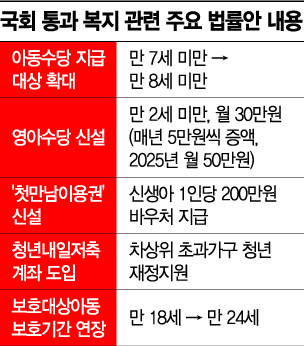
The eligibility for the child allowance, currently paid at 100,000 KRW per month, will also be extended from under 7 years old to under 8 years old starting next year. Considering the time needed for system upgrades, the government plans to retroactively pay the expanded child allowance beneficiaries (children born between February 1, 2014, and April 31, 2015) for January to March in a lump sum in April. The government explained that parents actually need more support after children enter elementary school, when childcare costs sharply increase, but the current child allowance only supports children under 7, failing to meet this need. Therefore, the eligibility age has been expanded. The government plans to gradually expand the age range while considering fiscal costs to alleviate the economic burden of child-rearing and ensure basic rights and welfare for children.
Additionally, a new “Youth Tomorrow Savings Account” system has been established to provide financial support for youth from households exceeding the lower-income threshold (50-100% of median income), specifically households with an annual income of up to 61.45 million KRW for a family of four next year. The protection period for children under care in child welfare facilities will be significantly extended from 18 to 24 years old, and provisions for self-reliance settlement funds and self-reliance allowances have been included. This is to help minors in welfare facilities enter society after sufficient preparation such as university graduation. To prevent child abuse, the investigation cycle will be shortened from 5 years to 3 years, prevention education will be separated from sexual violence education, and laws were passed to prohibit individuals with child abuse criminal records from working as postpartum care helpers.
© The Asia Business Daily(www.asiae.co.kr). All rights reserved.
![Clutching a Stolen Dior Bag, Saying "I Hate Being Poor but Real"... The Grotesque Con of a "Human Knockoff" [Slate]](https://cwcontent.asiae.co.kr/asiaresize/183/2026021902243444107_1771435474.jpg)
















