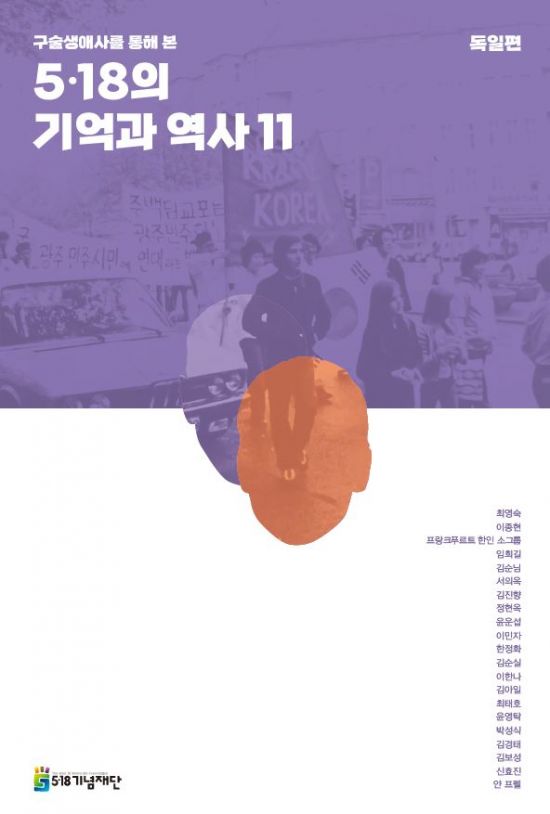
[Asia Economy Honam Reporting Headquarters, Reporter Yoon Jamin] The May 18 Memorial Foundation announced on the 2nd that ‘Memories and History of May 18 Seen Through Oral Life Histories 11: Germany Edition’ has been published.
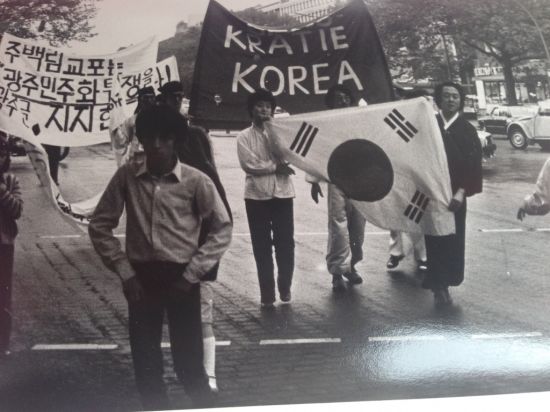
In Germany, the Re-Europe May People’s Festival honoring the spirit of the May 18 Democratic Uprising has been held every May without fail for over 40 years. Even last year, when almost all events were canceled due to COVID-19, the 40th anniversary event was held in Berlin through both online and offline means while strictly adhering to quarantine rules.
This Germany edition contains the stories of the protagonists who have maintained such historical continuity.
Germany was the first country in the world to learn about the horrors of Gwangju in 1980, and it is also a country where Korean expatriates and locals have spared no effort in solidarity for Korea’s democratization, human rights, and unification.
The first-generation Koreans in Germany, mostly former nurses and miners dispatched to Germany, have consistently worked to internationalize the spirit of May 18 and to build solidarity and empathy with the next generations and the local German society.
The Re-Europe May People’s Festival, initiated mainly by Koreans in Germany, is known as an overseas memorial event for the May 18 Uprising that has been held every year without interruption. Forty years?if born in 1980, one would already be middle-aged, and the European Koreans who were in their thirties or forties at the time have now passed their seventies.
What circumstances and reasons led the young Koreans who came as miners and nurses to Germany to honor the spirit of May 18? What does May 18 and Gwangju mean in their lives, and how have they contributed to the expansion and internationalization of the uprising’s spirit? As the first generation enters old age, what possibilities and directions will the next generations pursue?
This oral life history Germany edition is a collection of stories shared through the life histories of the protagonists addressing these questions.
It recalls and interprets the transnational life trajectories of individuals around May 18 in their own voices and portrays their feelings. Above all, the main figures who have been carrying on the Re-Europe May People’s Festival for 40 years are the key contributors to this life history.
This ‘Germany edition’ is composed of five parts in total.
The first part, ‘Forty Years of May,’ revisits the meaning and position of May 18 in the context of the Korean diaspora’s movement history in Germany. Koreans in Germany, including students, miners, and nurses, have been united since before 1980, learning Korean identity and new values while yearning for democratization and human rights improvements in their homeland. The first part tells the importance of May 18 through individual life histories within this historical context.
The second part, ‘From Girl Head of Household to Awake Woman,’ meets the life histories of women who came as nurses dispatched to Germany. In the 1960s and 1970s, women’s status in Korea was relatively low, but they willingly flew to distant Germany to support their impoverished families back home. Upon hearing the news of May 18, they dreamed of a homeland society where universal human rights and justice were realized. It was also because their families could be happier in such a society.
The third part, ‘Beyond Borders for Justice and Reconciliation,’ introduces three distinct life histories. These include a life that became a hidden worker in various Korean diaspora movements including the Re-Europe May People’s Festival since May 18, a life of a determined nurse who became a medical student and expanded the overseas pan-ethnic unification movement while now spreading Oriental beauty through Korean culture as a talented activist, and a life leading the Korea Council as a 1.5-generation Korean, spearheading the Korean decolonization movement and promoting the spirit of May 18 in Germany.
The fourth part, ‘With the Heart of Sharing Rice Balls,’ covers church and labor movements in Germany. Rather than focusing on events, it offers a glimpse into the trajectory of life and the context of the Korean diaspora’s movement that sprouted overseas democratization efforts even before May 18.
The church has played a significant role in reshaping the human rights and identity of overseas Koreans. From sermons filled with pastoral mission to meetings between students and workers in the church community, contributions were made to German society and prayers were offered for the development of the homeland.
The fifth part, ‘The Next Generation in Germany: Another Meaning of the May People’s Festival,’ is a dialogue with the second generation and young German activists who view May 18 with new meanings while accompanying the older generations introduced in previous chapters. The second generation, who participated in the Re-Europe May People’s Festival as children led by their parents and made it their own May Festival, have now become middle-aged raising the third generation. Their unique solidarity activities with local German activists and other immigrant communities raise expectations for how the internationalization of May 18 will proceed.
Professor Jeong Jinheon of the National Institute for Unification Education, who compiled these oral life histories, has conducted long-term field research on the lives of Koreans in Germany during his tenure at the Max Planck Institute for the Study of Religious and Ethnic Diversity and the Free University of Berlin.
In 2020, on the 40th anniversary of the Re-Europe May People’s Festival, with support from the May 18 Memorial Foundation, he was able to more closely record oral life histories. Considering the health and circumstances of interviewees under strengthened COVID-19 quarantine rules in Germany, individual in-depth interviews were conducted, and necessary materials were compiled to add explanations and interpretations to the oral content, aiming to weave the spirit of May as an ongoing process.
Choi Youngsook, Chairperson of the Re-Europe May Uprising Council, said, “Through the oral histories of many comrades, we can vividly record how we condemned the horrific massacre in our homeland Gwangju, fought, and inherited the spirit of May to strive for democratization and peaceful unification of our country. This is deeply moving,” and added, “I hope this will serve as a stepping stone for the next generations to establish their identity by presenting our living history and sharing experiences.”
Jeong Dongnyeon, Chairman of the May 18 Memorial Foundation, said, “It was because of the devoted activities of the German compatriots who first reached out and responded to the tears and pain of Gwangju that May 18 could be established as one of Korea’s important democratization movements,” and expressed hope that “this Germany edition will be valuable material for readers and researchers interested in overseas May 18 movements.”
© The Asia Business Daily(www.asiae.co.kr). All rights reserved.
![Clutching a Stolen Dior Bag, Saying "I Hate Being Poor but Real"... The Grotesque Con of a "Human Knockoff" [Slate]](https://cwcontent.asiae.co.kr/asiaresize/183/2026021902243444107_1771435474.jpg)

















