Deepening Decoupling Between Korean and US Stock Markets
Early Rebound Despite Omicron Landing in Korea
"Korean Market Offers Price Merit Compared to Developed Markets After Correction"
Decrease in Donghak Ants' Trading Share vs Increase in Seohak Ants' Holdings
[Asia Economy Reporters Ji Yeon-jin and Gong Byung-sun] Can the relative strength of the Korean stock market continue? Unlike the U.S. stock market, which was hit by fears of the COVID-19 Omicron variant, the domestic market, which started weak, showed a successful rebound in the early trading session. Analysts say that because the domestic market has experienced a prolonged correction this year, undervalued corporate values compared to developed countries have rekindled foreign investors' sentiment. However, cautious views remain that this is merely a technical rebound. Individual investors, known as Donghak Ants, are emphasizing the technical rebound and reducing their domestic stock holdings. Instead, Seohak Ants, who have shifted their focus to the U.S. market, are steadily increasing their holdings of U.S. stocks.
On the 2nd, foreigners led the early rebound of the KOSPI. From the market opening, foreigners concentrated their purchases on the semiconductor sector amid selling pressure from individuals and institutional investors, driving the KOSPI to turn upward within 20 minutes of the opening. Although the first Omicron case in the U.S. caused the three major U.S. indices to close down more than 1%, leading to expectations of weakness in the domestic market, the KOSPI recovered to 2900 in early trading, showing decoupling from the U.S. market. However, with the first domestic Omicron case dampening investor sentiment, institutions and individuals poured out sell orders, causing the KOSPI to turn downward again during the session, continuing a zigzag movement.
◆Foreigners Betting on Semiconductor Optimism= Foreigners appeared to continue shopping for semiconductors, Korea’s representative industry, driven by expectations of an improved semiconductor market. This was due to the increased likelihood of the passage of the U.S. Semiconductor Chip Production Support Act and Micron’s announcement of cooperation with Taiwan’s UMC to resolve semiconductor supply chain concerns. Foreigners have been net buyers of Samsung Electronics for three consecutive days since the 30th of last month, leading the stock’s rise for two days in a row, and SK Hynix recorded a 3% gain during the session.
Lee Jin-woo, a researcher at Meritz Securities, said, "The essence of the recent decoupling between the Korean and U.S. stock markets is price, not Omicron. Since the U.S. market has not undergone a correction, the Korean market, with its increased price merit, is in a favorable position. In particular, the rebound in semiconductor prices and industry issues linked to Micron triggered the market rebound." Han Ji-young, a researcher at Kiwoom Securities, added, "Strong fundamentals confirmed through robust exports in November, the decline in the won-dollar exchange rate, and the strength of major semiconductor stocks such as U.S. Micron are factors supporting the index’s downside."
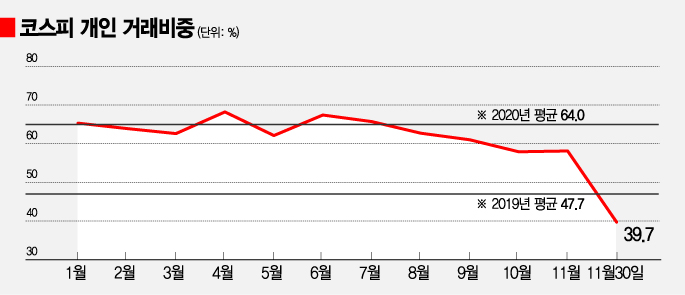
◆Frozen Donghak Ants= However, domestic individual investors’ sentiment is increasingly frozen, leading to forecasts that even if there is an additional rebound, the downward trend may continue. According to an analysis by Yuanta Securities, the proportion of individual trading in the domestic market fell to 39.7% on the 30th of last month. Before the COVID-19 crisis, individual trading proportions were below 50%, but after the sharp crash in March last year, they rapidly increased to 79.5% on July 24 of the same year. The daily average was maintained at 67% until June this year, but after the KOSPI began to decline in July, the individual trading proportion also formed a downward trend.
Although the KOSPI recorded its lowest point of the year on the 30th of last month and rebounded strongly due to buying pressure the following day, individual investors sold more than 1 trillion won net in the domestic market. Jeong In-ji, a researcher at Yuanta Securities, analyzed, "The decline in individual influence is believed to have led to the stock price correction."
◆Ignited Seohak Ants= On the other hand, individual investors known as Seohak Ants have further expanded their investments in U.S. stocks. According to the Korea Securities Depository’s Securities Information Portal, the average holdings of U.S. stocks by Seohak Ants in November this year reached $66.1859 billion, exceeding 78 trillion won in Korean won. This is the first time the monthly average holding size has surpassed the $60 billion mark. Compared to November last year ($29.1286 billion), the average holding size more than doubled.
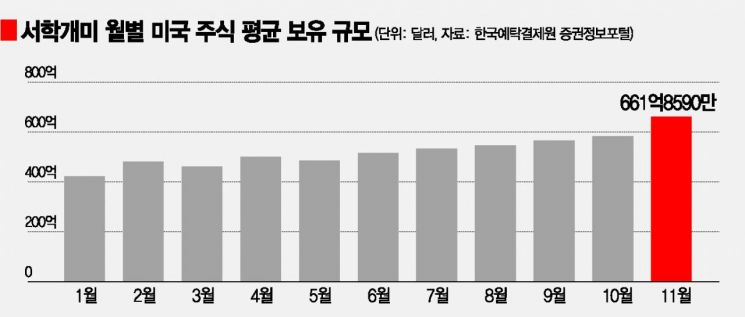
The reason Seohak Ants increased their U.S. stock holdings last month is that while the KOSPI was sluggish, the U.S. stock market kept hitting new records. On November 8 (local time), the Dow Jones Industrial Average reached 36,565.73, and on the 22nd, the S&P 500 (4,743.83) and Nasdaq (16,212.2) all hit all-time highs. Meanwhile, the KOSPI remained stuck between 2900 and 3000, closing down at 2839.01 on the 30th of last month.
Concerns have also been raised that Seohak Ants’ U.S. stock investment performance may worsen in the future. As uncertainty triggered by inflation grows, the U.S. stock market could also be hit. Hwang Se-woon, a research fellow at the Korea Capital Market Institute, explained, "Since domestic investors approach U.S. stocks from a diversification perspective, the holdings of Seohak Ants are unlikely to decrease significantly. However, if tapering begins in earnest, stock price corrections will be inevitable starting this month."
© The Asia Business Daily(www.asiae.co.kr). All rights reserved.
![Clutching a Stolen Dior Bag, Saying "I Hate Being Poor but Real"... The Grotesque Con of a "Human Knockoff" [Slate]](https://cwcontent.asiae.co.kr/asiaresize/183/2026021902243444107_1771435474.jpg)
















