Home Treatment as a Principle for All Confirmed Cases... Hospitalization Only When Necessary
People's Solidarity Condemns the Government's Complacent and Irresponsible COVID-19 Measures
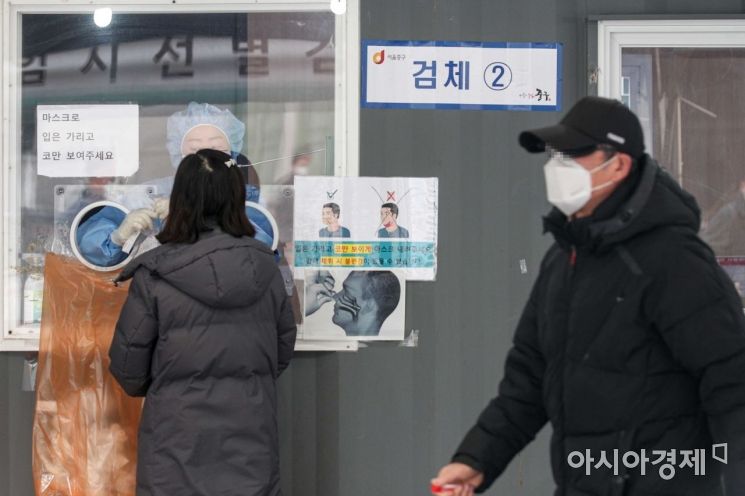 Citizens are being tested at a temporary screening clinic set up in Seoul Station Plaza. The photo is unrelated to specific expressions in the article. Photo by Jinhyung Kang aymsdream@
[Asia Economy Reporter Heo Midam] "Isn't this just neglect rather than home treatment?"
Recently, as the government announced its policy to make home treatment the basic principle for COVID-19 confirmed cases, voices of concern have emerged among citizens. Although this measure was introduced to solve the problem of hospital bed shortages, there are significant concerns about the risk of family infections and cluster infections in apartment complexes. There are also opinions that if timely inpatient treatment is not received, it could actually worsen the problem.
The quarantine authorities decided on the 29th of last month to shift the medical response system to focus on 'home treatment,' where all confirmed patients receive treatment at home.
Home treatment was initially conducted for consenting patients under 70 years old who were asymptomatic or had mild symptoms, but as the medical response system reached its limits recently, this was changed to the basic principle.
Accordingly, inpatient treatment will only be available for those with special factors, those living in environments vulnerable to infection, children, disabled persons, or elderly people aged 70 or older without caregivers.
Home treatment patients are provided with a home treatment kit containing an oxygen saturation meter, thermometer, and antipyretics. Confirmed patients must check their health status daily using these tools. Medical staff monitor temperature, oxygen saturation, and other symptoms twice a day, in the morning and afternoon, and will take measures such as prescribing medication if necessary.
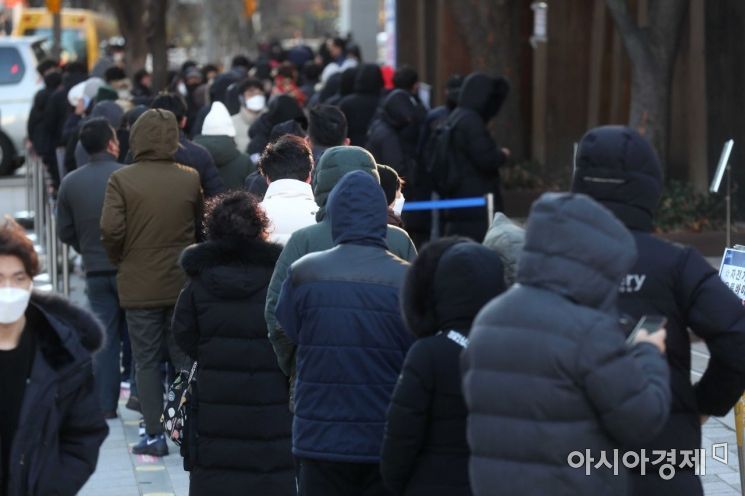 On the 1st, the screening clinic at Songpa-gu Public Health Center in Seoul is crowded with citizens seeking tests. The photo is unrelated to specific expressions in the article. Photo by Mun Ho-nam munonam@
Criticism from citizens is growing regarding this policy. There are concerns that as the number of home treatment patients increases and they move for outpatient visits, the use of shared facilities such as apartment elevators will increase, raising the risk of infection.
A 20-something office worker, Mr. A, said, "If one family member tests positive, it's almost certain that the whole family will get infected," and criticized, "The government's response is too inadequate. They must have known that confirmed cases would surge after With Corona, so how can they not have prepared hospital beds in advance? If this is the case, it would be better to reinstate social distancing."
He added, "Also, since there are especially many apartments in our country, what will happen if an infected person rides the elevator and infects neighbors?"
According to government policy, home treatment patients going out to shared spaces like elevators is considered a 'violation.' However, they may leave their homes to receive tests or treatment at short-term or outpatient clinics. Authorities require home treatment patients to wear a 'four-piece set' consisting of a KF94 mask, face shield, disposable gloves, and waterproof gown when going out, but doubts remain about the effectiveness of this measure.
Some also criticize the restriction on outings for family members living with home treatment patients. Home treatment lasts for 10 days after confirmation or symptom onset, during which cohabiting family members are also quarantined.
Furthermore, home treatment patients can be released from isolation after 10 days if they test negative. However, if cohabitants are not fully vaccinated against COVID-19, they are classified as contacts and must undergo an additional 10 days of quarantine after the home treatment ends. In other words, if the confirmed patient's cohabitant is unvaccinated and is an office worker or student, they cannot go to work or school for up to 20 days.
One netizen said, "Just because someone is vaccinated doesn't mean they can't get infected, so it's ridiculous that only unvaccinated people have to quarantine for 20 days," and added, "What if they get a bad reputation at work for not being able to go for 20 days? Who will take responsibility?"
Given this situation, civic groups have also criticized the home treatment plan for confirmed patients as irresponsible. On the 30th of last month, the People's Solidarity for Participatory Democracy issued a statement saying, "There is no specific response plan for securing hospital beds and expanding medical personnel in the government's announcement," and "We strongly condemn the government's complacent and irresponsible COVID-19 measures."
The group pointed out, "For about two years during the infectious disease situation, the government neglected the urgent demand from civil society to expand public hospital beds," and "As a result, citizens are waiting indefinitely for hospital beds for severe confirmed patients every day and are facing unjust deaths due to the shortage."
Meanwhile, the government expects to expand the proportion of confirmed patients receiving home treatment to 70%. The remaining 30% will be admitted to living treatment centers or medical institutions for treatment.
Son Youngrae, head of the Social Strategy Division at the Central Disaster and Safety Countermeasures Headquarters, appeared on CBS Radio's 'Kim Hyun-jung's News Show' on the 1st and said, "(In our country) about 50% of patients are undergoing home treatment, and 70% is likely the limit. About 30% will be managed through hospitalization."
He added, "Those who have no one to care for them or those who are asymptomatic but judged to have difficulty with home treatment due to family living arrangements will be admitted to living treatment centers or medical institutions. It is difficult to raise the home treatment rate to 90% like in other countries."
© The Asia Business Daily(www.asiae.co.kr). All rights reserved.
![Clutching a Stolen Dior Bag, Saying "I Hate Being Poor but Real"... The Grotesque Con of a "Human Knockoff" [Slate]](https://cwcontent.asiae.co.kr/asiaresize/183/2026021902243444107_1771435474.jpg)
















