[Asia Economy Reporter Ryu Tae-min] The transaction volume of semi-industrial zones, one of the few lands available for development in Seoul, has recently been declining. This is interpreted as buyers' price burdens increasing due to soaring prices amid rising expectations of value appreciation following the government's two announcements of semi-industrial zone development plans since last year. The semi-industrial zones are so popular because they have distinct characteristics that differentiate them from other land use zones.
Urban land use zones are divided into residential, commercial, industrial, and green areas. Among these, industrial zones are classified into exclusive industrial zones, general industrial zones, and semi-industrial zones. Semi-industrial zones accommodate light industries or factories with low environmental pollution within the industrial zones.
Semi-industrial zones have the advantage of wide spaces and fewer building regulations due to the presence of land previously used for factories, making them especially popular among companies requiring large headquarters. Additionally, unlike exclusive and general industrial zones, residential facilities as well as commercial and office facilities can be established, allowing for diverse utilization.
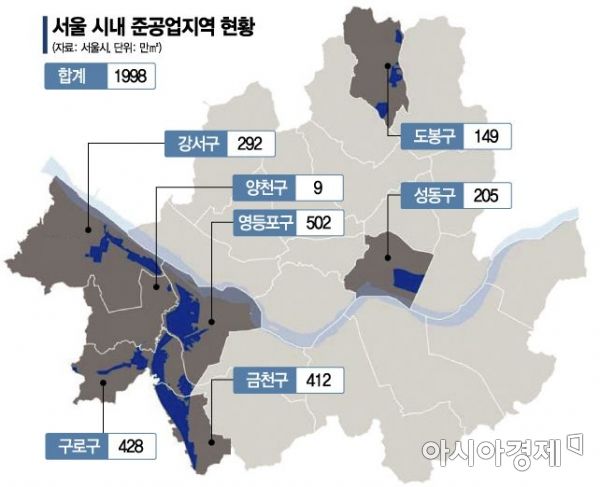
Currently, Seoul's semi-industrial zones cover a total area of 19.98 million square meters, mainly concentrated in the southwestern region such as ▲Yeongdeungpo-gu (5.025 million㎡) ▲Guro-gu (4.28 million㎡) ▲Geumcheon-gu (4.12 million㎡). An area of 2.05 million㎡ is also designated in Seongsu-dong, Seongdong-gu. These zones provided important job bases during the growth period of the 1970s and 1980s but have gradually lost their functions and experienced aging amid industrial advancement.
Compared to residential areas, which account for over 50% of Seoul's total area, semi-industrial zones occupy a relatively small proportion of 3.3%, making them scarce. Moreover, since land prices are relatively lower than commercial areas, they are considered easy-to-redevelop regions. Especially with additional benefits such as relaxed floor area ratios, their popularity is increasing.
In fact, last month, a district unit plan was finalized to develop 578,619㎡ in Seongsu-dong 2-ga, Seongdong-gu, as a specialized hub for information and communication technology (ICT) and research and development (R&D). This area, designated as a semi-industrial zone, will apply a maximum floor area ratio of 560%, allowing for high-rise buildings.
As these aspects have been highlighted, owners have recently withdrawn listings, leading to a decrease in transaction volume. According to the Korea Real Estate Board's nationwide housing price survey statistics, the land transaction volume in Seoul's semi-industrial zones was 1,234 parcels in September. This is 687 parcels (35.7%) less than the 1,921 parcels traded in January.
The sharp rise in land prices compared to other land use zones also seems to have had an impact. In September, land prices in Seoul's semi-industrial zones rose by 0.497%, which is 0.125% higher than the 0.384% recorded in September last year. Notably, since December last year, the semi-industrial zone land price increase rate has exceeded that of residential areas.
© The Asia Business Daily(www.asiae.co.kr). All rights reserved.
![Clutching a Stolen Dior Bag, Saying "I Hate Being Poor but Real"... The Grotesque Con of a "Human Knockoff" [Slate]](https://cwcontent.asiae.co.kr/asiaresize/183/2026021902243444107_1771435474.jpg)















