Bank of Korea "Need to Monitor Whether Current Loan Regulations Will Be Maintained"
Points Out Demand Changes Due to Regulatory Shifts
24,091 Households Planned in Seoul Next Year... Fewer Than This Year
Experts Say "Loan Regulations Unlikely to Suppress Demand"
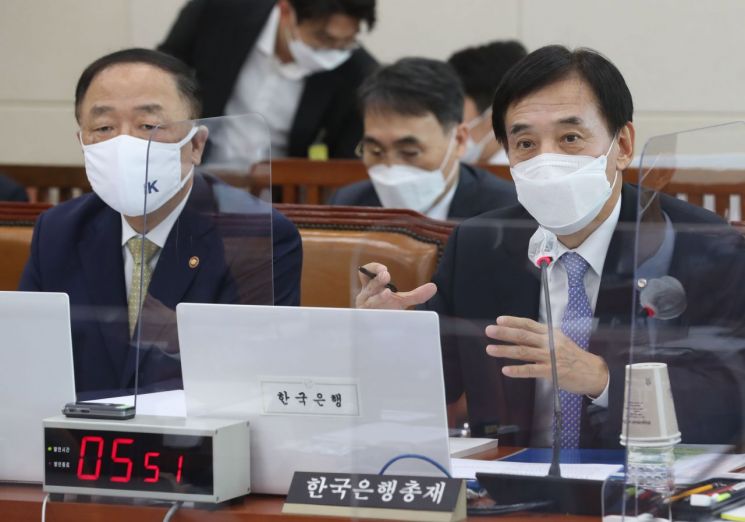
Lee Ju-yeol, Governor of the Bank of Korea, stated that "it is difficult to hastily conclude that housing prices have entered a long-term stabilization phase." This stance is in direct contrast to the government's assessment that housing prices have clearly entered a correction phase amid a recent increase in listings in some areas. The reason cited is that demand has been suppressed due to stringent loan regulations, and it is also uncertain whether supply will be sufficient.
◆Limitations of Demand Suppression through Loan Regulations= Governor Lee expressed this view on the future real estate outlook at a briefing held immediately after the Monetary Policy Committee meeting on the 25th. This contrasts with Deputy Prime Minister and Minister of Economy and Finance Hong Nam-ki’s statement that "the housing market has shown a slowdown in price increases since September, with recent increases in listings and a weakening of buying sentiment, which is being reflected in the perceptions of market participants."
There are two main reasons why Governor Lee believes the real estate market will maintain its strength. First, although a buyer’s market is emerging, it is a temporary demand suppression effect caused by stringent loan regulations. Second, it is currently difficult to expect an expansion in supply.
A Bank of Korea official said, "Demand is being suppressed due to loan regulations," adding, "It remains to be seen whether the current regulations will continue." This implies that demand could increase at any time depending on regulatory changes.
In this regard, commercial banks have recently resumed offering loan products. Hana Bank restarted credit loans and mortgage loans last month after a suspension. NH Nonghyup Bank is also considering resuming new mortgage loans for non-homeowners next month.
◆Short-Term Supply Expansion in the Capital Area Difficult= The position is that housing supply in the capital area is unlikely to improve significantly in the short term. According to Real Estate 114, the number of apartment move-ins and scheduled move-ins in Seoul next year is 20,491 units, which is 11,142 units fewer than this year’s 31,633 units. This is also significantly lower compared to 2016 (26,831 units) and 2018 (37,484 units).
The Housing Price Expectation Index, which reflects public opinion on housing prices one year ahead, recorded 116. Although it fell 9 points from the previous month’s 125, it still remains above 100. This indicates that expectations for housing price increases have not diminished. Mortgage loans in the third quarter increased by 20.8 trillion won, up 3.5 trillion won from the previous quarter’s 17.3 trillion won. The year-on-year growth rate was 8.8%, higher than the 8.5% and 8.6% recorded in the first and second quarters, respectively.
Kim Sang-bong, Professor of Economics at Hansung University, said, "Unless supply is increased mainly in the capital area, tax policies and loan regulations alone will not be able to curb demand," adding, "It is better to view the market from a long-term perspective rather than expecting changes in a short period."
Yoon Ji-hae, Senior Researcher at Real Estate 114, evaluated, "For the market to stabilize, three conditions are necessary: expansion of new supply, sufficient listings, and withdrawal of demand. Currently, none of these conditions are being met, and the withdrawal of demand is artificially suppressed."
© The Asia Business Daily(www.asiae.co.kr). All rights reserved.
![Clutching a Stolen Dior Bag, Saying "I Hate Being Poor but Real"... The Grotesque Con of a "Human Knockoff" [Slate]](https://cwcontent.asiae.co.kr/asiaresize/183/2026021902243444107_1771435474.jpg)















