At the Expert Meeting in the National Assembly on the 25th, Deadlock Persists
Netflix: "No Payments Anywhere Else
Only Korean Local ISPs Face Discriminatory Treatment, Difficult Situation"
Professor Cho Dae-geun: "Cases of Network Usage Fee Payments Exist in the US
Internet Is Not Free... Both Sides of Users Pay"
Ministry of Science and ICT: Neutral... Korea Communications Commission: "Pre- and Post-Regulation Needed"
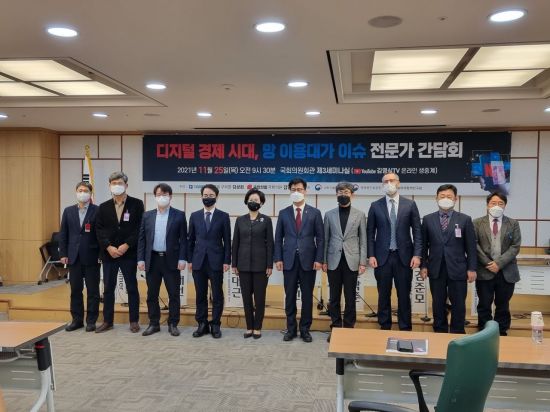 Kim Sang-hee, Deputy Speaker of the National Assembly from the Democratic Party of Korea, and Kim Young-sik, a member of the People Power Party belonging to the National Assembly Science, Technology, Information and Broadcasting and Communications Committee, held an expert roundtable on the 25th at Seminar Room 3 of the National Assembly Members' Office Building titled "Seeking Reasonable Solutions to the Issue of Network Usage Fees in the Digital Economy Era."
[Asia Economy Reporter Cha Min-young] "Netflix does not pay network usage fees to any internet service provider (ISP) in any country worldwide. Korean companies cannot be treated differently."
As legislative discussions are underway to regulate network usage fee contracts with overseas content providers (CPs) such as Netflix and Google, Netflix has maintained its existing stance of unwillingness to pay network usage fees in Korea. With both sides continuing to hold parallel views, the possibility of resolving the issue through legislation is considered high.
On the 25th, Kim Sang-hee, Deputy Speaker of the National Assembly from the Democratic Party, and Kim Young-sik, a member of the People Power Party, both members of the National Assembly's Science, Technology, Information and Broadcasting and Communications Committee, held an expert roundtable titled "Seeking Reasonable Solutions to Network Usage Fee Issues in the Digital Economy Era" at the National Assembly Members' Office Building Seminar Room 3.
The roundtable was organized amid bipartisan consensus on legislative discussions. Overseas CPs such as Netflix and Google, unlike domestic CPs like Naver and Kakao, use communication networks without paying usage fees or fulfilling quality maintenance obligations. Meanwhile, SK Broadband's network burden increased 24-fold from 50 gigabits per second (Gbps) in May 2013 to 1200 Gbps in September this year. The dispute between the two companies has escalated into legal battles, with the first hearing of the second trial scheduled for next month.
Netflix: "CPs Provide Content, No Obligation to Pay ISPs"
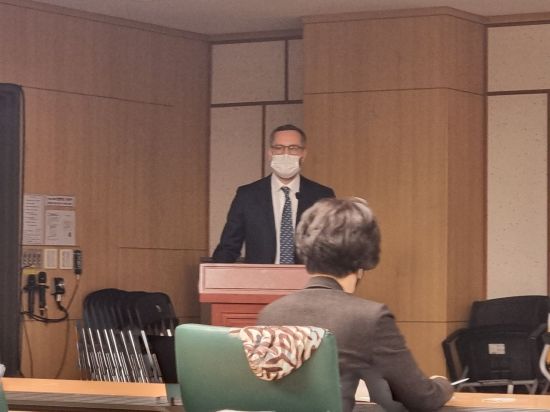 Thomas Bulmer, Director of Netflix Global Content Delivery, explained that "Netflix has no obligation to pay network usage fees."
Thomas Bulmer, Netflix's Global Content Delivery Director, who presented Netflix's position, argued that ▲Netflix does not pay network usage fees to any overseas ISP, so Korea cannot treat it differently, and ▲using Netflix's own Content Delivery Network (CDN) reduces ISPs' cost burdens. These are claims Netflix has repeatedly made.
Director Bulmer stated, "First, high-definition content triggers broadband demand, and Netflix's large-scale investments bring significant benefits to ISPs, creating a virtuous cycle," adding, "Network usage fees are tolls imposed on internet content and hinder the localization of content in Korea."
Netflix also argued that internet 'users' should be limited to 'end users' (general customers), so Netflix has no reason to pay. Bulmer claimed, "Since users request content and Netflix provides it, Netflix pays ISPs to transmit content to them." He argued that if ISPs also charge Netflix, it would be double charging.
While Netflix claims no obligation to pay network usage fees, it suggests that if the Korean ISP's burden due to long-distance transmission costs is too high, they should use Netflix's own CDN, Open Connect Appliance (OCA).
Professor Cho Dae-geun: Confirmed in US Charter Case... Both Sides Must Pay
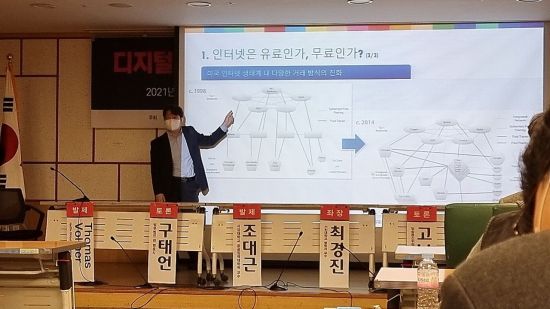 Professor Cho Dae-geun of Sogang University Graduate School of Public Policy is explaining, citing the case of American charter companies, that "the internet is not free."
In response, Professor Cho Dae-geun of Sogang University's Graduate School of Public Policy opposed Netflix's claims by citing the US Charter merger approval order, which confirmed ISPs' fee charging to CPs in the US market as a case.
Professor Cho said, "The internet was not originally free but operated on a mutual settlement basis among ISPs, known as 'settlement-free peering,'" and pointed out that there is a 'paid peering' method where ISPs and CPs connect with paid agreements. He cited the 2016 US Charter case as a representative example where the ISP-CP transaction relationship, previously unseen in private corporate contracts, became clear.
He also criticized Netflix's limitation of 'users' to end users as inconsistent with domestic law. Professor Cho said, "Under Korea's Telecommunications Business Act, CPs as value-added telecommunications service providers are included as 'users,'" and argued, "In a two-sided market, no user pays for the other party's communication; each pays according to their own use and purpose."
He further explained, "Access and transmission have different meanings. The network usage fee under debate in Korea refers to the cost of 'access' for CPs to use ISPs' networks," and "The claim that transmission is free does not fit here." He added that net neutrality regulations prohibit ISPs from discriminating against CPs but do not imply that usage fees are 'free.'
Professor Cho also mentioned six considerations for legislative discussions: examining limitations of existing law enforcement, establishing at least a minimal contract monitoring system, ensuring autonomy between contracting parties, defining and unifying terms related to network connections within the internet ecosystem, utilizing the Korea Communications Commission's network usage fee guidelines, and considering user protection and ecosystem sustainability.
Industry Opinions Divided... Different Views on Content Providers
Opinions from various sectors on the same issue are sharply divided. Attorney Koo Tae-eon from Law Firm Lin argued, "In broadcasting, content providers do not pay broadcasting usage fees, but in telecommunications, content providers are required to pay," and added, "Premature regulation of industries during the digital economy development phase may cause more harm than good, such as cost burdens when expanding overseas, rather than solving domestic CP discrimination."
On the other hand, Yoon Sang-pil, Executive Director of the Korea Telecommunications Operators Association (KTOA), emphasized, "Domestic ISPs, disadvantaged in negotiations, are fighting on a tilted field against global operators like Netflix, so legal gaps must be addressed," and stressed, "Even credit cards charge fees to both users and businesses; network costs should also be paid by both sides."
Ministry of Science and ICT Maintains Neutrality: "We Don't Know Well"... KCC Says "Pre- and Post-Regulation Needed"
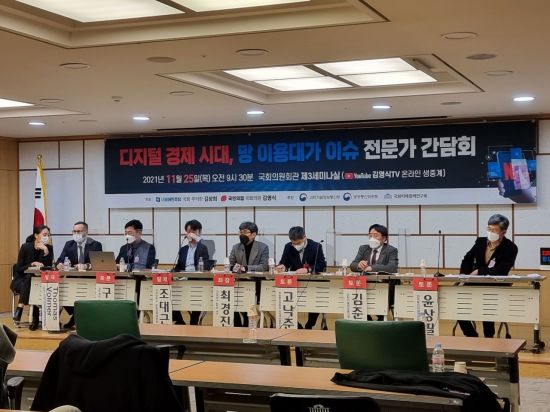
The Ministry of Science and ICT, the competent authority, maintained neutrality. Kim Jun-mo, Director of the Telecommunications Competition Policy Division at the Ministry, said, "We regret the noise over network usage fees, but since it is a private contract issue difficult for the government to regulate directly, we do not know much about the matter," adding, "We will listen to this discussion and aim to propose reasonable measures when legislative discussions arise."
The Korea Communications Commission (KCC) showed a proactive attitude toward legislative discussions, citing the Facebook-KCC legal dispute. At that time, Facebook bypassed domestic access routes overseas due to negotiation issues with existing ISPs, causing inconvenience to domestic users. Ko Nak-jun, Head of Internet User Division at KCC, said, "We created guidelines to prevent abuse of dominant position, but there were regulatory limits," and added, "Future amendments to the Telecommunications Business Act will not involve direct government intervention in contracts but will be laws to prevent discrimination," further stating, "Regulatory forms should cover both pre- and post-regulation, creating standard contracts to establish basic principles and prevent CPs from pretending to pay network usage fees during contracts while manipulating revenue sharing ratios."
Lawmakers from both parties emphasized voluntary resolution but drew a line at Netflix's claim of "inability to pay." Deputy Speaker Kim Sang-hee pointed out, "If providing the same service domestically, responsibility must be shared, but Netflix continues to evade legal regulations and reap benefits," while Representative Kim Young-sik said, "A global digital tax will be introduced from 2023, and taxes should be paid where profits exist," adding, "Rather than forcing network usage fees by law, we hope negotiations proceed well." Chairman Lee Won-wook of the Science, ICT, Broadcasting and Communications Committee also noted, "If negotiations fail, resolution through law is inevitable."
Deputy Speaker Kim Sang-hee introduced a partial amendment bill to the Telecommunications Business Act last November, specifying network usage fee contract regulations for overseas CPs. The new Article 34-3 (Conclusion of Information and Communication Network Service Use Contracts) requires telecommunications businesses to conclude contracts upon request from other telecommunications businesses regarding the use and provision of information and communication networks.
Earlier, Representative Kim Young-sik proposed a similar amendment to the Telecommunications Business Act in July. The bill prohibits value-added telecommunications service providers from failing to pay fair usage fees considering network composition and traffic volume despite receiving internet access services through public telecommunications networks under Article 22-7.
Meanwhile, Netflix reiterated its willingness to negotiate with SK Broadband, but skepticism increased. Director Bulmer stated, "We clearly have the intention to negotiate with SK Broadband. Dean Garfield, Vice President, met with SK Broadband officials before departing during his last visit to Korea." However, SK Broadband responded, "There have been no official discussions."
© The Asia Business Daily(www.asiae.co.kr). All rights reserved.
![Clutching a Stolen Dior Bag, Saying "I Hate Being Poor but Real"... The Grotesque Con of a "Human Knockoff" [Slate]](https://cwcontent.asiae.co.kr/asiaresize/183/2026021902243444107_1771435474.jpg)

















