Government Reviews and Finalizes 'Nuclear Power Reduction Cost Compensation Implementation Plan'
Covered by Electricity Fund Created from 3.7% Electricity Bill Deduction... "Effectively Using Taxes to Offset Nuclear Phase-Out Losses"
Including Wolseong Unit 1, Previously Claimed for Early Closure Due to Lack of Economic Feasibility, in Loss Compensation 'Contradiction'
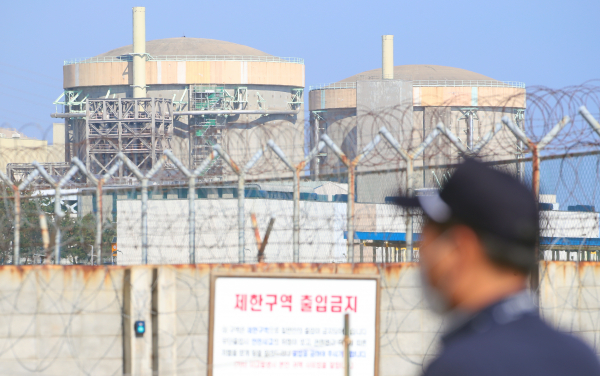
[Sejong=Asia Economy Reporter Kwon Haeyoung] Starting from the 9th of next month, the losses from nuclear power plant projects stranded due to the Moon Jae-in administration's 'nuclear phase-out' policy will be compensated through electricity bills paid by the public. A total of seven reactors are subject to this, including the early-closed Wolseong Unit 1, and the newly pursued Daejin Units 1 and 2, Cheonji Units 1 and 2, and Shin Hanul Units 3 and 4. The government’s forced reduction of nuclear power, which is a cheap and carbon-free energy source, followed by compensating the losses from the nuclear phase-out through electricity bills, has drawn criticism for shifting the burden onto the public and is also expected to indirectly act as a factor pressuring electricity price increases.
On the 25th, the government held a National Affairs Inspection and Coordination Meeting chaired by Prime Minister Kim Boo-kyum, where it reviewed and finalized the 'Energy Transition (Nuclear Reduction) Cost Compensation Implementation Plan,' which specifies the scope, standards, and procedures for compensating the expenses of nuclear reduction project operators.
This plan contains detailed contents aligned with the enforcement decree of the Electricity Business Act, which will be applied next month. In June, the government amended the enforcement decree of the Electricity Business Act to compensate for losses caused by the suspension of nuclear projects using the Electricity Industry Infrastructure Fund (Electricity Fund), which is formed by deducting 3.7% from the monthly electricity bills paid by the public.
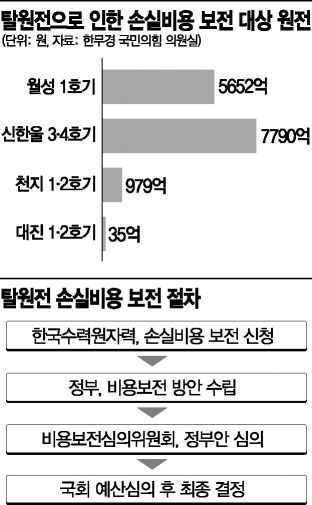
According to the cost compensation implementation plan announced by the government, the loss compensation targets include a total of seven reactors: Wolseong Unit 1, and the suspended Daejin Units 1 and 2, Cheonji Units 1 and 2, and Shin Hanul Units 3 and 4. According to data submitted by Korea Hydro & Nuclear Power (KHNP), the nuclear power plant operator, to the office of National Assembly member Han Mu-kyung of the People Power Party, the losses for these seven reactors are estimated at 1.4556 trillion KRW. Compensation applications can be made first for five reactors excluding Shin Hanul Units 3 and 4, which have had their construction plan approval period extended until December 2023.
The scope of cost compensation includes ▲for new nuclear power plants, expenses for acquiring permits and licenses, land acquisition costs incurred after obtaining permits, and construction costs ▲for the early-closed Wolseong Unit 1, equipment investment costs for continued operation, purchase costs of goods, and legally mandated costs associated with continued operation.
As the government decided to use the Electricity Fund as the financial source for compensating nuclear phase-out losses, criticism has been raised that the losses incurred during the unilateral pursuit of the nuclear power plant cancellation policy are being covered by a 'quasi-tax.' It is pointed out that the Electricity Fund, which should be used for the sustainable development and foundation of the electricity industry, is being used arbitrarily like petty cash without sufficient discussion, shifting the burden onto the public. In particular, there is criticism that including Wolseong Unit 1, which was early closed due to lack of economic feasibility, in the loss compensation target is inconsistent.
Professor Jeong Dong-wook of the Department of Energy Systems Engineering at Chung-Ang University criticized, "In the case of Wolseong Unit 1, it was judged to be economically unfeasible and was closed early, so including it as a loss compensation target is inconsistent," adding, "This is an example that shows how contradictory the current government's nuclear phase-out policy is." He continued, "The Electricity Fund is essentially a quasi-tax, and the fund also undergoes budget review by the National Assembly, but the government’s move to amend the enforcement decree without going through legislative procedures and proceed with compensating nuclear phase-out losses is an overreach."
With the enforcement of this amendment, the operator KHNP plans to first apply to the government for loss compensation for five nuclear reactors. Afterwards, the government’s proposal will be finalized through deliberation by the Cost Compensation Review Committee, composed of up to 12 government and private experts, and the final decision will be made through the National Assembly’s budget review.
© The Asia Business Daily(www.asiae.co.kr). All rights reserved.
![Clutching a Stolen Dior Bag, Saying "I Hate Being Poor but Real"... The Grotesque Con of a "Human Knockoff" [Slate]](https://cwcontent.asiae.co.kr/asiaresize/183/2026021902243444107_1771435474.jpg)
















