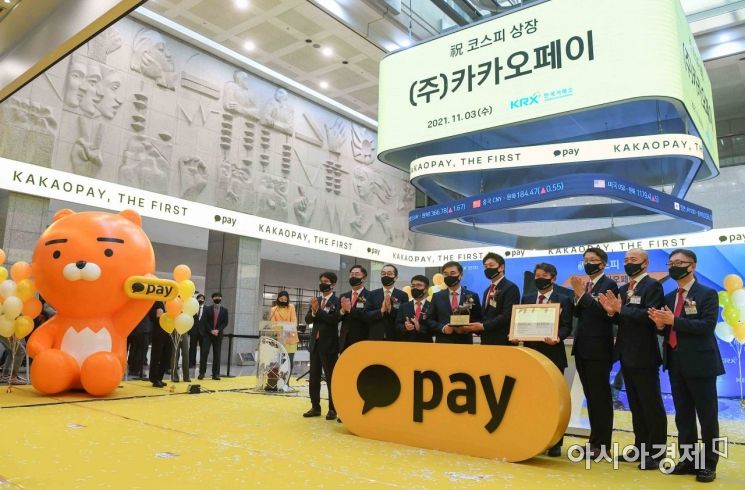
 On the 3rd, officials attending the commemorative ceremony for KakaoPay's new listing on the KOSPI at the Korea Exchange in Yeouido, Seoul, are taking a group photo. From the left: Song Young-hoon, Deputy General Manager of the Korea Exchange's KOSPI Market Headquarters; Ahn Sang-hwan, Chairman of the Korea IR Association; Jung Hyung-jin, Korea Representative of Goldman Sachs Seoul Branch; Lim Jae-joon, General Manager of the Korea Exchange's KOSPI Market Headquarters; Son Byung-doo, Chairman of the Korea Exchange; Ryu Young-joon, CEO of KakaoPay; Kim Joo-won, Vice Chairman of Kakao; Jang Seok-hoon, President of Samsung Securities; Park Tae-jin, Head of JP Morgan Securities Korea; Jung Woo-yong, Vice Chairman of the Korea Listed Companies Association Policy Committee. Photo by Kang Jin-hyung aymsdream@
[Asia Economy Reporter Ji Yeon-jin] Since being acquired by Kakao Pay, Kakao Pay Securities has continued its "perennial deficit" streak. Although it was expected that the synergy between Kakao Pay, a lifestyle finance platform, and Baro Investment Securities, a corporate finance specialist, would be significant, profitability has rather deteriorated after the merger.
According to Kakao Pay Securities' Q3 operating report on the 23rd, the company recorded an operating loss of 13.3 billion KRW in the third quarter, expanding its deficit more than fourfold compared to one year ago (-3.2 billion KRW). Compared to Q2 of this year (-8.4 billion KRW), the operating loss increased by nearly 5 billion KRW. Operating revenue in Q3 rose 16.96% year-on-year to 52.4 billion KRW, but net loss during this period ballooned from 2.8 billion KRW to 12.5 billion KRW.
Kakao Pay acquired a 60% stake in Baro Investment Securities in February last year and launched Kakao Pay Securities. Currently, Kakao Pay holds a 60% stake as the largest shareholder. Baro Investment Securities, as of 2019 before acquisition, was a small-to-medium-sized securities firm with 59.9 billion KRW in equity capital and 7.8 billion KRW in operating profit, specializing in corporate finance and corporate sales without branches, rather than retail finance. On the other hand, Kakao Pay is a lifestyle finance platform company focusing on retail services such as mobile easy payments, remittances, authentication, and billing. Because of this, there was analysis at the time of acquisition that synergy between online non-face-to-face channels like KakaoTalk and corporate finance would be difficult to achieve.
In fact, immediately after the Kakao Pay acquisition, Q1 sales last year were 17.8 billion KRW, with operating profit and net profit of 900 million KRW and 700 million KRW respectively, showing good profitability. However, from Q2 onward, operating losses and net losses occurred, resulting in six consecutive quarters of deficits through Q3 this year.
After acquiring Baro Investment Securities, Kakao Pay has strengthened its retail sector by introducing various investment products such as stocks and funds on the KakaoTalk platform, but even this was suspended following the implementation of the Financial Consumer Protection Act in August. Kakao Pay Securities expects retail sales to increase through the launch of a Mobile Trading System (MTS) in the second half of this year and fractional trading of overseas stocks.
However, according to Kakao Pay's securities registration statement, Kakao Pay Securities plans to increase its number of employees to 445 by 2023 to strengthen its retail business. As of Q3, the number of employees is 257, with personnel expenses reaching 27.6 billion KRW. This sharply increased from 19 billion KRW in Q2 and is one of the major factors that expanded the scale of operating losses.
© The Asia Business Daily(www.asiae.co.kr). All rights reserved.
![Clutching a Stolen Dior Bag, Saying "I Hate Being Poor but Real"... The Grotesque Con of a "Human Knockoff" [Slate]](https://cwcontent.asiae.co.kr/asiaresize/183/2026021902243444107_1771435474.jpg)















