Soju-Maekju and Palm Oil Price Surge
Raw Material Cost Share Significantly Increases
Ramen Industry Operating Profit Expected to Decline
Labor Cost Hike Also Affects Prices
Burger and Chicken Prices Rise Too
[Asia Economy Reporter Lee Seung-jin] Food prices are rising one after another as labor costs surge and raw material prices overlap. In the ramen industry, where the proportion of raw material costs in total sales is high, the raw material price relative to sales increased by more than 10% compared to last year, significantly increasing cost burdens. Processed food companies, which have a somewhat lower proportion of raw material costs, are caught in a vicious cycle of raising product prices as they cannot withstand the annually rising labor costs, leading to forecasts that the trend of price increases will continue next year.
No Profit Even After Raising Prices
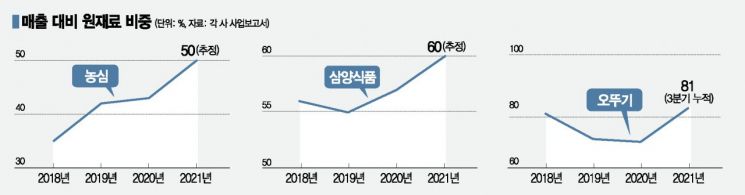
According to ramen companies on the 24th, although major product prices were raised by around 10%, performance remains sluggish. This is because the prices of main ingredients such as wheat and palm oil have surged, sharply increasing the proportion of raw material costs in total sales. For Nongshim, the proportion of raw material costs in total sales last year was 43%. This is an 8% increase compared to 35% in 2018. This year, the proportion of raw material costs in total sales is expected to exceed at least 50%.
Nongshim imported wheat at $202 per ton last year, but this year it was brought in at $258, a 27% higher price. For palm oil, the price rose from $627 per ton last year to $1,110 this year, nearly doubling, sharply increasing cost burdens.
Ottogi and Samyang Foods are in similar situations. For Ottogi, the proportion of raw material costs in total sales was 69% last year, but by the third quarter of this year, it rose to 81%. For Samyang Foods, the proportion of raw material costs is expected to rise from 56% last year to over 60% this year. Especially for Samyang Foods, ramen accounts for 90% of total sales, and despite product price increases, operating profit is expected to decline.
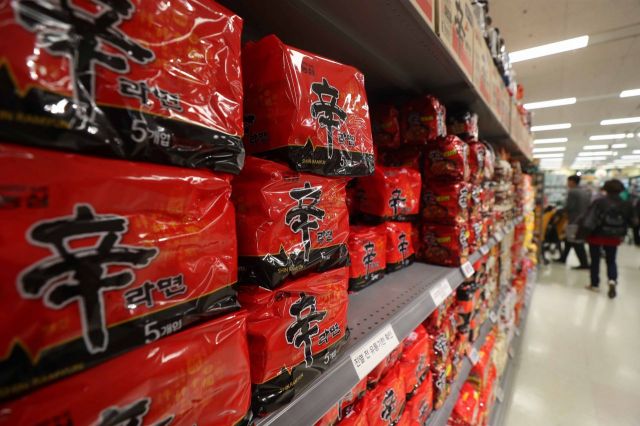 On the 15th, ramen is displayed at a large supermarket in downtown Seoul. Photo by Mun Ho-nam munonam@
Everyone Raising Prices
Food companies less affected by raw material price increases are facing problems with soaring labor costs. For CJ CheilJedang, the proportion of wages in total sales rose from the 8% range in 2018 to the 9% range in 2019, exceeding 10% last year. This is because labor cost expenditures have increased more than sales growth. Especially since labor costs rise every year regardless of sales, the burden felt by companies is greater.
Lotteria announced that from the 1st of next month, it will raise product selling prices by an average of 4.1%. The price increase applies to 16 types of burgers, 17 types of sets, 12 types of chicken, 8 types of desserts, and 10 types of drinks, with an average increase of about 200 won per item. The representative single-item menus, Bulgogi Burger and Shrimp Burger, will be adjusted from 3,900 won to 4,100 won, and set menus from 5,900 won to 6,200 won. The Korean beef Bulgogi Burger, made with domestic Korean beef, will be raised from 7,200 won to 7,500 won for single items and from 8,900 won to 9,200 won for set menus.
Kyochon F&B raised the prices of major products by an average of 8.1%, the first increase in seven years since 2014. Although the reason given was the rise in raw chicken prices, the main factors are delivery fee increases and minimum wage hikes. Kyochon stated, "Due to the cumulative labor cost increases over several years and various fee burdens, combined with recent widespread price hikes, improving franchise profitability is an urgent matter." Competitors have stated they have no immediate plans to raise prices, but franchisees have been steadily requesting price increases from headquarters.
Dongwon F&B also raised prices for 22 types of canned tuna by an average of 6.4%. Dongwon F&B explained that the increase in raw material costs raised manufacturing costs, but the biggest factor is labor cost increases. This is Dongwon Tuna's first price increase in five years.
Food Industry: "We Have Endured as Much as We Could"
Earlier this year, as prices of instant rice, canned ham, and other food products rose one after another, some consumer groups claimed that the food industry was fueling inflation. They pointed out that while raw material prices fluctuate annually, product prices are not lowered when raw material prices fall.
In response, the food industry claims that despite the labor cost burdens endured over the past several years, they have kept product prices frozen to suppress inflation as much as possible. In fact, many of the products whose prices rose this year had been frozen for several years.
A food industry official said, "Every time the minimum wage increases, it acts as a pressure factor for product price hikes, but considering consumer backlash, prices have been frozen for years. With labor cost burdens accumulating over the past several years and raw material prices rising, companies are no longer able to bear the cost burden."
© The Asia Business Daily(www.asiae.co.kr). All rights reserved.
![Clutching a Stolen Dior Bag, Saying "I Hate Being Poor but Real"... The Grotesque Con of a "Human Knockoff" [Slate]](https://cwcontent.asiae.co.kr/asiaresize/183/2026021902243444107_1771435474.jpg)
















