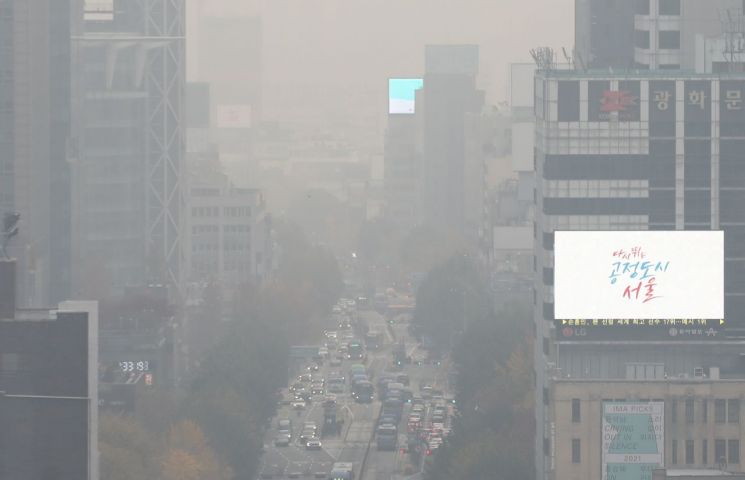
 The sky over Seoul city covered with fine dust on the morning of the 19th. [Image source=Yonhap News]
[Asia Economy Reporter Hwang Sumi] As the smog originating from China continues, the domestic sky has been covered with ultrafine dust and fine dust. Meanwhile, China is increasing its coal production again, raising concerns about a fine dust crisis this winter.
The National Institute of Environmental Research forecasted on the 20th that fine dust levels in the Seoul metropolitan area, Gangwon region, Chungcheong region, Gwangju, Jeonbuk, Daegu, Ulsan, and Gyeongbuk would be "bad," while other regions would be "normal." The Seoul metropolitan area and Chungcheong region are expected to experience "very bad" levels in the morning and at night.
This fine dust began to flow in from China on the afternoon of the 18th, carried by northwesterly winds, affecting the central and western regions. Due to stagnant air, domestic fine dust emissions added to the concentration, increasing its density.
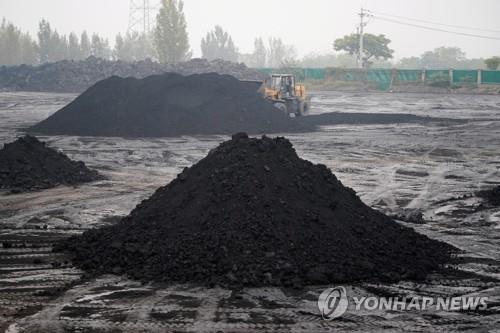
Recently, the Chinese government has started to increase coal production for power generation again to resolve the national power shortage.
According to the National Bureau of Statistics of China on the 15th, China's coal production in October reached 357.09 million tons. This is a 6.88% increase compared to the previous month (334.10 million tons), marking the highest level since March 2015.
Previously, the Chinese government had imposed restrictions on power generation using fossil fuels. However, as coal prices surged and power shortages spread, plans to increase coal mine production were encouraged and approved to suppress prices and expand supply. As a result, coal production has significantly increased.
Last month, the National Development and Reform Commission of China allowed production expansion at more than 154 large coal mines since July this year, projecting a 55 million ton increase in coal production in the fourth quarter from October to December. Additionally, on November 10, China announced that daily coal production reached a record high of 12.05 million tons, with the daily average coal production from November 7 to 9 reaching 11.75 million tons.
Coal accounts for a very high proportion of China's power generation. About 70% of China's total power generation is handled by thermal power plants, which rely almost entirely on coal.
As the world's largest coal consumer and carbon emitter, China is finding it difficult to give up coal easily despite the global trend toward climate change.
The Wall Street Journal (WSJ) recently cited two reasons why China finds it difficult to abandon coal. One is that the Chinese economy, known as the world's factory, is centered on heavy industry, making it inherently more carbon-intensive than Western countries. The other is that unlike the United States, China does not have a robust domestic natural gas industry that would enable a rapid transition away from coal.
Other reasons why China struggles to quit coal include the coal mining industry being a major employer, many coal-fired power plants carrying significant debt requiring debt reduction, and long-delayed upgrades to power grids to accommodate renewable energy.
Furthermore, the Wall Street Journal predicted that for China to phase out coal use early and gradually, a substantial increase in natural gas imports is inevitable. This holds true even if China continues to invest heavily in renewable energy or nuclear power. Due to the intermittent nature of solar and wind energy, natural gas is the optimal energy source to complement them.
Meanwhile, as China increases coal power generation due to power shortages and full-scale heating begins with the winter season, domestic fine dust emissions are also expected to surge sharply.
© The Asia Business Daily(www.asiae.co.kr). All rights reserved.
![Clutching a Stolen Dior Bag, Saying "I Hate Being Poor but Real"... The Grotesque Con of a "Human Knockoff" [Slate]](https://cwcontent.asiae.co.kr/asiaresize/183/2026021902243444107_1771435474.jpg)
















