KCCI Holds 7th Future Industry Forum
Reviewing the Progress of 'Digital Transformation and Carbon Neutrality' in the Steel Industry
[Asia Economy Reporter Hwang Yoon-joo] It has been pointed out that extraordinary measures such as early securing of hydrogen reduction steelmaking technology and the establishment of policy funds are necessary for the steel industry to achieve carbon neutrality according to the scenarios announced by the government.
The Korea Chamber of Commerce and Industry held the '7th Future Industry Forum' on the 5th to review the progress of carbon neutrality and digital transformation in the steel industry, which has been struggling due to recent global supply chain instability.
At the forum, the practical difficulties of carbon neutrality in the steel industry were first mentioned. An industry official attending the forum said, "Developing hydrogen reduction steelmaking technology, which is the core task of carbon neutrality in the steel industry, and building infrastructure will cost tens of trillions of won," adding, "The domestic steel industry’s profitability has recently deteriorated significantly, greatly reducing its investment capacity." This underscores the urgent need for government-level measures.
A phased strategy for carbon neutrality is needed... Hydrogen reduction steelmaking technology development will take a long time
It was pointed out that the carbon neutrality strategy should be divided into short-term and mid-to-long-term phases. The steel industry is a representative high greenhouse gas emitter due to its high use of bituminous coal and electricity. As of 2019, greenhouse gas emissions from the steel industry amounted to 117 million tons, accounting for 16.7% of the national total emissions and 30.0% of the industrial sector. Without groundbreaking progress in hydrogen reduction steelmaking technology development in the future, there is little room for additional reductions.
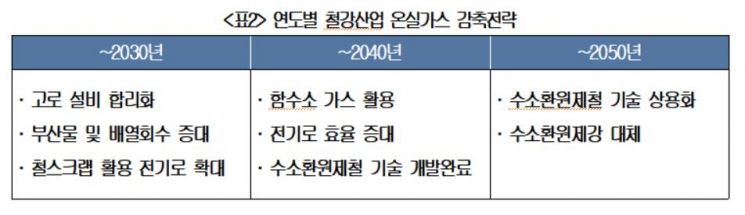
Jeong Eun-mi, head of the Korea Institute for Industrial Economics and Trade, stated that in the short term, efforts should focus on improving the efficiency of coal-based steelmaking processes and expanding electric furnaces, while in the long term, the development and commercialization of hydrogen reduction steelmaking technology should be accelerated to expand hydrogen-based steelmaking processes.
However, while short-term strategies can be implemented by companies themselves, mid-to-long-term strategies require government support. Jeong said, "For carbon neutrality, the steel industry must actively engage in technology development and bold investment, but considering the expected large-scale investments and risks, the government should provide active tax benefits and financial support."
Steel industry: "Government fund establishment needed for carbon neutrality... Emissions trading system improvement also necessary"
There was also a point made that the government's role is important for the steel industry to transform its industrial structure into digital and eco-friendly sectors. This means that the government should take a more active role in expanding R&D investment in new materials, nurturing specialized personnel, and revitalizing upstream and downstream industries. Additionally, Professor Jang requested that the basic tariffs imposed on steel raw materials be waived, similar to competing countries like China and Japan, and emphasized that exemptions from preliminary feasibility studies should be actively considered for national-level technology development such as hydrogen reduction steelmaking.
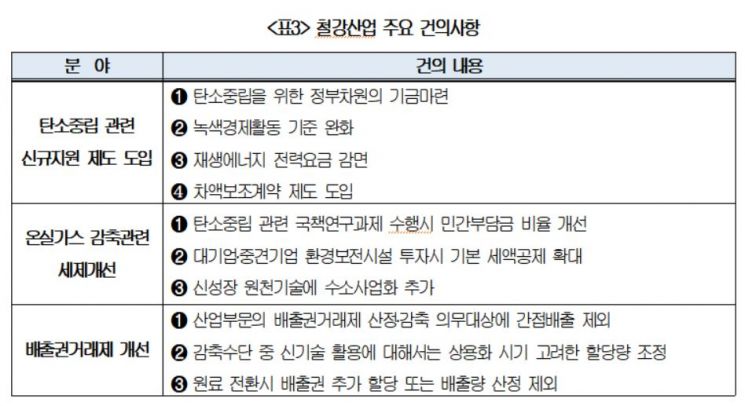
The steel industry also proposed ▲establishment of a carbon neutrality fund ▲expansion of tax credits for new growth source technologies ▲improvements to the emissions trading system.
Byun Young-man, full-time vice chairman of the Korea Iron & Steel Association, said, "The steel industry has established a challenging plan to reduce greenhouse gas emissions by 95% by 2050," adding, "Since major overseas countries are already actively promoting policies such as fund establishment and tax support at the government level to support carbon neutrality in the industry, our government also needs to actively implement policy fund expansion, introduction of new support systems, and improvements to tax and emissions trading systems."
Ko Jun-hyung, president of POSCO Research Institute, said, "While it is clear that the steel industry's response to eco-friendliness is a major challenge, the development of new materials cannot be neglected at the same time," adding, "As demand for high-performance steel products is expected to increase in future cars and ships, innovation by companies and government support in this area are necessary."
© The Asia Business Daily(www.asiae.co.kr). All rights reserved.
![Clutching a Stolen Dior Bag, Saying "I Hate Being Poor but Real"... The Grotesque Con of a "Human Knockoff" [Slate]](https://cwcontent.asiae.co.kr/asiaresize/183/2026021902243444107_1771435474.jpg)
















