Netflix Vice President Visits Amid Renewed Network Usage Fee Controversy
National Assembly and President Moon Mention 'Reasonable Network Usage Fees'
Ruling and Opposition Parties Push for Fair Network Usage Fee Legislation by Consensus
Fair Trade Commission Chairman Jo Seong-wook: "Abuse of Position... Like Participant Number One"
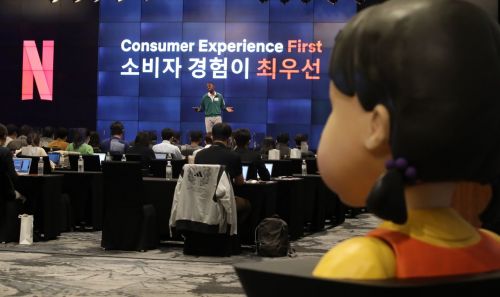 Global online video service (OTT) Netflix, which has been under scrutiny for the 'network free-riding' controversy, has once again claimed that it cannot pay network usage fees. Dean Garfield, Netflix's Chief Policy Officer, is speaking at a media open talk held on the 4th at the JW Marriott Dongdaemun Square Seoul Hotel in Jongno-gu, Seoul. Photo by Kim Hyun-min kimhyun81@
[Asia Economy reporters Seulgina Jo, Minyoung Cha, Sangdon Joo] "The Korean government should establish a support system to prevent Internet Service Providers (ISPs) from charging Content Providers (CPs) transmission fees."
Global online video service (OTT) Netflix, which has been under scrutiny over the 'network free-riding' controversy, once again claimed it cannot pay network usage fees. Netflix executives not only maintained their stance of refusing to pay any fees despite generating massive traffic in Korea, but also made an unreasonable demand that the Korean government intervene to prevent local telecom companies from charging them fees.
Dean Garfield, Netflix's Vice President of Policy, stated at a press conference held on the morning of the 4th at the JW Marriott Dongdaemun Square in Jongno-gu, Seoul, "The government must recognize that CPs like Netflix play a crucial role in stimulating demand for broadband internet services."
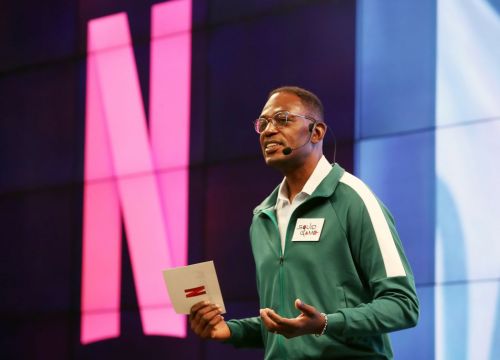 Dean Garfield, Vice President of Policy at Netflix, is speaking at the Media Open Talk held on the 4th at JW Marriott Dongdaemun Square Seoul Hotel in Jongno-gu, Seoul. Photo by Hyunmin Kim kimhyun81@
Wearing the green tracksuit and name tag from the Korean original content 'Squid Game' on stage, he said, "I am very pleased to visit Korea after the great success of Squid Game," but clearly drew the line on paying network usage fees.
He reiterated Netflix's existing position, saying, "More than 1,000 ISPs worldwide use Netflix's own Content Delivery Network (CDN), Open Connect (OCA), which was created with a 1 trillion won investment to reduce the burden on ISPs, free of charge." Regarding global OTTs like Disney Plus and Apple TV Plus, which have CDN contracts and indirectly pay domestic ISPs, he said, "That is a business decision."
Netflix essentially repeated its stance of not paying network usage fees. On the contrary, he emphasized, "Netflix's investment has brought significant benefits to ISPs, including increased revenue and growth in broadband internet service demand."
Garfield's visit to Korea came amid strong prospects for the passage of a fair network usage fee bill within the year, agreed upon by ruling and opposition parties in the National Assembly. Kim Young-sik, a member of the People Power Party, has proposed legislation related to network usage fees and plans to pass it during the regular session through bipartisan agreement. President Moon Jae-in also directly mentioned this issue, urging, "Please keep an eye on it."
In this regard, Garfield visited the National Assembly the day before and requested, "Please ensure that the bill does not hinder the adoption of the latest technology and considers fair network usage fee setting and the fair use of collected fees."
Cho Sung-wook, Chairman of the Korea Fair Trade Commission, criticized major platforms including Netflix, saying, "They are like the number one participant in 'Squid Game,' who acts as both referee and player." He pointed out, "(The number one participant) abuses dual status to manipulate exposure order and distort competition in their favor," adding, "The monopolization by platform operators creates a tilted playing field that restricts competition and may weaken innovation momentum."

The controversy over network free-riding by global CPs including Netflix is not new. Among the top 10 operators by average daily traffic in Q2, overseas CPs such as Google and Netflix account for a staggering 78.5%. They earn huge profits based on domestic infrastructure but do not pay network usage fees. This sharply contrasts with domestic CPs like Naver and Kakao, which pay hundreds of millions of won annually in network fees to ISPs, cooperating in stable network management and expansion.
In particular, Netflix lost a lawsuit confirming non-existence of debt against SK Broadband and subsequently appealed the decision. However, it has been confirmed that Netflix effectively pays network usage fees to overseas ISPs such as Comcast, Verizon, and AT&T.
A telecommunications industry official said, "Netflix does not want to be the first global case to explicitly mention the term 'network usage fee,'" adding, "They seem to be in a hurry as they lost the first trial related to network usage fee lawsuits and the National Assembly and government are taking direct action."
© The Asia Business Daily(www.asiae.co.kr). All rights reserved.
![Clutching a Stolen Dior Bag, Saying "I Hate Being Poor but Real"... The Grotesque Con of a "Human Knockoff" [Slate]](https://cwcontent.asiae.co.kr/asiaresize/183/2026021902243444107_1771435474.jpg)


















