Element Water Shortage Crisis Due to China's Export Ban
Essential Item Suppressing Carcinogens in Diesel Emissions
Traded at Over 10 Times Price on Online Platforms Like 'Danggeun Market'
55% of 3.6 Million Trucks Nationwide Are Diesel... Concerns Over 'Logistics Crisis'
Industry "Truckers Facing Real Difficulties... Closely Monitoring Situation"
Government Exploring Diversification of Element Water Import Sources
 On online trading platforms such as Danggeun Market, posts from netizens appeared offering to purchase urea solution at prices typically more than 10 times higher. / Photo by Internet Community Capture
[Asia Economy Reporter Lim Juhyung] As the shortage of 'urea solution,' essential for operating diesel vehicles, continues, prices are also soaring. Urea solution is a liquid that reduces harmful emissions from diesel vehicles and is essential for operating diesel trucks. On the secondhand goods trading application 'Danggeun Market,' the price of urea solution registered has surged more than 10 times the usual price, drawing attention.
The problem lies in the fact that if the supply disruption of urea solution worsens, it will affect the entire logistics industry. This is because a significant portion of domestic freight trucks are diesel vehicles. Some express concerns that the shortage of urea solution could lead to a 'logistics crisis.'
Recently, on online trading platforms such as Danggeun Market, a 10ℓ (liter) container of urea solution has been confirmed to be traded at up to 120,000 to 130,000 KRW. Previously, the item was traded at around 10,000 KRW, so the price has jumped more than tenfold. As the shortage of urea solution has worsened recently, it has effectively become a situation where the price is whatever the seller demands.
On the 3rd, Asia Economy searched for urea solution on trading platforms and found numerous posts from netizens willing to purchase urea solution at prices exceeding 100,000 KRW. One netizen pleaded, "I cannot operate my vehicle because there is no urea solution," and begged, "I will buy it at any price, so please sell me even one." There were also posts urging urea solution sellers to "prioritize selling to freight trucks or buses that are struggling with their business immediately."
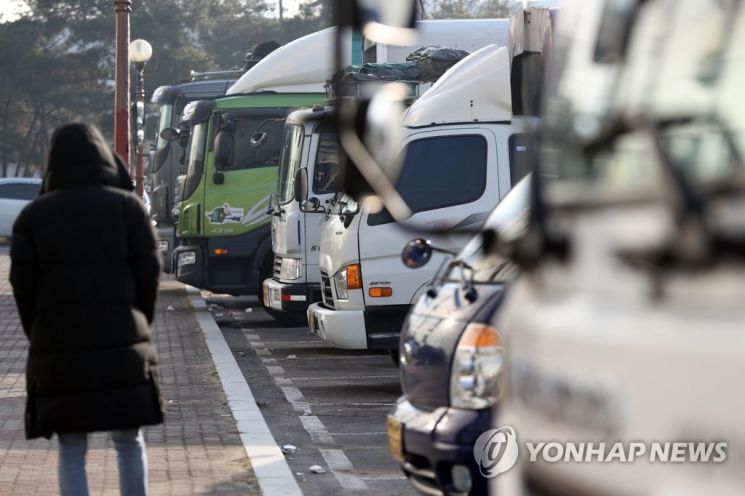 Cargo trucks parked in the parking lot. The photo is not related to any specific expression in the article. / Photo by Yonhap News
◆Urea Solution Shortage Caused by Halted Imports from China
Urea solution is a liquid that reduces emissions from diesel vehicles. It is especially essential for diesel trucks as it converts nitrogen oxides (NOx), which are carcinogenic substances, into water and nitrogen.
Urea solution is manufactured by extracting urea (ammonia) from coal or natural gas and mixing it with distilled water. Although domestic chemical companies produce the product itself, the problem lies in the supply of the essential raw material, urea. A significant portion of domestic urea is imported from China. According to the Ministry of Trade, Industry and Energy, about 550,000 tons of urea were imported from China last month alone.
However, in China, after the ban on Australian coal imports, coal-fired power generation decreased, leading to ongoing power shortages and a reduction in urea production. Consequently, Chinese authorities have banned the export of urea to prioritize domestic demand. As imports of Chinese urea, which account for most of the domestic supply, have been cut off, production of urea solution has been disrupted, leading to the shortage.
◆Concerns Over Logistics Industry Chaos if Supply Shortage Deepens
There are concerns that if the shortage of urea solution worsens, the entire logistics industry could suffer significant damage. Freight trucks, which serve as the 'lifeline' essential for logistics such as parcel delivery, are mostly diesel vehicles.
According to statistics from the National Logistics Integrated Information Center, as of the end of last year, about 3.6 million freight trucks were registered domestically. Among them, approximately 2 million are equipped with Selective Catalytic Reduction (SCR) systems that require urea solution. This means that at least half of the domestic freight trucks could be directly or indirectly affected by the urea solution shortage.
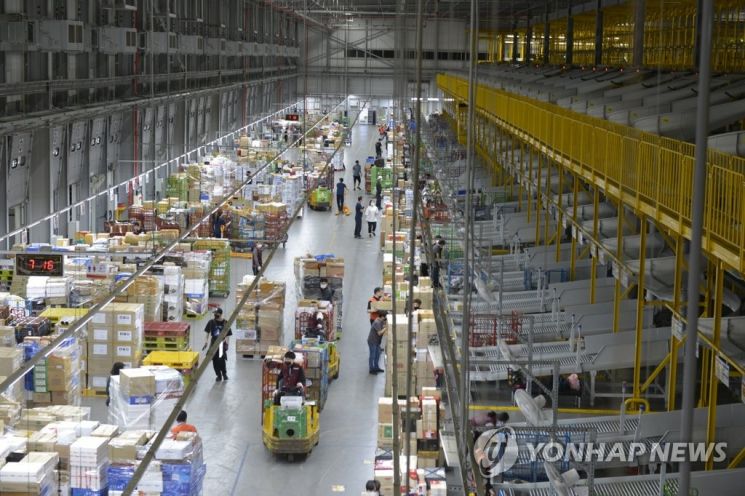 Concerns are rising that the shortage of diesel exhaust fluid could lead to a decrease in the operating rate of freight trucks, potentially escalating into a 'logistics crisis.' The photo shows the Daejeon Post Office Logistics Center in September last year. This is unrelated to any specific expressions in the article. / Photo by Yonhap News
A logistics crisis could cause massive disruption to the everyday economy. According to data released by the Korea Transport Institute in July, the average monthly number of parcel deliveries in Korea has increased by about 56.5% compared to before the COVID-19 pandemic. Since parcel delivery is relied upon for everything from general goods delivery to food supply, if the logistics network is paralyzed, the damage could escalate uncontrollably.
◆Industry: "Freight Trucks Haven't Stopped Yet, But Difficulties Are Growing"
The freight truck industry reported that the current shortage of urea solution is seriously affecting truck drivers.
The Korea Federation of Freight Truck Transportation stated, "We have not yet received reports of freight trucks stopping or being unable to operate due to the shortage of urea solution," but emphasized, "It is true that the industry is facing difficulties due to the actual shortage."
They added, "Although no specific measures have been decided or official documents received yet, we are closely monitoring the situation" and are exploring various ways to resolve the urea solution shortage.
The government is reviewing measures to alleviate the urea solution supply crisis in the short term. On the 2nd, the Office for Government Policy Coordination checked the domestic urea supply status at the Government Seoul Office with related ministries such as the Ministry of Economy and Finance and the Ministry of Foreign Affairs.
The government is first requesting cooperation from the Chinese government to resume imports of essential quantities to facilitate smooth urea imports. Additionally, to prepare for prolonged supply instability, it plans to diversify import sources beyond China to countries including Russia and is also considering converting industrial-grade urea for vehicle use within limits that do not affect public health or vehicle operation safety.
© The Asia Business Daily(www.asiae.co.kr). All rights reserved.
![Clutching a Stolen Dior Bag, Saying "I Hate Being Poor but Real"... The Grotesque Con of a "Human Knockoff" [Slate]](https://cwcontent.asiae.co.kr/asiaresize/183/2026021902243444107_1771435474.jpg)

















