Fierce 'Body Expansion' Competition to Secure Market Lead NO
Ha Go and Others Discover and Invest in Emerging Designer Brands
[Asia Economy Reporter Lim Hye-seon] Amid accelerating alliances and mergers among platforms for external growth, there is a fashion platform pursuing a differentiated strategy.
According to industry sources on the 30th, HAGO L&F is focusing on domestic designer brands in line with the fashion consumption trend of expressing individuality at reasonable prices. It simultaneously operates the rising platform HAGO and incubates emerging designer brands. On the HAGO platform, domestic designer brand products are showcased. Additionally, it was among the first to introduce a funding system co-created by brands and consumers, along with developing in-house brands such as Abonne (le abonne), ROAJU, and COILY. Thanks to this differentiated platform operation, HAGO is recording a monthly growth rate exceeding 300%.
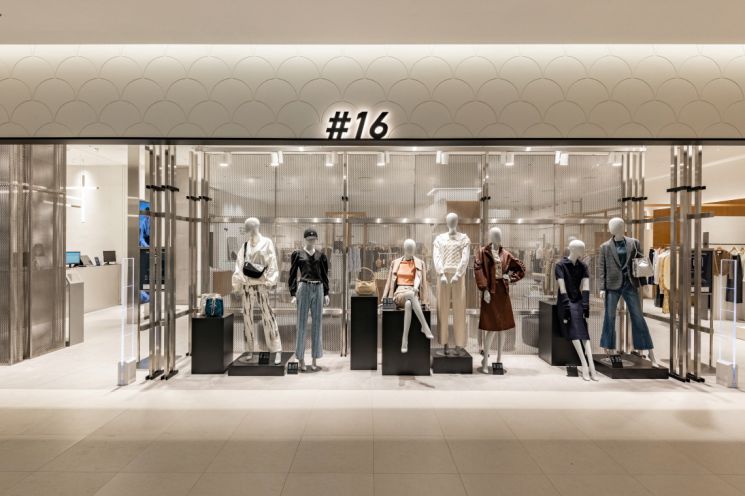
It is also focusing on incubating domestic emerging designers. HAGO L&F is currently investing in a total of 9 companies and 20 domestic designer brands. Notably, it recently opened '#16,' a new-concept showroom-style store for domestic designer brands, marking the first time a fashion platform has entered major offline distribution. Opened in August at Lotte Department Store Dongtan branch with a size of 100 pyeong, '#16' is a space where customers can meet 16 domestic designer brands including apparel, bags, and jewelry all in one place, achieving sales of 500 million KRW within just one month of opening.
Especially, the smart payment system 'Order HAGO,' developed first in the industry by HAGO L&F, solved the inventory problem, which was the highest entry barrier for offline expansion, and minimized labor costs, allowing designers to focus solely on product development without the burden of investment costs.
Hong Jung-woo, CEO of HAGO L&F, said, "As competition among fashion platforms intensifies recently, many are expanding categories by selling large corporate brands, imported brands, and even electronic products to grow in size, but HAGO will steadfastly pursue a differentiated strategy of securing and investing in domestic designer brands."
While numerous online fashion platforms are rapidly growing targeting the MZ generation (Millennials + Generation Z) consumers, some are targeting niche markets with differentiated target selections. In particular, fashion platforms targeting the 5060 'OPAL (Older People Active Lifestyle)' generation, who are quickly adapting to mobile applications through YouTube, are attracting attention.
'BLANCODE' is a women's clothing platform for active seniors in their 50s and 60s, targeting seniors who are highly interested in youthful fashion styling. It breaks the prejudice that "stylish clothes enjoyed by younger people do not fit senior body types" by presenting sophisticated fashion styles that are faithful to basics and suitable for senior body shapes. This has garnered positive responses from seniors in their 50s and 60s, achieving 147% of its sales target within 20 days of launch.
'Queenit,' targeting women in their 40s and 50s, is a fashion platform that gathers department store brands favored by middle-aged women such as 'Compagnia' and 'Joinus.' It surpassed 1 million cumulative downloads within 8 months of launch, and its transaction volume increased more than tenfold within one year of launch. Particularly notable is its thoughtful design considering middle-aged users unfamiliar with mobile shopping environments. While usually 4 to 5 products are displayed on a mobile screen, the Queenit app shows only one product at a time and increases the font size. The complicated membership registration process was simplified to allow input of only a phone number.
© The Asia Business Daily(www.asiae.co.kr). All rights reserved.
![Clutching a Stolen Dior Bag, Saying "I Hate Being Poor but Real"... The Grotesque Con of a "Human Knockoff" [Slate]](https://cwcontent.asiae.co.kr/asiaresize/183/2026021902243444107_1771435474.jpg)















