Scale of Private Sales of Public Land in 3rd New Towns 20 Times Larger Than Daejang-dong
Estimated Private Developer Profit of 8 Trillion Won from Sale
People's Solidarity Demands "Halt to Private Sales Policy of Public Land"
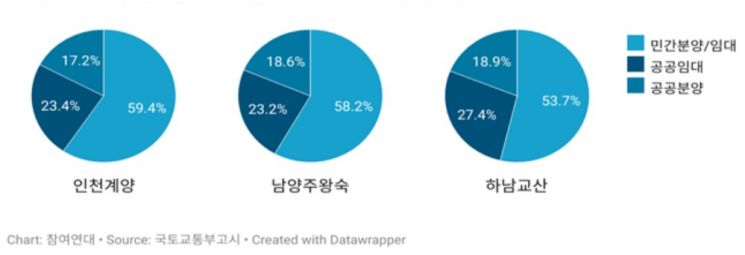 Proportion of Supply Land by Housing Supply Type in the 3rd New Town / Ministry of Land, Infrastructure and Transport Notice. Provided by People's Solidarity for Participatory Democracy.
[Asia Economy Reporter Kangwook Cho] A survey revealed that private developers are expected to gain approximately 8 trillion KRW in development profits from five 3rd generation new towns, including Incheon Gyeyang. The People's Solidarity for Participatory Democracy (PSPD), which announced the findings, urged the government and the National Assembly to promptly implement measures such as △ halting the sale of public land to private entities, △ designating public development districts, and △ expanding the supply of public housing on public land to prevent the 3rd generation new towns from becoming another Daejang-dong.
At a press conference held on the 26th, PSPD stated that out of approximately 174,000 housing units planned for construction across five 3rd generation new towns?Incheon Gyeyang, Namyangju Wangsuk, Hanam Gyosan, Goyang Changneung, and Bucheon Daejang?about 75,000 units (43%) are expected to be supplied as privately sold apartments. They estimated that private developers would secure development profits amounting to 8.1426 trillion KRW from these sales.
According to the Ministry of Land, Infrastructure and Transport's public notice, more than half of the total housing supply land in three new towns?Incheon Gyeyang, Namyangju Wangsuk, and Hanam Gyosan?where district plans have been finalized, is scheduled to be sold to private entities. The highest ratio of public land sold to private developers is in Incheon Gyeyang at 59.4% (471,000㎡), followed by Namyangju Wangsuk at 58.2% (1,736,000㎡), and Hanam Gyosan at 53.8% (712,000㎡).
Specifically, PSPD estimated that private apartments to be sold on a total of 2.8 million㎡ of public land sold to private developers in these three areas would amount to 7,618 units in Incheon Gyeyang, 30,987 units in Namyangju Wangsuk, and 13,329 units in Hanam Gyosan, totaling 51,934 units (excluding private rental housing). The development profits that private developers would gain after sales are estimated to be up to 5.6045 trillion KRW.
Furthermore, under the current 'Special Act on Public Housing,' about 40% of housing constructed on public land must be privately sold apartments. Therefore, assuming that at least 40% of public land is sold in Goyang Changneung and Bucheon Daejang?where district plans have not yet been finalized?and at levels similar to other new towns, PSPD estimated that 15,200 units in Goyang Changneung and 8,000 units in Bucheon Daejang would be supplied as privately sold apartments, with private developers' development profits reaching up to 2.5381 trillion KRW.
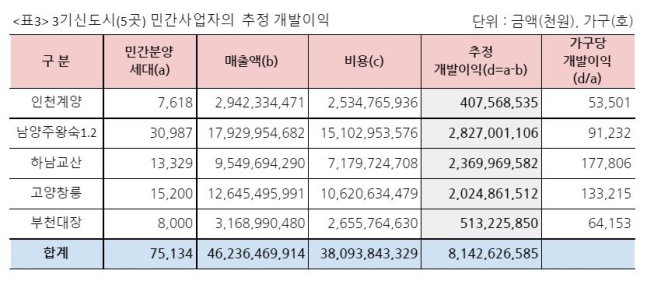
Professor Jaeman Lim of Sejong University's Department of Real Estate, who presented the analysis, said, "Considering that private developers are expected to sell about 75,000 units, it is estimated that the average development profit per apartment sold will exceed 100 million KRW for private developers." He added, "Including the newly announced supply plans for Gwangmyeong and Siheung new towns this year, the scale of development profits will increase further."
Professor Lim also criticized, "The enormous development profits, amounting to three times the 2.4 trillion KRW housing welfare budget for next year, will be attributed to private developers. If more than half of the public land forcibly acquired for housing supply is used as a money-making tool for private construction companies, it is questionable whether this can be called public land and why public land is being developed at all."
PSPD warned that a second or third Daejang-dong could be reproduced in the public land of the 3rd generation new towns. They argued that although the Daejang-dong development project was conducted as a public-private partnership, it effectively demonstrated how private developers developed public land and reaped astronomical development profits for a few individuals.
Amid growing calls to strengthen the public nature of the 3rd generation new towns, the 'Special Act on Public Housing' amendment bills proposed by Park Sang-hyuk of the Democratic Party, which mandates supplying over 80% public housing on public land, and Shim Sang-jung of the Justice Party, which mandates 100% public housing supply, have been submitted to the National Assembly. Additionally, following the Daejang-dong incident, both ruling and opposition parties have insisted on thoroughly reclaiming development profits from public land. However, PSPD reported that the National Assembly remains focused on political disputes, and the 'Special Act on Public Housing' amendment bills have not even been discussed in the relevant standing committees.
Kim Nam-geun, a lawyer and policy committee member of PSPD, emphasized, "The fundamental cause of excessive development profits going to private entities during the Daejang-dong land development process was the failure to pursue public development of public land created through compulsory land acquisition." He stressed, "It is urgent to introduce a public development district designation system to prevent the sale of public land created by the public to private entities and to amend the 'Special Act on Public Housing' to expand public housing supply."
Kim also added, "Rather than large-scale land development methods, a land reserve bank should be established to steadily secure public land and use it in line with the original purpose of public land development." He further stated, "Public land purchased by the land reserve bank should be supplied for purposes such as public rental housing construction by LH and others, ensuring it is not sold to private entities."
© The Asia Business Daily(www.asiae.co.kr). All rights reserved.
![Clutching a Stolen Dior Bag, Saying "I Hate Being Poor but Real"... The Grotesque Con of a "Human Knockoff" [Slate]](https://cwcontent.asiae.co.kr/asiaresize/183/2026021902243444107_1771435474.jpg)
















