Opposition Presidential Primary Candidates Successively Call for 'Abolition of Ministry of Gender Equality and Family'
20 Years Since Ministry's Establishment... Repeated Expansion and Reduction
One-Tenth of Ministry of Health and Welfare's Budget, Criticized for Broad Scope and Limitations
Experts: "Ministry Uses 0.2% of Total Government Budget"
"Discussions on Abolition Possible Only After Gender Discrimination Ends"
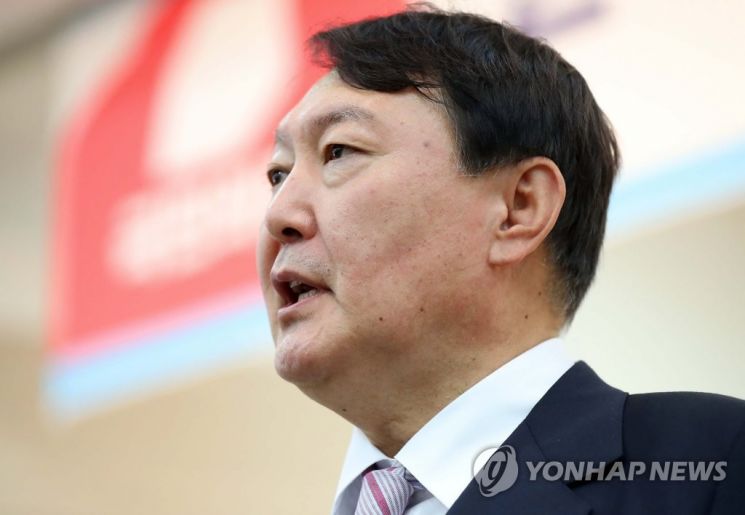 Yoon Seok-yeol, a leading presidential candidate from the People Power Party, announced a plan to abolish the Ministry of Gender Equality and Family and reorganize it into the Ministry of Gender Equality and Family as part of his 'Youth Pledge.' / Photo by Yonhap News
[Asia Economy Reporter Lim Juhyung] As opposition party presidential primary candidates have consecutively advocated for the abolition of the Ministry of Gender Equality and Family (MOGEF), the controversy over whether to maintain or abolish the ministry is expected to intensify. Those calling for the abolition of MOGEF argue that the ministry's role is virtually ineffective and that it fuels gender conflicts. On the other hand, there are criticisms that indiscriminately abolishing a ministry that carries out various projects to help socially vulnerable groups is an irresponsible decision. Experts pointed out that before discussing the abolition of MOGEF, society's widespread gender discrimination issues must first be alleviated.
Yoon Seok-yeol, a leading presidential candidate from the People Power Party and former Prosecutor General, announced plans to abolish and reorganize MOGEF as part of his youth pledge on the 21st. He stated, "MOGEF has failed to properly perform its function of gender equality and has disappointed the public by promoting messages that treat men as potential criminals," adding, "We will reorganize MOGEF into the Ministry of Gender Equality and Family to embrace diversity and realize substantive gender equality between men and women, adjusting its duties and budget accordingly."
This is not the first time the opposition has proposed the 'abolition of MOGEF.' Another presidential candidate, former lawmaker Yoo Seung-min, also wrote on his Facebook in July, questioning whether MOGEF is truly necessary and argued that the policies handled by MOGEF should be divided among relevant ministries such as the Ministry of Health and Welfare, Ministry of Employment and Labor, and Ministry of Justice for more efficient administration.
Lee Jun-seok, leader of the People Power Party, also raised concerns after attending a youth entrepreneur meeting in Daegu, stating to reporters, "Despite MOGEF consistently receiving budgets and operating, gender conflicts have dramatically increased over the past decade," and added, "There is a need to question whether it should continue to exist in its current form."
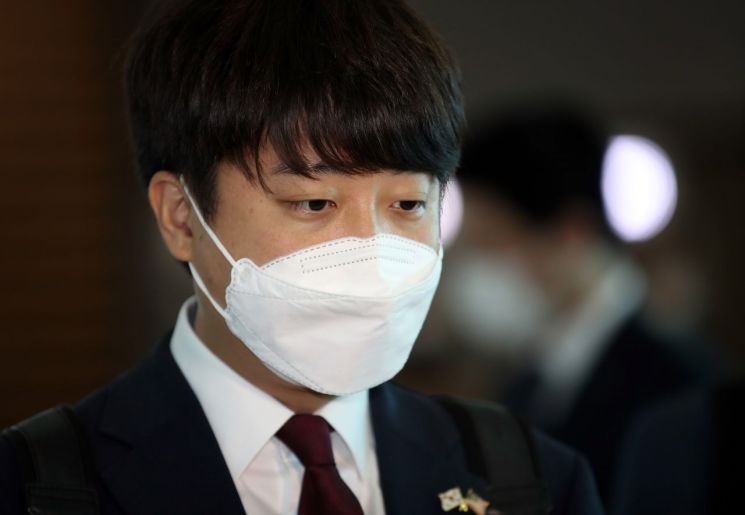 Lee Jun-seok, the leader of the People Power Party, criticized the Ministry of Gender Equality and Family, saying, "It has consistently received funding and operated, but gender conflicts have only increased over the past 10 years." / Photo by Yonhap News
The ruling party immediately pushed back against these claims from opposition presidential candidates. Former leader of the Democratic Party, Lee Nak-yeon, criticized on Facebook, "I worry that this is a populist idea riding on hatred toward a specific gender."
Democratic Party lawmaker Jang Kyung-tae also criticized, saying, "Claiming equal opportunity when starting from different starting points is not truly equality," and added, "The pledge to abolish MOGEF ignores the value of realizing gender equality and fuels gender conflicts."
◆Repeated Expansion and Reduction Over 20 Years Since Establishment
The controversy over whether to maintain or abolish MOGEF is not new in the political arena. Over nearly 20 years since its establishment, MOGEF has undergone dramatic changes.
MOGEF was first established in 2001 under the Kim Dae-jung administration as the Ministry of Women. Four years later, in 2005, it was expanded and reorganized as the Ministry of Gender Equality and Family, taking on family welfare-related duties as well.
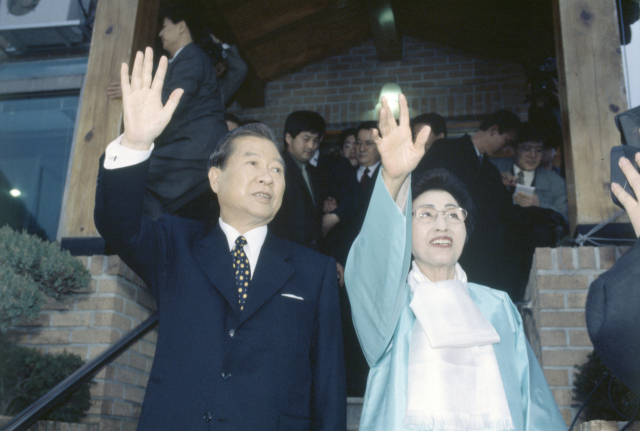 On December 19, 1997, when his presidential election was confirmed, then President-elect Kim Dae-jung and his wife Lee Hee-ho were leaving their home in Ilsan. Former President Kim is credited with contributing to domestic women's policies by establishing the Ministry of Gender Equality in 2001. / Photo by Yonhap News
However, former President Lee Myung-bak, who won the 17th presidential election, reduced the functions of MOGEF and reverted it back to the Ministry of Women, focusing solely on women's affairs. In 2008, Lee criticized MOGEF as "a department only for those claiming women's power." At that time, the ministry's budget was slashed from 1.1994 trillion won to 53.9 billion won, a reduction of over 90%, drawing heavy criticism.
In 2010, under the Park Geun-hye administration, some family-related projects were added back, and the ministry's name was changed again to the Ministry of Gender Equality and Family, which has continued to this day.
Having gone through turbulent times, MOGEF has faced criticism for its small size and unclear role. According to the 2022 budget proposal, MOGEF's budget totals 1.4115 trillion won, which is only about one-tenth of the Ministry of Health and Welfare's 96.9377 trillion won.
With about 260 employees, it is one of the smallest government ministries, yet it handles a wide range of policies including digital sex crimes and women's violence response, child-rearing support and family services, and employment support for women with career interruptions.
Given its relatively small size and budget but broad responsibilities, the public hardly feels the benefits provided by MOGEF.
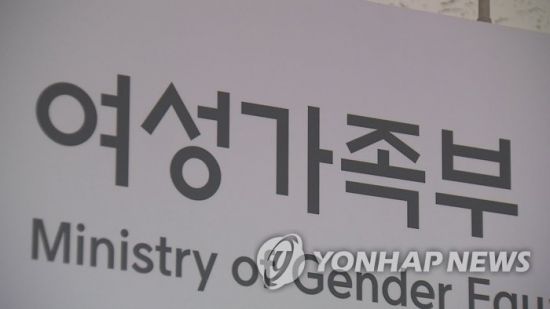 According to a survey conducted by the polling agency 'The Research' in December last year, 7 out of 10 citizens hold negative opinions about the Ministry of Gender Equality and Family. / Photo by Yonhap News
According to a public opinion poll conducted last December by the office of People Power Party lawmaker Kim Jung-jae through the polling agency 'The Research,' surveying 998 adult men and women, 72.3% of respondents expressed negative opinions about MOGEF. Notably, women (74.3%) were more negative toward MOGEF than men (71.4%).
◆Expert: "MOGEF Uses Only 0.2% of Total Budget... It's Too Early to Discuss Abolition"
Given this situation, public opinion on the 'abolition of MOGEF' is divided.
A 20-something office worker, A, said, "Honestly, I don't really know what MOGEF does. Just looking at the controversy over the 'shutdown system'?what does reducing kids' gaming time have to do with women's rights?" and added, "If its role is this ambiguous, it would be better to abolish it and focus on policies that truly help women."
On the other hand, another office worker, B (28), said, "Currently, MOGEF supports socially marginalized groups such as women with career interruptions, runaway youth, and single-parent families, yet people say to abolish it because it's useless instead of increasing its budget. If this isn't populism, then what is?" and expressed frustration, "If the ministry is abolished, these people will be the ones who suffer, so is the idea just to get rid of it without any alternatives?"
Experts pointed out that MOGEF's budget is too small to have a substantial impact on people's lives.
Kim Ji-hak, director of the Korea Diversity Research Institute, said, "MOGEF uses about 0.2% of the country's total budget. Given its budget size and authority, it is not at a level to properly operate the ministry or to be accused of fueling gender conflicts," and added, "The abolition debate often arises in politics, but I think it is more about rallying supporters for elections."
He continued, "Almost every country has government ministries responsible for women, youth, and families. Of course, it would be more positive if such ministries eventually disappear, but that is a story for when gender discrimination has vanished. Given that gender discrimination remains in safety, employment, and socio-political culture, now is not the appropriate time."
© The Asia Business Daily(www.asiae.co.kr). All rights reserved.
![Clutching a Stolen Dior Bag, Saying "I Hate Being Poor but Real"... The Grotesque Con of a "Human Knockoff" [Slate]](https://cwcontent.asiae.co.kr/asiaresize/183/2026021902243444107_1771435474.jpg)

















