[Asia Economy Reporter Jeong Hyunjin] The Presidential Committee on Carbon Neutrality recently finalized the carbon neutrality goals of reducing greenhouse gas emissions by 40% by 2030 and achieving zero carbon emissions by 2050. Meanwhile, nine out of ten domestic energy experts evaluated that raising the 2030 Carbon Neutrality Basic Act (NDC) target will inevitably impact the national economy and industry. They also assessed that the share of nuclear power generation should be maintained or expanded considering the 2050 carbon neutrality goal.
On the 20th, the Federation of Korean Industries announced the results of a survey conducted from the 13th of last month to the 8th of this month targeting 116 members of energy-related academic societies including the Korean Energy Society, the Korean Resource Economics Association, and the Korean Nuclear Society regarding the 2030 NDC and carbon neutrality policies. According to the results, 89.7% of respondents diagnosed that raising the 2030 NDC would have a negative impact on the overall national economy in terms of international competitiveness. The response rate expecting adverse effects on the manufacturing industry as a whole was even higher at 92.2%, and 79.3% anticipated that exports would be hit. By industry, domestic key sectors were expected to face difficulties as follows: ▲Steel industry 89.7% ▲Petrochemical/Refining industry 93.1% ▲Cement industry 91.4% ▲Automobile 68.1% ▲Semiconductor 67.2%.
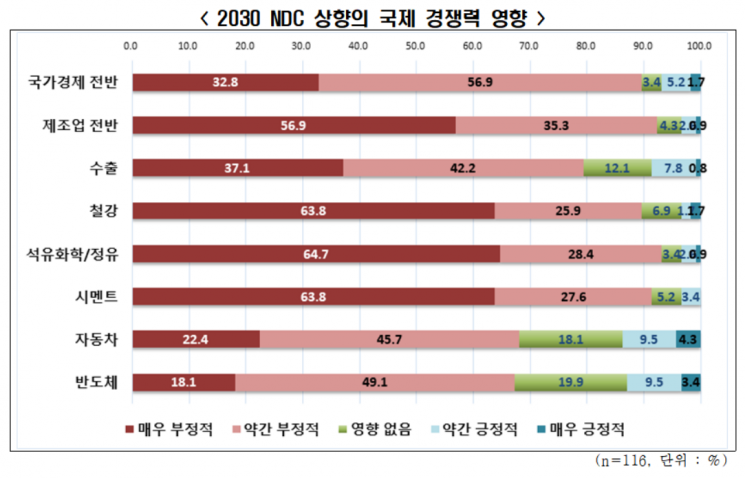
Experts viewed the reduction obligation specified in the NDC, which requires a reduction of more than 35%, as excessive. The 2030 NDC specifies reducing greenhouse gas emissions by more than 35% compared to 2018 levels by 2030, and the 2050 carbon neutrality scenario proposes reducing industrial sector emissions by 79.6% compared to 2018. Among the energy experts who responded to the survey, 69.0% answered that the 2030 NDC is excessive. Regarding the industrial sector reduction plan in the 2050 carbon neutrality scenario disclosed by the Carbon Neutrality Committee last August, 79.3% also perceived it as excessive.
When asked whether key carbon reduction technologies would be commercialized by 2030, many responded that commercialization would be difficult. The negative outlook rates for commercialization of technologies in major carbon-intensive industries were ▲Steel industry 75.9% ▲Petrochemical/Refining industry 75.0% ▲Cement industry 72.4%. Regarding carbon capture, utilization, and storage technology (CCUS), which was presented as a core means of carbon reduction, 69.8% of respondents believed commercialization would not be easy. For new energy sources such as hydrogen power generation and ammonia power generation, negative outlooks were 65.5% and 74.2%, respectively.
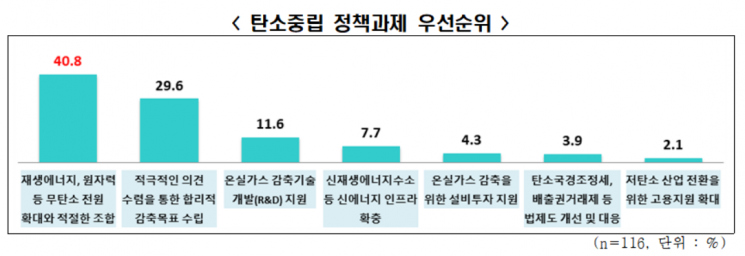
Respondents were asked how much electricity rates would increase if, in the 2050 carbon neutrality scenario proposed by the Carbon Neutrality Committee, the share of renewable energy generation expands up to 70.8% and the share of nuclear power generation shrinks to 6-7%, about one-third of the current level. The largest portion, 66.4%, answered that electricity rates would increase by 'more than 50%'. Regarding the most urgent policy task in the carbon neutrality promotion process, 40.8% answered 'expansion and appropriate combination of zero-carbon energy sources such as renewable energy and nuclear power'. Regarding the share of nuclear power generation, 94.8% responded that considering the 2050 carbon neutrality goal, the share should be expanded (79.3%) or maintained (15.5%).
Yoo Hwan-ik, Director of Corporate Policy at the Federation of Korean Industries, said, "Since it is difficult to introduce breakthrough carbon reduction technologies and new energy (hydrogen, ammonia) by 2030, it is necessary to review whether the reduction targets for the power generation and industrial sectors are excessive." He added, "Rather than setting reduction targets for show in the international community, it is urgent to prepare realistic alternatives such as expanding the share of nuclear power generation, which is a zero-carbon power source, and strengthening support for the development of carbon reduction technologies."
© The Asia Business Daily(www.asiae.co.kr). All rights reserved.
![Clutching a Stolen Dior Bag, Saying "I Hate Being Poor but Real"... The Grotesque Con of a "Human Knockoff" [Slate]](https://cwcontent.asiae.co.kr/asiaresize/183/2026021902243444107_1771435474.jpg)

















