Domestic Gasoline Prices Surpass 1700 Won for the First Time in 7 Years
Rapid Increase Makes 2000 Won a Matter of Time
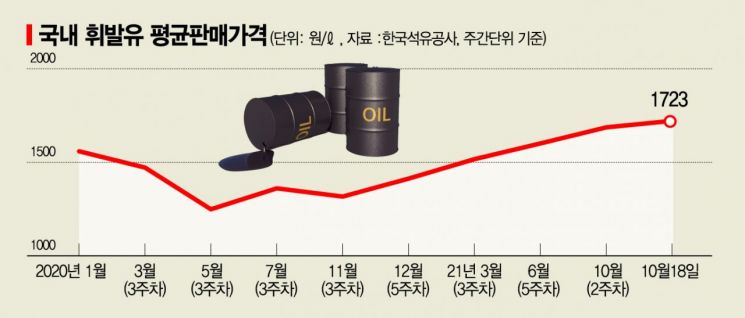
[Asia Economy New York=Correspondent Baek Jong-min, Reporter Choi Dae-yeol] Domestic fuel prices are soaring sharply amid the surge in international oil prices. The average retail price of gasoline in Korea has risen by nearly 80 KRW per liter just this month, surpassing 1,700 KRW for the first time in seven years. In Seoul, the average gasoline price has exceeded 1,800 KRW per liter. This increase is steeper than when international oil prices rose due to the U.S. sanctions on Iran in 2018. With forecasts suggesting that international oil prices could exceed 200 dollars per barrel, it is only a matter of time before the average gasoline price breaks 2,000 KRW per liter.
According to data from the Korea National Oil Corporation's Opinet as of the morning of the 18th, the average retail price of gasoline in Korea was 1,723 KRW per liter, up 77 KRW from 1,646 KRW at the end of last month. Prices had shown only slight increases or remained stable earlier this year, but the rise has accelerated this month.
Seoul, where gasoline is the most expensive nationwide, saw the average price exceed 1,800 KRW per liter as of this date. In central districts such as Jung-gu, Jongno-gu, and Gangnam-gu, prices have mostly surpassed 2,000 KRW. The last time the average gasoline price exceeded 1,700 KRW was in early December 2014, making this the highest level in over seven years. Although prices rose in 2018 due to U.S. sanctions on Iran, they did not exceed 1,700 KRW at that time.
The rise in gasoline prices is due to the increase in international oil prices. According to the Korea National Oil Corporation, prices were around 70 dollars per barrel at the beginning of last month but rose to 84.9 dollars per barrel (Brent crude) as of the 15th. International oil prices typically affect domestic retail prices with a lag of two weeks to a month. Demand had shrunk due to COVID-19, but expectations of increased industrial demand worldwide following expanded vaccination in developed countries have been factored in.
On the other hand, supply has not kept pace. To respond to environmental regulations such as climate change, global oil majors have been reluctant to make new investments in recent years. Oil-producing countries, including OPEC, have shown no significant moves to increase production. The Korea National Oil Corporation analyzed that "international oil prices are rising due to energy supply shortages, the International Energy Agency's forecast of increased oil demand, and the expected decline in U.S. crude oil production."
 Due to the rise in international oil prices, gasoline prices at gas stations in Seoul have increased for the fourth consecutive week, surpassing 2,000 won on the 17th. Photo by Yoon Dong-joo doso7@
"Betting on $100 by year-end, $200 next year" Increasing
Demand recovery combined with energy shortages likely to prolong supply-demand imbalance
In the international market, there are growing forecasts that oil prices will steadily rise, reaching 100 dollars per barrel by the end of the year and soaring to 200 dollars next year. According to a report by The Wall Street Journal (WSJ) on the 17th (local time), citing data from QuikStrike, traders in the crude oil futures options market are trading with the expectation that Brent crude could reach 200 dollars per barrel by the end of next year.
Trades anticipating West Texas Intermediate (WTI) crude oil prices to surge to 100 dollars per barrel by year-end are also spreading. According to CME Group data, the most actively traded options in the crude oil futures market currently are call options with a strike price of 100 dollars. The trading volume of call options with a 100-dollar strike price reached 141,500 contracts on the 15th, equivalent to about 141 million barrels. This corresponds to the world's daily production volume.
While the current WTI price is in the 80-dollar range, the heavy investment in options granting the right to buy at much higher prices reflects investors' expectations that crude oil prices will continue to rise. WTI prices have been on a steady decline since falling below 100 dollars in 2014. Although WTI traded in negative territory immediately after the COVID-19 outbreak last year, it has recently been soaring amid energy shortages. WTI has risen about 70% this year and about 10% just this month.
The WSJ reported that it is unusual for options with strike prices much higher than the current level to be heavily traded. It expressed concern that both small investors and existing investors are flocking to the energy market amid expectations that energy prices will continue to rise amid supply chain disruptions. Mark Bernino, Energy Investment Director at StoneX Group, said, "The market has never experienced such a prolonged explosive upward trend as it is now."
Although calls for reducing fuel taxes have emerged within and outside the political sphere, both the government and industry remain passive. While there is persuasive argument for lowering taxes to ease the burden of rising fuel prices on self-employed and others hit by COVID-19, there is concern that this could be seen as contradicting the government's carbon neutrality efforts. The refining industry also shows reluctance to actively pursue fuel tax cuts or hikes, considering past cases where such measures took time to have an effect. Previously, the government temporarily reduced fuel taxes by 10-15% in 2008 and 2018.
© The Asia Business Daily(www.asiae.co.kr). All rights reserved.
![Clutching a Stolen Dior Bag, Saying "I Hate Being Poor but Real"... The Grotesque Con of a "Human Knockoff" [Slate]](https://cwcontent.asiae.co.kr/asiaresize/183/2026021902243444107_1771435474.jpg)

















