Maximum Lease Guarantee Period Extended to 10 Years
Implementation of the Commercial Lease Protection Act Amendment
Increase in Vacant Stores Due to Landlords Giving Up Leasing
Seoul Medium-to-Large Commercial Building Vacancy Rate
Records Highest Level in Q2
[Asia Economy Reporter Kim Min-young] The A-type residential lodging facility in Jung-gu, Seoul, which was sold in July 2019, was completed earlier this year and residents have moved in, but the commercial stores on the lower floors have been vacant for nearly 10 months. Although 26 out of 30 stores were sold with expectations of demand from foreign tourists, none are currently operating.
A sales official of the building said, "At the time of sale, the first-floor stores were completely sold out at prices ranging from 1 billion to 1.8 billion KRW due to proximity to Myeongdong and expectations of Chinese and Japanese lodging customers," adding, "However, due to the self-employed business slump caused by COVID-19 and the Commercial Lease Protection Act (CLPA), it is difficult to find tenants."
The number of vacant commercial stores unable to find tenants is rapidly increasing. As the COVID-19 crisis prolongs, not only small alleyway commercial districts but also major commercial areas such as Myeongdong, Gangnam, and Hongdae are struggling, and due to the significantly strengthened tenant protection regulations under the CLPA, store owners are facing double hardships.
According to industry sources on the 13th, amid the ongoing wave of self-employed business closures and suspensions due to COVID-19, the implementation of the CLPA, which extends the tenant's lease guarantee period to a maximum of 10 years, has led to an increase in landlords giving up leasing their stores.
An official from a commercial building sales company said, "It seems that landlords set the rent too low to find tenants but got caught by the CLPA, which makes it difficult to raise rent for about 10 years," adding, "Many landlords prefer to leave stores vacant rather than receiving inadequate rent."
In fact, the industry points out that the government's implementation of the CLPA amendment in April, which guarantees a 10-year lease period, is another cause of commercial vacancies. There is concern that if a lease contract is signed at a low price, landlords will be unable to properly raise rent for 10 years, so they choose to leave stores empty instead.
An official from A Real Estate Agency in Euljiro said, "The average rent for a first-floor, 20-pyeong (approximately 66 sqm) commercial store in this area was 3.5 million KRW, but considering the self-employed business recession caused by COVID-19, it was lowered to 3 million KRW," adding, "It seems that 3 million KRW is the landlord's bottom line for rent." He explained that besides the economic downturn, the price gap between landlords and tenants is also a cause of vacant stores.
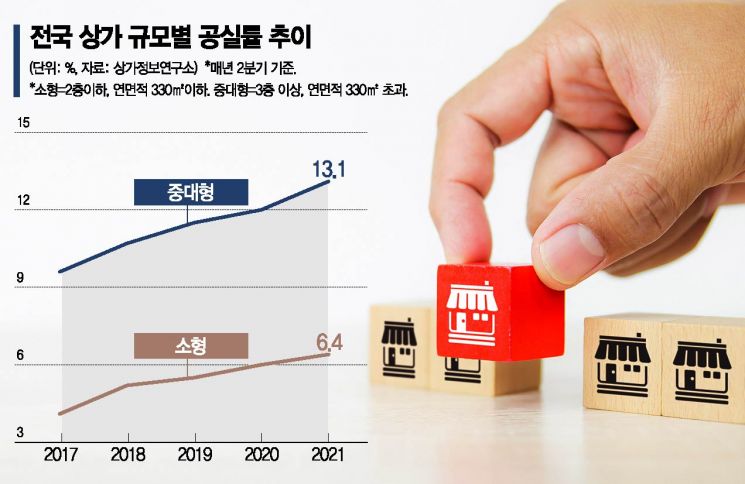
As a result, the vacancy rate of commercial buildings continues to rise. According to the Commercial Information Research Institute, the nationwide vacancy rate for medium-to-large commercial buildings over three floors and with a total floor area exceeding 330㎡ increased from 12.0% in Q2 last year, when COVID-19 began in earnest, to 12.7% in Q4 of the same year, and further rose to 13.1% in Q2 this year. The vacancy rate for medium-to-large commercial buildings in Seoul in Q2 reached 9.5%, the highest since related statistics began in 2013.
Even the vacancy rate for small commercial buildings, which was relatively better, continues to rise. The vacancy rate for small commercial buildings in Seoul, which hovered around 3% from 2017 to 2019, surged to 6.5% in Q2 this year.
Park Dae-won, director of the Commercial Information Research Institute, said, "Some landlords prefer to leave stores vacant rather than lowering rent indiscriminately," adding, "They believe that the rent gap is offset by rising land prices and increased building values."
© The Asia Business Daily(www.asiae.co.kr). All rights reserved.
![Clutching a Stolen Dior Bag, Saying "I Hate Being Poor but Real"... The Grotesque Con of a "Human Knockoff" [Slate]](https://cwcontent.asiae.co.kr/asiaresize/183/2026021902243444107_1771435474.jpg)















