President Moon Announces Plan to Distribute 7 Pungsan Dog Puppies to Local Governments
6 Puppies Distributed in 2019... Some Currently Living in Zoos
Civilians Criticize, "Talking About Animal Welfare but Not Taking Responsibility for Owned Dogs"
Experts Say, "Diplomatic Practice of Exchanging Animals as Gifts Is Inappropriate"
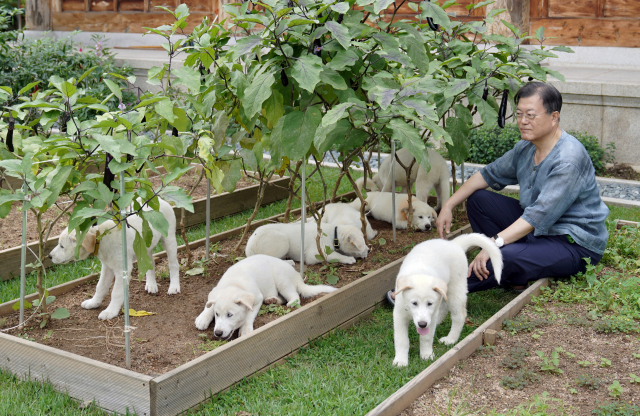 President Moon Jae-in is taking care of Pungsan dog puppies at the Blue House. Photo by the Blue House
[Asia Economy Reporter Kang Juhee] Criticism is emerging over President Moon Jae-in's announcement to distribute seven puppies born between Pungsan dog "Gomi," gifted by Kim Jong-un, General Secretary of the Workers' Party of North Korea, and his own pet dog "Maru," to local governments. The Blue House had also distributed six puppies born to Gomi to four local governments in 2019, but some of these dogs were sent to zoos and used for exhibition and promotion purposes.
Citizens are deeply concerned that the seven puppies to be distributed this time will undergo a similar process. Experts point out that sending dogs, which have a strong tendency to emotionally bond with humans, to zoos is inappropriate, and that the diplomatic practice of exchanging animals as gifts is also improper.
President Moon stated in a Facebook post on the 1st of last month, "Seven Pungsan dog puppies born three months ago between Maru and Gomi have all grown up healthy," and added, "I will distribute two puppies each to local governments that wish to receive them."
Previously, in August 2019, the Blue House also distributed six puppies (San, Deul, Gang, Byeol, Dal, Haetnim) born to Gomi to four local governments including Seoul, Incheon, Daejeon, and Gwangju. These dogs were subsequently sent to zoos and training centers through the local governments.
San is living at Seoul Grand Park in Gwacheon, Gyeonggi Province; Haetnim and Deul are at Yeonpyeong Peace and Security Training Center and Incheon Grand Park in Incheon, respectively; Dal and Gang are at O-World in Daejeon; and Byeol is at Uchi Zoo in Gwangju. Except for Haetnim and Deul, who were sent to the Incheon area, all are being used for exhibition purposes at zoos.
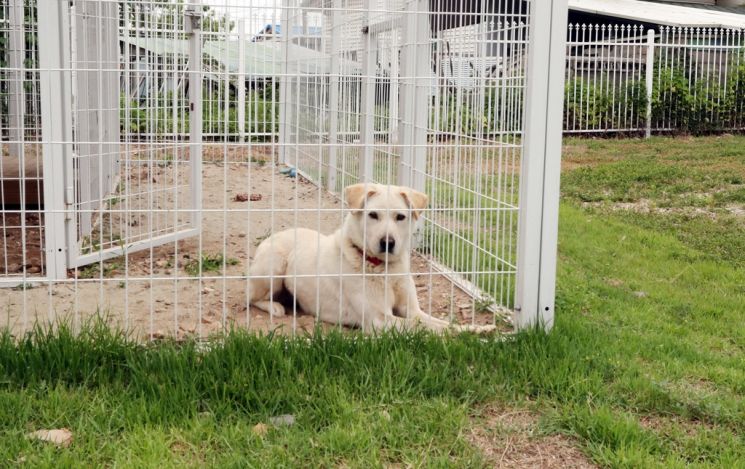 On the afternoon of June 23 last year, our Pungsan dog 'Haetnim' is sitting inside the Peace and Security Training Center on Yeonpyeong Island, Ongjin-gun, Incheon./Photo by Yonhap News
According to the Hankook Ilbo, most of the dogs sent to zoos spend their time inside exhibition rooms set up within the zoos, and are taken for walks once or twice a day by keepers. Deul, living at Incheon Grand Park, is housed in a 50㎡ indoor enclosure in a private area rather than an open exhibition space, sharing the space with another dog, and the park stated that a keeper takes the dog for a walk once in the morning. However, when the keeper is off duty or absent, the dogs are inevitably confined in cages without a guardian.
In the case of Haetnim, it was reported in June last year that due to the COVID-19 pandemic, the Yeonpyeong Peace and Security Training Center was closed for an extended period, and with deteriorating inter-Korean relations reducing the number of visitors, Haetnim has been spending lonely times confined in a cage. Uchi Zoo, where Byeol resides, was also criticized in 2007 for selling six dogs it was raising for only 50,000 won each due to a lack of enclosures.
The Blue House's distribution of Pungsan dogs to local governments was also criticized in political circles at the time. The Green Party stated in a September 2019 commentary, "Even considering that these dogs symbolize the hope for inter-Korean peace, sending newborn puppies to zoos, given the dogs' strong nature to bond and form private relationships with humans, is anti-life and against animal rights," and criticized the poor breeding environment, lack of expertise, and negligence that led to the unfortunate deaths of several animals.
Some have pointed out that President Moon's recent emphasis on pet welfare and regulatory systems, including mentioning the ban on dog meat consumption, contradicts this decision. One netizen commented, "If you can't take responsibility, you should have neutered them. Is there any guarantee that local governments will take full responsibility after distribution?" and added, "Policies on abandoned dogs and cats are urgent, but you should first take responsibility for the puppies you have."
In response to concerns about potential negligence in management after distribution to local governments, the Blue House stated on the 3rd, "Taking all that into account, once the destinations are decided, we will request thorough management," and confirmed that animal registration for the seven Pungsan dogs has been completed.
Experts have pointed out that distributing dogs to local governments or zoos is inappropriate. Lee Won-bok, head of the Korea Animal Protection Alliance, explained, "The difference between advanced and developing countries lies in adhering to proper conditions when raising pets, and neutering is a basic responsibility of owners," adding, "Last year alone, over 130,000 animals were abandoned or lost, and more than one-third were euthanized due to not being adopted."
He continued, "Sending dogs to local governments as exhibition or promotional animals is not responsible behavior. The dogs have no special owners and are placed in emotionally unstable situations where they cannot properly bond with people," emphasizing, "Recently, a revision to the Civil Act was passed stating that animals are not objects. I hope the diplomatic practice of exchanging animals as gifts will also change." He added, "The Blue House sets an example for many people depending on its actions. Pet distribution should be approached carefully and responsibly."
© The Asia Business Daily(www.asiae.co.kr). All rights reserved.
![Clutching a Stolen Dior Bag, Saying "I Hate Being Poor but Real"... The Grotesque Con of a "Human Knockoff" [Slate]](https://cwcontent.asiae.co.kr/asiaresize/183/2026021902243444107_1771435474.jpg)
















