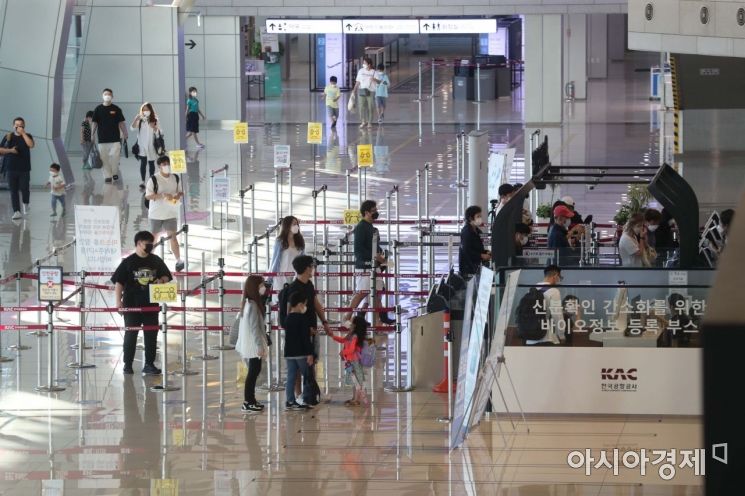
 Ahead of the Chuseok holiday, the spread of COVID-19 is accelerating mainly in Seoul and the metropolitan area. On the 16th, the domestic terminal of Gimpo Airport in Gangseo-gu, Seoul, was crowded with passengers. Photo by Mun Ho-nam munonam@
[Asia Economy Reporter Kang Nahum] Last year, South Korea's Gimpo-Jeju route recorded the highest number of passengers among all domestic routes worldwide, with over 10.22 million passengers.
The Korea Air Transport Association announced on the 29th that this was revealed after analyzing the International Air Transport Association (IATA)'s "2021 World Air Transport Statistics" report.
According to the report, the total number of airline passengers worldwide last year was 1.5 billion, with RPK (Revenue Passenger Kilometers ? the number of paying passengers multiplied by the flight distance) decreasing by 65.9% compared to the previous year.
Among major airlines, Emirates ranked first in RPK, followed by Ryanair and Qatar Airways. Korean Air ranked 19th.
In terms of domestic passenger transport performance, the Gimpo-Jeju route led with 10,223,667 passengers, the highest worldwide. The second was the Vietnam Hanoi-Ho Chi Minh route (5.9 million passengers), and third was the China Shanghai-Shenzhen route (3.6 million passengers).
For airport passenger handling performance, China’s Guangzhou International Airport ranked first, followed by the United States’ Atlanta International Airport and China’s Qingdao International Airport.
Last year, global CTK (Cargo Ton Kilometers ? the weight of paid cargo multiplied by the flight distance) decreased by 9.1% compared to 2019. Korean Air and Asiana Airlines ranked 5th and 19th respectively in international cargo transport volume. The top three were Qatar Airways, FedEx, and Emirates.
Until May last year, global CTK showed a downward trend due to increased grounded aircraft and reduced cargo supply, but as countries eased restrictions thereafter, air cargo demand quickly recovered.
Additionally, due to a shortage in cargo supply, freight rates rose by 40% compared to the previous year, resulting in air cargo revenue increasing by 27% to a record high of $128.2 billion (approximately 150 trillion KRW).
In terms of airport cargo handling performance, the United States’ Memphis International Airport ranked first, followed by Hong Kong International Airport and Shanghai International Airport. Incheon International Airport handled a total of 2,822,370 tons, ranking 6th.
© The Asia Business Daily(www.asiae.co.kr). All rights reserved.
![Clutching a Stolen Dior Bag, Saying "I Hate Being Poor but Real"... The Grotesque Con of a "Human Knockoff" [Slate]](https://cwcontent.asiae.co.kr/asiaresize/183/2026021902243444107_1771435474.jpg)















