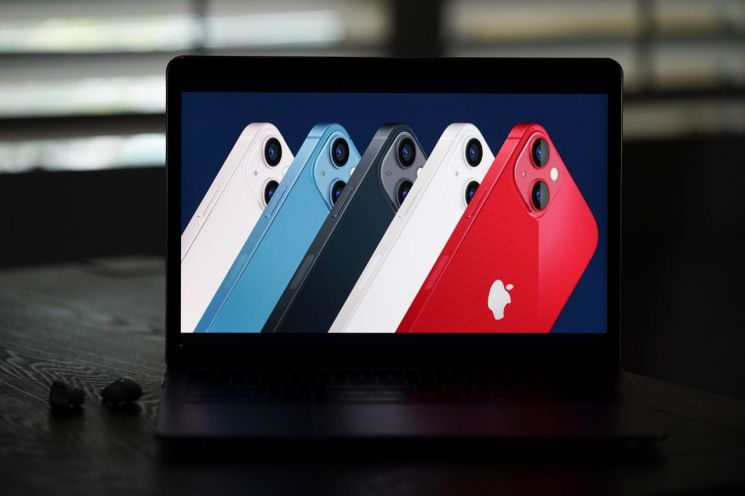
[Asia Economy Reporter Eunmo Koo] The pre-order for Apple’s new smartphone series, the iPhone 13, is just one day away. With Apple’s loyal customer base, expectations are rising not only in the mobile telecommunications industry but also in the e-commerce sector. There is also interest in whether Apple can suppress the recent craze for Samsung Electronics’ foldable phones and even fill the void left by the 'Galaxy Note'.
◆ iPhone 13 Pre-orders Start in Korea from the 1st... Competition to Attract Customers Among Carriers, MVNOs, and E-commerce
According to industry sources on the 30th, Apple will begin pre-orders for the iPhone 13 series in Korea on the 1st of next month, with the official launch on the 8th. The three major mobile carriers and e-commerce companies like Coupang will conduct pre-orders online.
The iPhone 13 series, unveiled on the 15th, consists of four models just like its predecessor: the iPhone 13 (6.1 inches), iPhone 13 mini (5.4 inches), iPhone 13 Pro (6.1 inches), and iPhone 13 Pro Max (6.7 inches). While the iPhone 13 series does not show significant external changes compared to the previous generation, it features the ‘A15 Bionic’ chip, which improves CPU processing performance by up to 50%, enhancing overall performance. The domestic retail prices start from 950,000 KRW for the iPhone 13 mini, 1,090,000 KRW for the iPhone 13, 1,350,000 KRW for the iPhone 13 Pro, and 1,490,000 KRW for the iPhone 13 Pro Max, depending on storage capacity.
The industry is optimistic about the success of Apple’s new product, given its high customer loyalty. Positive evaluations of the iPhone 13 are emerging due to improvements in the efficiency of the A15 Bionic processor and camera performance, along with the continued growth in 5G adoption rates. Since the iPhone 13 is Apple’s second 5G-supported model, new demand is expected from customers considering an upgrade. Korea Investment & Securities also forecasts that the iPhone 13 series will ship 77 million units this year, a 21.9% increase over the iPhone 12 series sales.
The mobile telecommunications industry is quickly moving to attract customers with various benefits. SK Telecom offers delivery of devices on the launch day (the 8th) to all pre-order customers through its official online mall ‘T Direct Shop’, with early morning delivery on launch day for the first 10,000 customers. KT provides a ‘Midnight Delivery Service’ starting at 0:00 on launch day for the first 1,000 pre-order customers in Seoul. LG Uplus has prepared prizes such as the 3rd generation iPad Pro (3 units), 6th generation Apple Watch (13 units), and iPad Pro (13 units) through a lottery for those who sign up for pre-order notifications. Hong-sik Kim, a researcher at Hana Financial Investment, commented, “Although marketing costs among telecom operators may increase due to the early October launch of the iPhone 13 in Korea, expectations for revenue growth are even higher.”
Due to the iPhone’s characteristic of high preference for unlocked purchases, the MVNO industry and e-commerce companies like Coupang are also excited. Since the official subsidy for the iPhone is set low, there is relatively less incentive to purchase through carriers. Moreover, due to the cost burden of 5G plans and quality concerns, more users are preferring MVNOs or LTE plans.
An industry insider said, “Since the launch of the iPhone 12 last year, the number of rational young consumers choosing a combination of MVNO SIM cards and unlocked devices has gradually increased. We expect the popularity of MVNOs to continue, especially among young subscribers, after the iPhone 13 launch.” E-commerce companies are promoting card discounts and membership benefits, while MVNO providers are preparing prize events targeting iPhone 13 unlocked buyers.
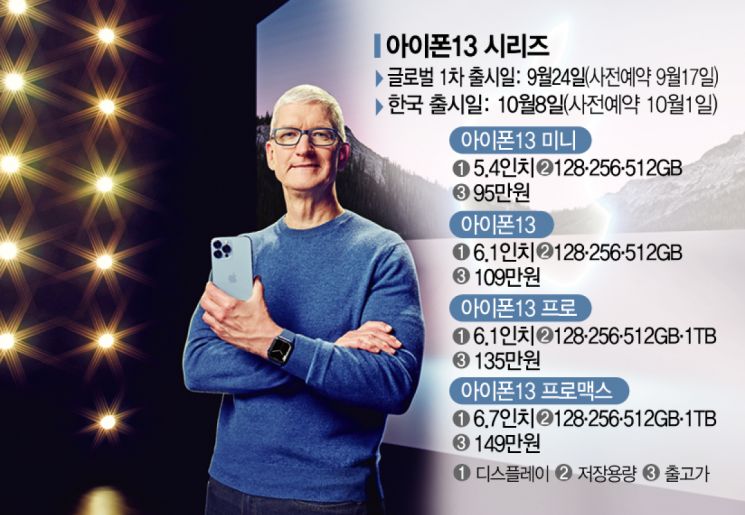
◆ Can Apple Exploit Samsung’s Foldable Phone Shipment Delays?
There is attention on whether the iPhone 13 series can capitalize on the shipment delays of Samsung Electronics’ foldable smartphones. Samsung’s 3rd generation foldable phones, the Galaxy Z Fold3 and Galaxy Z Flip3, released on the 27th of last month, have been on the market for over a month but are still experiencing supply delays due to shortages.
The ongoing shipment and activation delays of Samsung’s foldable phones are due to demand forecasting failures and a shortage of system semiconductors. There are even rumors that Samsung canceled the online unpacking event for the mid-range ‘Galaxy S21 Fan Edition (FE)’, originally planned for mid-October, to focus on foldable phone production amid difficulties in procuring application processor (AP) chips.
In terms of volume, how much the iPhone 13 can fill the gap left by the ‘Galaxy Note’ series, which was a ‘cash cow’ with cumulative sales of around 10 million units per series, is also considered a factor that will influence the iPhone 13’s success. Apple is also accelerating the expansion of its distribution channels, targeting LG Electronics’ domestic market share of around 10%, following LG’s recent exit from the mobile business.
However, there are also views that the initial supply situation of the iPhone 13 series will not be easy, as Samsung anxiously watches the launch of competing products. Apple is also affected by semiconductor chip supply issues. In the U.S., where pre-orders started earlier as a first-wave launch country, stock shortages have already been confirmed. JP Morgan stated in a report, “Customers who pre-ordered online will have to wait four weeks for the iPhone 13 Pro and Pro Max, and two weeks for the iPhone 13 to receive their products.”
© The Asia Business Daily(www.asiae.co.kr). All rights reserved.
![Clutching a Stolen Dior Bag, Saying "I Hate Being Poor but Real"... The Grotesque Con of a "Human Knockoff" [Slate]](https://cwcontent.asiae.co.kr/asiaresize/183/2026021902243444107_1771435474.jpg)
















