Impact of Priority Vaccination on Repeat Test Takers: Absence Rate Doubled from Last Year
10,000 More Repeat Test Takers Applying Due to New Pharmacy Schools
Top Math Score Increased by 1 Point... Probability and Statistics Participation Down 14.3%
Increase in Calculus Participation in Humanities
Korean Score Variance Low, English Top Grade Rate at 4.8%
 On the 1st, repeat test takers are taking the mock exam at Jongno Academy Gangbuk Main Branch in Mapo-gu, Seoul, where the 2022 College Scholastic Ability Test (CSAT) September mock evaluation is being conducted. Photo by Jang Jin-hyeong aymsdream@
[Asia Economy Reporter Han Jinju] The absentee rate for the September mock exam of the 2022 College Scholastic Ability Test (CSAT) doubled compared to the previous year due to phantom applicants registering for vaccination purposes.
The Korea Institute for Curriculum and Evaluation announced on the 29th that it will notify examinees of the scoring results for the '2022 CSAT September Mock Exam' conducted on the 1st. A total of 401,705 students took the mock exam, of which 324,738 were current students and 76,967 were graduates or repeat test-takers.
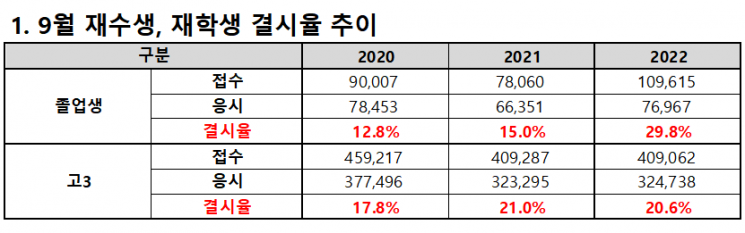 Absence Rates for Repeat Test Takers and Current Students in the September Mock Exam Over the Past 3 Years (Source: Jongro Academy)
Notably, the absentee rate among graduates and repeat test-takers was 29.8%, about twice last year's 15.0%. This year, priority vaccination benefits were given to repeat test-takers, resulting in 31,555 more applicants than the previous year, but the number of absentees reached 16,206, confirming concerns about phantom applicants aiming for vaccination.
Lim Seong-ho, CEO of Jongro Academy, explained, "The absentee rate increased by 14.8 percentage points compared to last year, but the absentee rate among third-year high school students was similar to last year. Even if the absentee rate increases, it does not affect score calculation, as actual scoring is based only on those who took the exam."
The number of graduate examinees in the September mock exam increased by 10,616 compared to last year. The total number of mock exam examinees increased by 12,059 from last year. It is expected that the number of repeat test-takers will increase in this year's CSAT due to the introduction of the undergraduate program in pharmacy and the expansion of regular admissions.
Lee Mangi, director of Uway Education Evaluation Research Institute, stated, "Since the proportion of graduates taking the actual CSAT is expected to increase even more compared to the mock exam, the influence of graduates in this year's CSAT is likely to grow."
Decrease in 'Probability and Statistics' Participation Rate... Humanities Students Also Taking Calculus
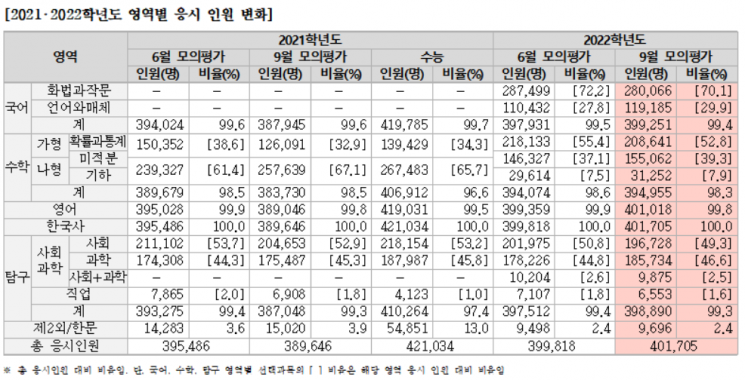
Regarding the participation rates by elective subjects, in Korean, the proportion of students taking Language and Media (29.9%) increased compared to the June mock exam (27.8%), while those taking Speech and Composition accounted for 70.1%. In Mathematics, the participation rate for Probability and Statistics (52.8%) decreased compared to the June mock exam (55.4%), while the participation rate for Calculus (39.3%) increased by 2.2 percentage points compared to June (37.1%).
Compared to last year's September mock exam for Mathematics Type B, the proportion of students choosing Probability and Statistics dropped by 14.3 percentage points this year. In last year's September mock exam, the proportion of social studies elective takers among Mathematics Type A students was 0.6%, while in this year's June mock exam, 4.8% of Calculus takers chose social studies, increasing to 5.4% in the September mock exam. This is analyzed as many humanities students taking Calculus, which is more advantageous for scoring.
Director Lee said, "This trend is expected to continue in the CSAT, and it will be relatively difficult for those choosing Probability and Statistics to achieve top grades in the mathematics section."
The participation rate for science inquiry subjects increased by 1.3 percentage points to 46.6% compared to last year's September mock exam (45.3%), while social studies inquiry decreased by 3.6 percentage points. This year, many new departments such as advanced science and pharmacy have been established in the natural sciences, and the perception that these fields offer better employment prospects has led to a yearly increase in natural science students.
Difficult Mathematics, Increase in Highest Standard Scores... Low Discriminatory Power in Korean
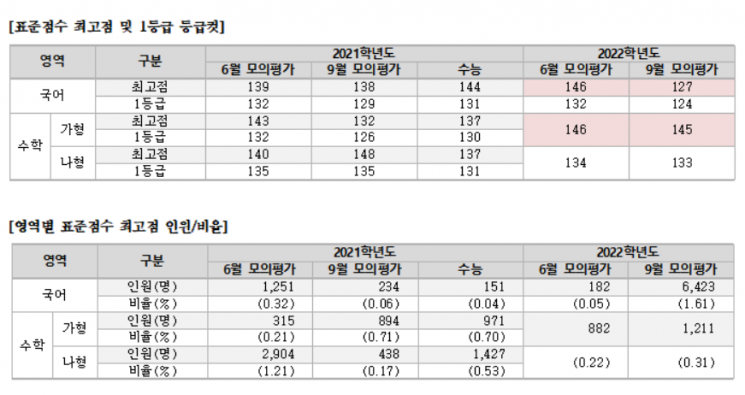 Standard Score Highest Points and Grade Cutoffs for Korean and Mathematics Areas in the 2021-2022 Academic Year (Source: Uway)
In the September mock exam, the highest standard score in Korean dropped significantly, while Mathematics was as difficult as in the June mock exam. The highest standard score in Korean was 127 points, 19 points lower than the June mock exam (146 points) and 17 points lower than last year's CSAT (144 points). The number of students achieving the highest standard score in Korean was 6,423 (1.61%), an increase of 6,272 compared to 151 students in the 2021 CSAT. There was no discriminatory power among top scorers in the Korean section.
The number of students achieving the highest standard score in Mathematics was 1,211, lower than last year's CSAT Mathematics Type A (971) and Type B (1,427). The highest standard score in Mathematics for September was 145 points, similar to June's Calculus (146 points) and Probability and Statistics (142 points).
In the English section, the top grade rate was 4.87%, lower than June's 5.51%, and less than half of last year's CSAT rate of 12.66%. English was difficult in both mock exams administered by the evaluation institute, partly due to the removal of direct EBS-linked questions.
For inquiry subjects, in social studies, East Asian History had the highest standard score of 71 points, while Ethics and Thought had the lowest at 65 points. In science, Biology 1 (71 points) and Chemistry 2 (67 points) were the highest and lowest scoring subjects, respectively.
Director Lee said, "This year's CSAT is expected to be more difficult than last year's but easier than the June and September mock exams. Considering that humanities students choosing Probability and Statistics face difficulties meeting the minimum CSAT standards, it is predictable that the top grade rate will be around 7.43%, similar to the 2020 CSAT."
CEO Lim added, "This is the second year of COVID-19 and the first year of the integrated CSAT changes, along with increased difficulty due to adjustments in EBS linkage rates (especially in English), making it the most challenging CSAT. Students should focus on balanced study across subjects, whether or not they are competitive in those subjects, as the integrated exam's difficulty between subjects is unpredictable."
© The Asia Business Daily(www.asiae.co.kr). All rights reserved.
![Clutching a Stolen Dior Bag, Saying "I Hate Being Poor but Real"... The Grotesque Con of a "Human Knockoff" [Slate]](https://cwcontent.asiae.co.kr/asiaresize/183/2026021902243444107_1771435474.jpg)

















