China Aerospace Science and Technology Corporation Reveals Plans to Launch Solar Spectrum, Magnetic Field, and Solar Wind Exploration Satellites This Year
Presumed to Be Part of Space Solar Power Plant Project
[Asia Economy Beijing=Special Correspondent Jo Young-shin] China will launch a solar exploration satellite this year.
According to Chinese media including the official Xinhua News Agency and People's Daily on the 29th, China Aerospace Science and Technology Corporation will launch a solar exploration scientific satellite this year to conduct investigations of the sun.
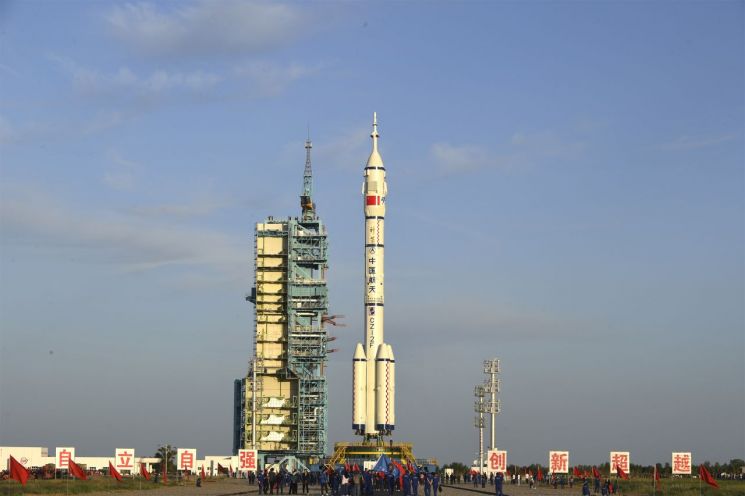
China Aerospace Science and Technology Corporation revealed the solar exploration satellite launch plan at the '13th Zhuhai Airshow (China International Aviation and Aerospace Exhibition)' which opened the day before. Chinese media emphasized that this is the first time China is launching a satellite to investigate the sun, marking China's entry into the era of solar exploration.
People's Daily explained that the sun has a profound impact on life on Earth, and while investigations have been conducted from the ground so far, from now on, changes in the sun will be observed through solar exploration satellites.
Since 2018, China has been carrying out a space solar power station project, and the solar exploration satellite appears to be part of this project. The space solar power station project aims to accumulate solar energy in space and transmit it to the ground. When accumulating solar energy on the ground, factors such as weather limit the amount of energy that can be stored, but there are no such constraints in space.
In fact, a 1㎡ solar panel is known to have an efficiency of 0.4 kW on Earth, 7 to 8 kW in the stratosphere, and 10 to 14 kW in Earth orbit 36,000 km away from the surface. The space solar power station is still reported to be at the idea stage.
People's Daily explained that once the solar exploration satellite is launched, investigations into the solar spectrum, magnetic field, and solar wind can be conducted in greater detail. It further predicted that solar observation and research in space will not only have significant scientific value but also a wide range of future applications.
People's Daily reported that some countries such as the United States and Europe began space solar exploration after the 1970s. It mentioned the solar probe Ulysses launched in 1990, the solar observation satellite SOHO, and the Parker Solar Probe.
Wang Wei, Deputy Director of China Aerospace Science and Technology Corporation, said, "China's first solar satellite will analyze the sun's spectral data in space and investigate the dynamic and physical mechanisms of the sun, such as temperature and velocity during solar eruptions," adding, "China's international status in the field of solar physics will further rise."
© The Asia Business Daily(www.asiae.co.kr). All rights reserved.
![Clutching a Stolen Dior Bag, Saying "I Hate Being Poor but Real"... The Grotesque Con of a "Human Knockoff" [Slate]](https://cwcontent.asiae.co.kr/asiaresize/183/2026021902243444107_1771435474.jpg)















