Korea Consumer Agency, Survey Results on Usage Practices in Seoul Area
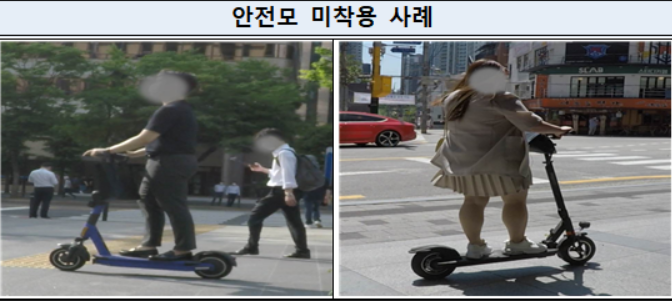
[Asia Economy Reporter Lim Chun-han] Although wearing helmets while using electric kickboards has been legally mandated since May of this year, a significant number of users were found not wearing them during rides.
On the 28th, the Korea Consumer Agency announced that after surveying 87 electric kickboard users (64 shared kickboard users and 23 personal kickboard users) around 10 subway stations in Seoul for about a month starting early May, only 16.1% (14 people) wore helmets. Notably, among shared kickboard users, only 2 wore helmets.
Among all surveyed users, 69% rode on sidewalks where electric kickboard riding is prohibited, and 2.3% violated traffic rules such as crossing the center line of the road. Of the 37 who used crosswalks, only 5.4% dismounted from the electric kickboard and crossed on foot as per regulations. There were also cases of two or more people riding simultaneously or using mobile phones while driving.
The Consumer Agency warned, "According to consumer injury monitoring system data, from January 2018 to last June, out of 1,458 cases of physical injuries caused by electric kickboard accidents, head and face injuries accounted for 51.9%, the highest proportion," adding, "Not wearing protective gear while using electric kickboards can result in serious injuries."
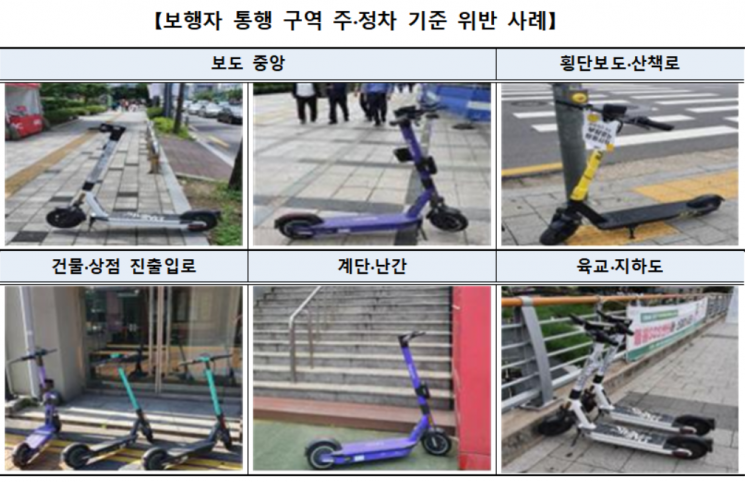
Analyzing 673 cases of obstruction to pedestrian passage and facility use caused by electric kickboard parking and stopping at 40 locations near major subway stations in Seoul, the Consumer Agency found that 57% of cases involved blocking the passage of pedestrians including vulnerable groups by parking on tactile paving or in child protection zones. Cases obstructing traffic flow by parking on roads or public transportation platforms accounted for 31%, and those obstructing major safety facilities such as fire equipment accounted for 12%.
Meanwhile, compensation varied among electric kickboard sharing service providers even for the same type of accident. Although all 12 sharing service providers surveyed by the Consumer Agency had insurance, coverage conditions differed, with accidents caused by user inexperience often not covered by insurance. Some devices operated by these companies had kickstands protruding from the side of the footboard, raising concerns about physical injury, and some had damaged lighting or reflective devices.
The Consumer Agency stated, "Currently, electric kickboard sharing services are classified as free businesses, making it difficult to institutionally manage service operation methods such as strengthening safety management for users," and raised the need to revise related standards and laws.
© The Asia Business Daily(www.asiae.co.kr). All rights reserved.
![Clutching a Stolen Dior Bag, Saying "I Hate Being Poor but Real"... The Grotesque Con of a "Human Knockoff" [Slate]](https://cwcontent.asiae.co.kr/asiaresize/183/2026021902243444107_1771435474.jpg)
















