Design Change Construction... KEPCO Leads with 152 Cases, KHNP Tops with 2.5 Trillion Won
Frequent Design Changes and Increases After Low-Bid Contract and Construction Start... Board Approval Not Required Post-Construction Start
KEPCO Debt Reaches 140 Trillion Won, Wasting Taxpayer Money... "Thorough Preparation Needed from Project Planning Stage"
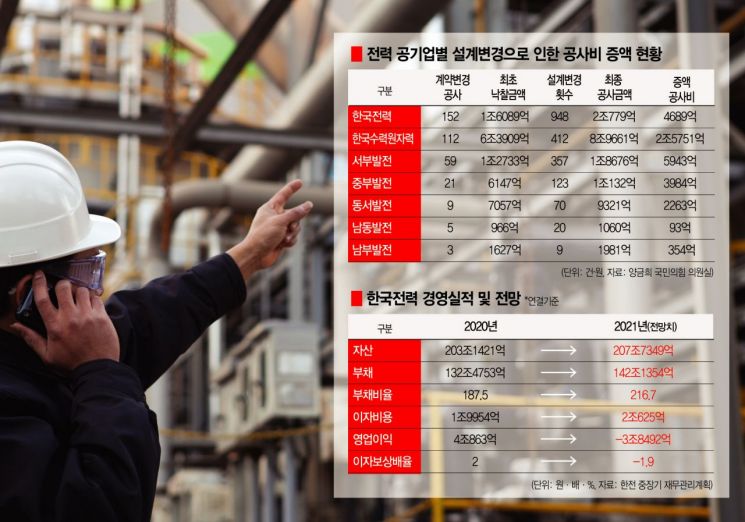
[Sejong=Asia Economy Reporter Kwon Haeyoung] Criticism is being raised that "inflating construction costs" has become a common practice among electric power public enterprises, including Korea Electric Power Corporation (KEPCO) and Korea Hydro & Nuclear Power (KHNP), which have spent more than 4 trillion won in additional construction costs over the past decade due to frequent design changes after groundbreaking. In some cases, construction costs were increased by hundreds of billions of won beyond the original plan for building office buildings or employee housing, in addition to power plants and transmission and distribution network construction and maintenance. For construction projects above a certain scale, board approval is required before groundbreaking, but it has been pointed out that design changes after groundbreaking can be approved internally without board resolution if certain conditions are met. With the financial situation of electric power public enterprises deteriorating due to the nuclear phase-out and accelerated energy transition policies, there are concerns that this will ultimately increase the burden on the public through electricity rate hikes, making institutional improvements necessary to eradicate such practices.
◆KEPCO leads with 152 design change projects= KHNP increased office building construction costs by 18.5 billion won= According to data submitted on the 28th by Yang Geumhee, a member of the People Power Party, from KEPCO, KHNP, and five power generation companies, KEPCO had the highest number of projects with design changes at 152 cases (948 design change occurrences). Following were KHNP (112 cases, 412 occurrences) and Korea Western Power (59 cases, 357 occurrences). The company that increased construction costs the most was KHNP, which spent an additional 2.5751 trillion won from 2010 to this year. Korea Western Power added 594.3 billion won, and KEPCO added 468.9 billion won.
Looking at specific projects, KEPCO's "154KV Yanggu-Hwacheon Hydropower Transmission Line Construction Project," contracted in 2015, originally had a contract amount of 21.5 billion won, but after seven design changes by 2019, the final construction cost rose to 42 billion won. This is an increase of 20.5 billion won compared to the original plan, nearly doubling the construction cost. In the case of Korea Western Power, the Taean Thermal Power Units 9 and 10 civil engineering project was awarded at 191.7 billion won in 2012, but after 72 design changes until this year, the expenditure increased by 131.4 billion won to a total of 323.1 billion won.
There were also cases where construction costs were increased by hundreds of billions of won for office building or employee housing construction. KHNP signed a construction contract for its headquarters building in 2013 for 92.6 billion won, but after five design changes by 2016, the total construction cost reached 111.1 billion won, an increase of 18.4 billion won from the original plan. For the Shin-Wolseong Units 1 and 3 employee housing construction, after the contract in 2011, five design changes were made by 2015, increasing the construction cost from 55.1 billion won to 91.4 billion won. The Gori Headquarters golf practice range construction was contracted at 4 billion won in 2016, but after three design changes, an additional 700 million won was spent.
◆Design changes do not require board approval= Electric power public enterprises explain that unexpected defects or the need for additional work often arise during power plant construction, reinforcement, and maintenance, making it inevitable to increase construction costs. However, it is also pointed out that the practice of frequently increasing construction costs through design changes has become entrenched due to structural issues, such as many cases where board approval is not specifically required for design changes.
For example, in KHNP, for projects other than power plant establishment, board approval is required if the construction cost exceeds 20 billion won, but if the increase in construction cost due to design changes is less than 20% of the initial project cost, this procedure can be bypassed. Since the burden of increasing construction costs is not significant, this can create an incentive to easily increase construction expenditures. In the political sphere, there are opinions that institutional improvements should be considered to strengthen internal approval and board resolution procedures related to construction cost increases due to design changes. Through this, electric power public enterprises should establish a more thorough pre-review system from the project planning stage and be guided to reduce construction costs.
Representative Yang Geumhee said, "The debts of KEPCO and its subsidiaries, which will reach 140 trillion won this year, will inevitably return as a burden on the public through electricity rate hikes, but electric power public enterprises are wasting taxpayers' money through frequent design changes after construction as if it were a routine practice." She added, "Since durability and safety of facilities are important, electric power public enterprises need to prepare thoroughly from the project planning stage to enhance safety, and institutional improvements to prevent unnecessary tax expenditures should also be considered."
© The Asia Business Daily(www.asiae.co.kr). All rights reserved.
![Clutching a Stolen Dior Bag, Saying "I Hate Being Poor but Real"... The Grotesque Con of a "Human Knockoff" [Slate]](https://cwcontent.asiae.co.kr/asiaresize/183/2026021902243444107_1771435474.jpg)















