Strengthening Mountain Area Regulations Amid Concerns Over Forest Destruction
New Forest Facility Installations Decrease Compared to Farmland
Rapid Increase in Solar Installations on High Land-Value Farmland...Inevitable Rise in Power Generation Costs
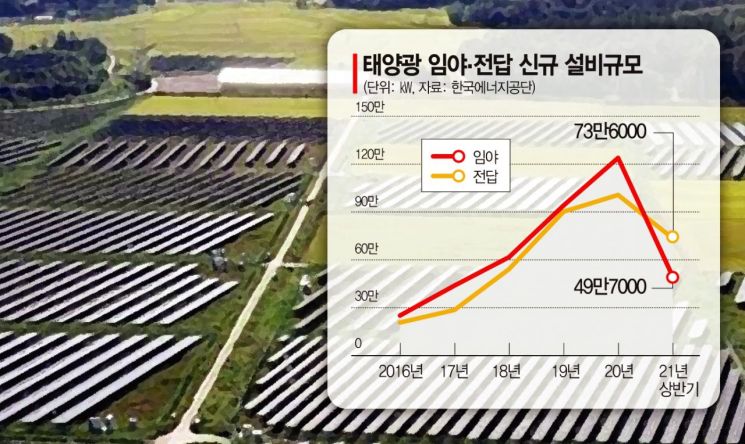
[Sejong=Asia Economy Reporter Joo Sang-don] In the first half of this year, newly installed solar power facilities on rice paddies and farmland surpassed those on forest land. In just the first half, farmland equivalent to about 1,000 soccer fields was covered with solar facilities. This is largely due to strengthened regulations on solar power site locations in mountain areas amid concerns over forest destruction. Along with worries about the reduction of arable land, the installation of solar power on farmland, which has higher land value than mountain areas, has inevitably led to an increase in power generation costs.
According to the Korea Energy Agency on the 28th, the newly installed solar power capacity on rice paddies and farmland in the first half of this year reached 736,000 kW. The solar industry estimates that installing a 100 kW solar facility requires 300 pyeong (991.7㎡) of land. Considering this, solar power facilities were installed on approximately 7,286,400㎡ of arable land in just the first half of this year. This area is 2.5 times the size of Yeouido (area 2.9 million㎡) and equivalent to 1,020 soccer fields covered by solar facilities. A representative from the Korea Rural Economic Institute stated, "Only 20-30% of all solar installations by farmers are on their own land, with most others installed by businesses leasing land long-term."
Solar facilities on arable land such as rice paddies are rapidly increasing. The capacity grew from 207,000 kW in 2016 to 542,000 kW in 2018, and reached 1,007,000 kW last year. If the upward trend continues in the first half of this year, the total installed capacity for this year will exceed 1,400,000 kW.
On the other hand, the scale of solar power installations on forest land (mountain areas), which had been rapidly increasing, is now decreasing. In the first half of this year alone, 497,000 kW of new capacity was installed, which is smaller than the capacity installed on farmland.
The rapid encroachment of solar facilities on farmland is rooted in strengthened site regulations for mountain areas. Since 2018, the government has changed mountain solar permits from 'exclusive use' to 'temporary use' and tightened the slope permit criteria from 25 degrees to 15 degrees. As a result, the area of mountain land with solar installations decreased significantly from 24.43 million㎡ in 2018 to 2.29 million㎡ last year.
However, considering that farmland such as rice paddies has higher land value than mountain areas, the expansion of solar power facilities on arable land inevitably leads to increased electricity costs. A representative from the Korea Photovoltaic Industry Association pointed out, "With stricter slope criteria and the continuous decline of Renewable Energy Certificate (REC) weighting for mountain solar, it has become difficult to find profitable mountain sites. Since the land price and rent for farmland are higher than for forest land, the cost of electricity production through solar power inevitably becomes more expensive."
The installation of solar facilities on rice paddies has also raised concerns about a decline in food self-sufficiency due to reduced farmland. According to the Korea Rural Economic Institute, the total cultivated area decreased from 171.5 million㎡ in 2010 to 158.1 million㎡ in 2019, an average annual decline of 0.9%. The grain self-sufficiency rate dropped from 23.8% in 2015 to 21.0% in 2019. Achieving the government's target of 27.3% by 2022 also appears difficult. An institute official said, "Because solar operators pay higher rent than tenant farmers, tenant farmers are unable to lease farmland, which hinders farming activities," adding, "To promote national-level rural solar policies in response to the climate crisis, it is necessary to comprehensively consider the public value of rural areas and food security."
© The Asia Business Daily(www.asiae.co.kr). All rights reserved.
![Clutching a Stolen Dior Bag, Saying "I Hate Being Poor but Real"... The Grotesque Con of a "Human Knockoff" [Slate]](https://cwcontent.asiae.co.kr/asiaresize/183/2026021902243444107_1771435474.jpg)















