COVID-19 Vaccination Q4 Implementation Plan Released
mRNA Vaccine Interval Extended to '6 Weeks'
Gradual Normalization to Pfizer 3 Weeks, Moderna 4 Weeks
Vaccination Now Available for Children and Adolescents Aged 12-17 and Pregnant Women
Booster Shots Begin for Elderly, Immunocompromised, and Healthcare Workers
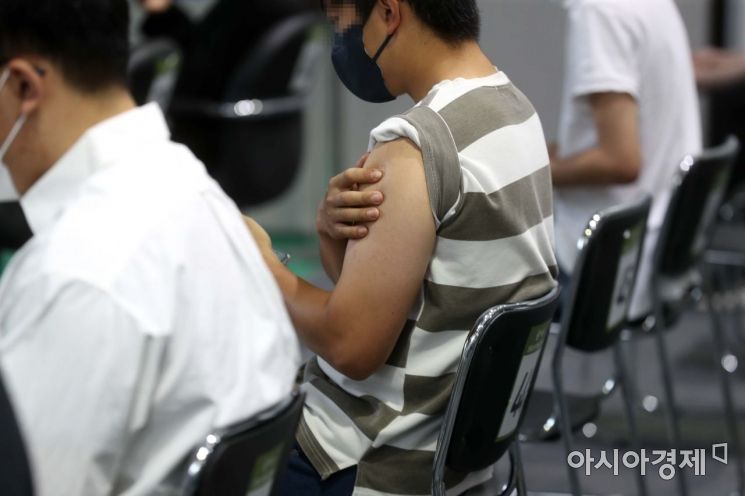 On the 27th, as the spread of COVID-19 continues, citizens who received the vaccine are waiting in the adverse reaction monitoring area at the vaccination center set up at Bukahyeon Culture and Sports Center in Seodaemun-gu, Seoul. Photo by Moohonam
[Asia Economy Reporter Lee Chun-hee] To further increase the COVID-19 vaccination completion rate, which is still in the 40% range, the vaccination interval will be shortened, the target groups expanded, and additional vaccinations to boost immunity for those with weakened immunity and high-risk groups will be implemented in the fourth quarter.
Jung Eun-kyung, head of the COVID-19 Vaccination Response Promotion Team (Director of the Korea Disease Control and Prevention Agency), announced the "COVID-19 Vaccination Fourth Quarter Implementation Plan" on the 27th during a special briefing by the KDCA, stating, "At the point of completing the first dose for adults aged 18 and over, we have comprehensively evaluated the progress of vaccinations over the past eight months and the current quarantine situation, and through this, we have set future goals and key tasks to be pursued."
mRNA Vaccine Interval Extended to '6 Weeks'... Gradual Normalization
The most impactful change in this vaccination plan affects the normalization of the interval between doses for Pfizer and Moderna messenger RNA (mRNA) vaccines. Jung Eun-kyung stated, "By shortening the mRNA vaccine interval and actively utilizing leftover vaccines to administer the second dose, we aim to increase the vaccination completion rate to prevent severe cases and deaths caused by COVID-19 and respond to the Delta variant surge," outlining this plan.
The approved dosing intervals for each mRNA vaccine are three weeks for Pfizer and four weeks for Moderna. However, since the 16th of last month, due to supply instability of the Moderna vaccine, the interval for the second dose of mRNA vaccines was temporarily extended uniformly to six weeks. Considering that supply has normalized this month, the dosing interval will be reverted.
However, to avoid confusion at medical sites by abruptly shortening already notified schedules, those who have second dose appointments until November 14 will have their intervals gradually shortened. First, 21.6 million people scheduled for vaccination from November 4 to 10 will receive their doses at the currently announced 6-week interval. Then, 90.9 million people scheduled from November 11 to November 7 will receive their second dose with a shortened 5-week interval. Lastly, 16.3 million people scheduled from November 8 to 14 will receive their doses with a 4-week interval, shortened by two weeks. If the adjusted schedule conflicts with clinic closures or exceeds reservation capacity, the appointment will be automatically postponed to the next day.
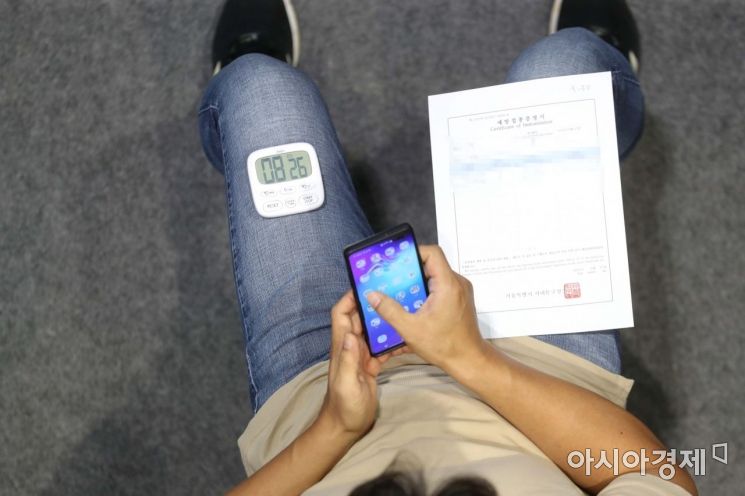 On the 27th, as the spread of COVID-19 continues, citizens who received vaccines are waiting in the adverse reaction monitoring area at the vaccination center set up in Bukahyeon Culture and Sports Center, Seodaemun-gu, Seoul. Photo by Mun Ho-nam munonam@
The adjustment of vaccination intervals will be automatically reflected in the COVID-19 vaccination system on the 28th. Individual notifications will also be sent to the recipients. If vaccination at the adjusted time is difficult, individuals can change their appointments starting from the 1st of next month through the COVID-19 vaccination pre-reservation website. During the sequential adjustment period, changes to the reservation date are only possible within 5 to 6 weeks after the first dose. However, if leftover vaccines are used, vaccination intervals equivalent to Pfizer's 3 weeks or Moderna's 4 weeks are also possible.
From October onward, new vaccinations will follow the original approved intervals of 3 weeks for Pfizer and 4 weeks for Moderna.
2.77 Million Children and Adolescents and 140,000 Pregnant Women to Begin Vaccination Next Month
Additionally, 2.77 million children and adolescents aged 12 to 17 and 136,000 pregnant women, who were previously excluded from vaccination targets, will begin vaccination next month.
At the time the COVID-19 vaccination plan was first established in January, children and adolescents were excluded because no vaccines were authorized for this group. However, since then, the authorized age for the Pfizer vaccine was lowered to 12 years, and as the need for vaccination in this group was raised, the Vaccination Expert Committee recommended vaccination for them on the 25th of last month.
Choi Eun-hwa, chair of the Vaccination Expert Committee, explained, "As adult vaccination rates have increased globally, the proportion of COVID-19 cases among children and adolescents has relatively increased. Therefore, it is time to provide children and adolescents with the opportunity to be protected from COVID-19 through vaccination."
Vaccination for children and adolescents will be conducted in stages considering the influenza vaccination starting next month and academic schedules such as midterm and final exams. Those aged 16 to 17 will make pre-reservations from November 5 to 29, with vaccinations conducted from November 18 to December 13. Those aged 12 to 15 will make pre-reservations two weeks later, from November 18 to December 12, with vaccinations from December 1 to 27.
The vaccine used will be the Pfizer vaccine, which is currently the only vaccine authorized for ages 12 to 17. Moderna has applied to the Ministry of Food and Drug Safety to lower the authorized age to 12, but approval has not yet been granted.
The vaccination interval will be three weeks, and vaccinations will be administered at designated medical institutions based on individual or proxy pre-reservations and with the consent of a guardian (legal representative).
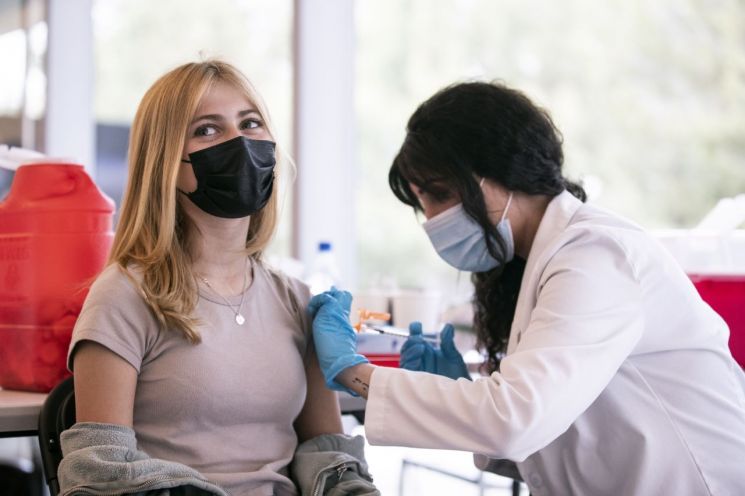 In May, a 12-year-old girl received the Pfizer COVID-19 vaccine in Los Angeles, California, USA.
 [Image source=EPA Yonhap News]
The health authorities recommend voluntary vaccination for children and adolescents by providing information on vaccination opportunities and the benefits and risks of vaccination, but will actively recommend vaccination for high-risk groups such as those with underlying conditions by thoroughly informing them of the necessity.
Also, 136,000 pregnant women will be eligible for vaccination starting next month. Choi Eun-hwa stated, "Pregnant women are a high-risk group for severe illness and death from COVID-19 infection. International cases report that COVID-19 vaccination is safe for pregnant women, and countries such as the United States, the United Kingdom, and Australia recommend vaccination for pregnant women. Considering the high necessity and benefits of vaccination for pregnant women, we recommend COVID-19 vaccination for them."
Accordingly, health authorities will provide vaccination opportunities and related information to pregnant women to encourage voluntary vaccination decisions, but for those with underlying conditions or in early pregnancy under 12 weeks, a medical examination of the mother and fetus will be conducted before vaccination, and vaccination will be recommended.
Pre-reservations for pregnant women will begin on November 8. When making a reservation, pregnant women must directly enter information such as pregnancy status and expected delivery date so that medical staff can be informed at the time of vaccination. For leftover vaccine vaccinations, medical institutions must be informed to input this information during vaccination.
Vaccinations will start on November 18 at designated medical institutions nationwide using Pfizer or Moderna messenger RNA (mRNA) vaccines.
Booster Shots for Elderly, Immunocompromised, and Medical Staff
Meanwhile, from October, additional COVID-19 vaccinations ("booster shots") will begin for those aged 60 and over, immunocompromised individuals, and workers in hospital-level or higher medical institutions.
Jung Eun-kyung stated, "Since the start of COVID-19 vaccinations in February, as time has passed after the primary vaccination, the effectiveness has decreased recently, and breakthrough infections have occurred, increasing the need for additional vaccinations. Based on the deliberations of the Vaccination Expert Committee and trends of additional vaccinations overseas, we plan to start additional vaccinations for high-risk groups including immunocompromised individuals, the elderly, and healthcare workers," she said.
Booster shots will be prioritized from next month for those aged 60 and over who completed the primary vaccination at least six months ago, hospital-level or higher medical institution workers (including COVID-19 treatment hospitals), and residents and workers in infection-vulnerable facilities. Immunocompromised individuals will be included in the priority group if two months have passed since their primary vaccination, even if six months have not yet elapsed. The vaccine used will be messenger RNA (mRNA) vaccines.
 Last month, a man in Holon, central Israel, received the third dose ('booster shot') of the Pfizer COVID-19 vaccine from public healthcare workers.
 [Image source=AFP Yonhap News]
Pre-reservations for those aged 60 and over, residents and workers in infection-vulnerable facilities, and other high-risk groups will begin on November 5. Vaccinations will start on November 25.
Approximately 60,000 workers at COVID-19 treatment hospitals, 500,000 patients, residents, and workers at nursing hospitals and facilities, and 340,000 workers at hospital-level or higher medical institutions will receive vaccinations through on-site and visiting vaccinations similar to the primary vaccination. After a preliminary survey to assess demand, the necessary vaccine quantities will be delivered. Vaccinations at COVID-19 treatment hospitals will start on November 12, at nursing hospitals and facilities on December 10, and at hospital-level or higher medical institutions on December 15.
Booster shot vaccinations for immunocompromised individuals will begin on November 1 after pre-reservations starting November 18. Eligible individuals include adults aged 18 and over with conditions such as acute leukemia or those undergoing immunosuppressive therapy who have difficulty forming immunity.
The promotion team plans to prepare detailed plans for a second phase of booster shots targeting the general public, including essential social workers, after this initial phase of booster vaccinations.
© The Asia Business Daily(www.asiae.co.kr). All rights reserved.
![Clutching a Stolen Dior Bag, Saying "I Hate Being Poor but Real"... The Grotesque Con of a "Human Knockoff" [Slate]](https://cwcontent.asiae.co.kr/asiaresize/183/2026021902243444107_1771435474.jpg)

















