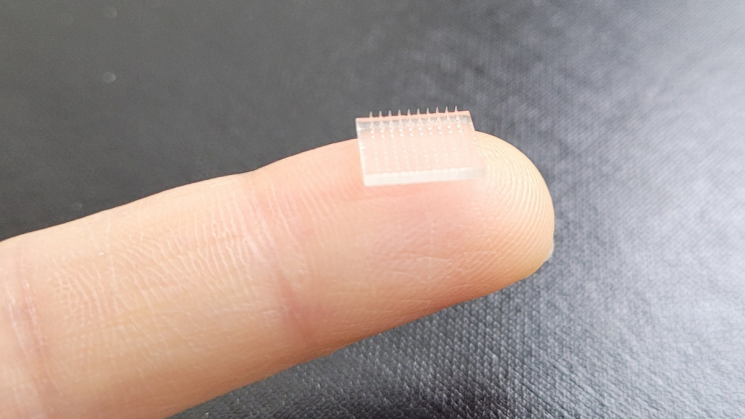
 A joint research team from the University of North Carolina at Chapel Hill and Stanford University announced on the 23rd (local time) that they have developed a "microneedle vaccine" technology in the form of a bandage using 3D printing technology.
 [Photo by University of North Carolina at Chapel Hill website]
[Asia Economy Reporter Sumi Hwang] In the United States, a COVID-19 vaccine patch in the form of a bandage using 3D printing technology has been developed. The patch contains tiny needles, making it easy to apply simply by sticking it onto the skin.
A joint research team from the University of North Carolina at Chapel Hill and Stanford University announced on the 23rd (local time) that they have developed a 'microneedle vaccine' technology in the form of a bandage using 3D printing technology, which provides greater immune effects than conventional vaccine injections.
According to the joint research team, this vaccine patch was made by coating one side of the vaccine chip with a gel or semi-solid form of the drug. When applied to the skin like a bandage, it melts due to body temperature and is absorbed into the skin through the tiny needles.
The research team explained, "Animal studies showed that the immune response caused by the vaccine patch was more than 10 times higher than that of vaccines administered by conventional injections." This means that the same immune effect can be achieved with a smaller amount of the drug than that administered by injection.
This vaccine technology also has the advantage of easy storage and transportation. Since the drug is coated in a solid form, there is no need for low-temperature storage in refrigerators or freezers like conventional vaccines.
Additionally, since medical institutions only need to receive the vaccine chip and apply it to the skin, the research team expects it will help increase vaccination rates.
Currently, the research team has begun commercialization studies to create vaccine chips for RNA vaccines such as Pfizer and Moderna.
Professor Joseph Desimone of the University of North Carolina said, "We hope to establish a foundation to develop vaccines more rapidly worldwide with low doses that cause no pain or anxiety," adding, "Because vaccine chips use 3D printing technology, they can be rapidly mass-produced according to the type and need of vaccines, including COVID-19, influenza, measles, and hepatitis."
© The Asia Business Daily(www.asiae.co.kr). All rights reserved.
![Clutching a Stolen Dior Bag, Saying "I Hate Being Poor but Real"... The Grotesque Con of a "Human Knockoff" [Slate]](https://cwcontent.asiae.co.kr/asiaresize/183/2026021902243444107_1771435474.jpg)















