[Asia Economy Reporter Choi Seok-jin, Legal Affairs Specialist] Amid the recent rejection of the amendment to the Court Organization Act last month in the National Assembly, which sought to lower the qualification for judge appointment to 5 years of legal experience, the Supreme Court has once again called for resolving the shortage of judicial personnel by presenting statistical data comparing the workload of judges in South Korea and foreign countries.
The Supreme Court emphasized that due to the excessive workload of judges, faithful and prompt trials are being hindered, and repeated cases of judges dying from overwork are occurring. It stressed the need for practical measures, including increasing the number of judges and judicial researchers.
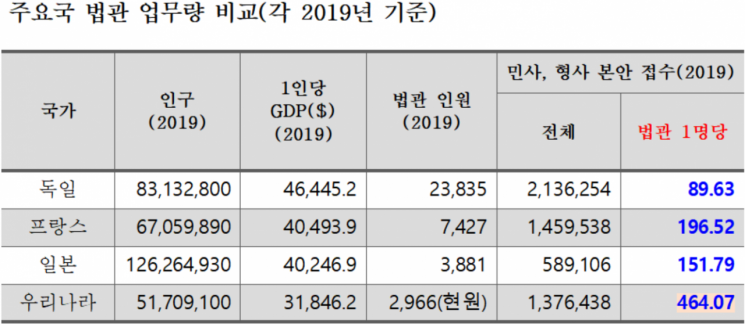
According to the Supreme Court on the 23rd, as of 2019, the number of judges in South Korea was 2,966, which is significantly fewer compared to Germany (23,835), France (7,427), and Japan (3,881).
Considering the population of each country, the number of cases per judge in 2019 was 464.07 in South Korea, approximately 5.17 times that of Germany (89.63 cases) and about 3.05 times that of Japan (151.79 cases).
Based on these figures, to handle cases at the same level as Germany, South Korea would need to increase its judges by 12,390; to reach France's level, an increase of 4,038 judges would be necessary; and to match Japan's level, 6,102 more judges would be required.
The Supreme Court noted that these statistics only account for civil and criminal main cases, and when including other main cases and non-contentious cases, the number of cases domestic judges must handle is much higher.
The Supreme Court also views the series of judge deaths presumed to be related to overwork in 2012, 2013, 2015, 2018, and 2020 as stemming from the excessive workload burden on judges.
According to the materials from the 'Discussion on Analyzing Judges' Workload and Exploring Desirable Judicial Staffing' held in February by the National Judges' Representative Meeting, a survey of judges showed that 89% of respondents agreed on the necessity of increasing the number of judges.
Additionally, 65% responded that their physical health was affected by their duties, 52% reported experiencing burnout due to their work, and 48% said their average weekly working hours exceeded 52 hours.
When asked about the average number of weekly overtime shifts, the most common response was "3 times per week." Regarding which tasks caused the most time burden, 75.8% of respondents answered reviewing case records. Other responses included 15.5% for drafting judgments and only 7.2% for analyzing Supreme Court precedents and researching new legal principles.
Meanwhile, a 2018 survey conducted by the Korean Bar Association found that 94% of responding lawyers agreed on the need to increase the number of judges. When asked why, 69% said it would help resolve the court's excessive workload problem.
Earlier, on July 5, the National Judges' Representative Meeting passed the 'Resolution on Solving the Judge Shortage Problem.'
In the resolution, the representatives pointed out that due to the excessive number of cases per judge, faithful and prompt trials are hindered, and the long-standing situation makes it difficult to realize the trial-centered principle and oral hearing system stipulated by the Civil Procedure Act. They further noted that with the implementation of unified legal profession allowing experienced legal professionals to serve as judges, the average age of judges is rapidly increasing, changing the court's personnel structure, but the support from experienced legal professionals applying to become judges remains insufficient, raising concerns that the shortage of judges will worsen. Lastly, ▲the National Judges' Representative Meeting expressed deep concern over these issues and urged urgent discussions on practical measures, including increasing the number of judges and judicial researchers.
Article 42, Paragraph 2 of the current Court Organization Act sets the legal experience required for appointment as a judge at 10 years or more. However, according to the supplementary provisions of the Court Organization Act amended in July 2011 to realize unified legal profession, and further revised in 2014, those appointed as judges between January 1, 2013, and December 31, 2017, must have at least 3 years of legal experience; between January 1, 2018, and December 31, 2021, at least 5 years; and between January 1, 2022, and December 31, 2025, at least 7 years of legal experience.
The amendment to the Court Organization Act, which was rejected last month in the National Assembly with 111 votes in favor, 72 against, and 46 abstentions, included provisions to shorten the required legal experience for judge appointment to 5 years or more, but required 10 years or more of legal experience for judges of the High Court and Patent Court, which are the final courts of fact-finding.
© The Asia Business Daily(www.asiae.co.kr). All rights reserved.
![Clutching a Stolen Dior Bag, Saying "I Hate Being Poor but Real"... The Grotesque Con of a "Human Knockoff" [Slate]](https://cwcontent.asiae.co.kr/asiaresize/183/2026021902243444107_1771435474.jpg)
















