Wall Street "Moves Accelerating Asset Price Correction as Bubble Deflates"
Financial Sector "Government Support Expected... Impact Seen as Limited"
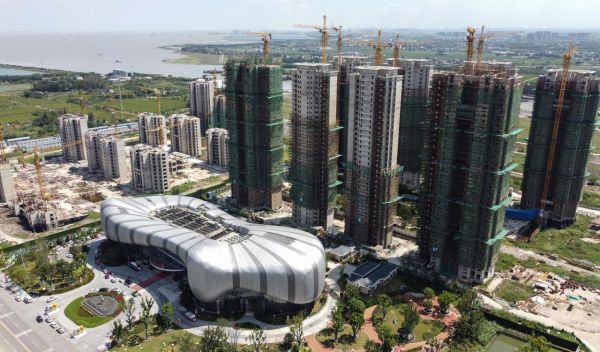 Cultural tourism complex of China Evergrande Group, whose construction has been halted.
 [Image source=Yonhap News]
[Asia Economy Reporter Lee Seon-ae] Global financial markets are shaking amid concerns over the bursting of the China-originated real estate bubble. There are worries that the financial crisis triggered by the 2008 Lehman Brothers bankruptcy might be repeated. However, if the Chinese government intervenes actively, the impact is expected to be limited.
On the 20th (local time), the U.S. stock market plunged. Due to fears of the bankruptcy of Evergrande (恒大, English name Evergrande), a Chinese real estate developer with astronomical debt exceeding $300 billion, the market experienced its largest decline since May 12. Evergrande is the second-largest real estate developer in China. The U.S. S&P index fell as much as 2.9% in the afternoon before closing down 1.7%. The Nasdaq index plunged 2.19%, and the Dow Jones index dropped 1.78%.
The stock market crash in China, including Hong Kong, led the sharp declines in international markets such as the U.S. Evergrande’s stock, the epicenter of this crash, plummeted by 10%, and Hong Kong’s Hang Seng Real Estate Index fell 7%, marking its lowest level since 2016. The overall Hang Seng Index also plunged 3.3%, hitting its lowest point since October last year.
Evergrande’s disclosed debt amounts to 1.97 trillion yuan ($304 billion). Since this spring, voices expressing concern over bankruptcy have emerged, and on the 7th and 8th, international credit rating agencies Moody’s and Fitch downgraded Evergrande’s credit rating by two notches each and warned of a 'possibility of bankruptcy.' Evergrande faces a critical juncture this week with interest repayments exceeding $80 million due. In particular, on the 21st, interest payments on loans borrowed from two banks are due. Financial information company REDD has predicted that Evergrande will suspend interest payments.
China’s real estate market has rapidly started to deflate, with new home prices plunging 20% this year. The Chinese government has heavily relied on infrastructure construction and the real estate sector for economic growth, which led to soaring real estate prices. Excessive real estate price surges threatened the livelihood of ordinary citizens and widened the wealth gap, prompting President Xi Jinping to issue direct warnings. Recently, as asset bubbles intensified and online platform companies grew huge in China, President Xi labeled this as 'unsustainable economic growth,' strengthening regulations on large platform companies while tightening the funding sources for real estate.
Without Chinese government support, it is highly likely that Evergrande will fail to repay the interest due this week. Opinions differ on whether the Chinese government will provide support. The New York Times reported that the Chinese government, signaling its intention to phase out its real estate-dependent economy over the past decades, is not moving toward a bailout for Evergrande.
Domestic securities firms expect proactive intervention from China. Although the scale of corporate bond defaults in China has been hitting record highs annually, it still remains within the 'planned default' category approved by the government. Last year, when defaults reached an all-time high, China’s corporate bond default rate was only 0.3%, below the OECD average of 1.0%. Especially with the 2022 Winter Olympics approaching, it is anticipated that Chinese authorities are more likely to intervene.
Jeon Jong-gyu, a researcher at Samsung Securities, said, "If Evergrande Group’s default risk materializes, it could escalate into the worst financial crisis leading to the collapse of the financial system beyond real estate risks. However, in the short term, the possibility of the Evergrande crisis spreading into a destructive default contagion is low. China prioritizes economic and financial system stability ahead of the Winter Olympics in February next year and the leadership transition in autumn, so it will not allow financial market turmoil to persist."
Park Soo-hyun, a researcher at KB Securities, also forecasted, "Unlike past events that caused major shocks to China’s financial market, the government is proactively involved, and the liquidity crisis trigger is determined internally by the government’s judgment rather than external shocks, so it is unlikely to spread into systemic risk."
Meanwhile, experts view that if Evergrande faces bankruptcy, it could lead not only to the collapse of the Chinese real estate bubble but also to a financial crisis. The Evergrande situation is said to resemble the Lehman Brothers case that triggered the 2008 global financial crisis.
China’s largest insurance company, Ping An, saw its stock price plunge 5% on the 17th and another 8.4% on this day due to concerns over its ties with Evergrande. Although Ping An announced that it has no involvement with Evergrande’s debt or bonds, it has invested 631 trillion yuan ($98 billion) in Chinese real estate company stocks. Louis Che, director of Welthy Securities in Hong Kong, warned foreign media, "Evergrande is just the tip of the iceberg. The impact will spread to banks as well."
However, local media reported that Wall Street and others see little risk of the Evergrande crisis escalating into a financial crisis triggered by the Lehman Brothers bankruptcy, but it is expected to accelerate asset price adjustments. Major financial firms on Wall Street have not heavily invested in Evergrande’s bonds or stocks, and China’s financial market is not closely linked with international markets. Therefore, even if Evergrande goes bankrupt, the possibility of the crisis spreading beyond China is low.
Nevertheless, Evergrande’s bankruptcy or the resulting collapse of the Chinese real estate bubble and stock market crash could act as a trigger for asset price adjustments caused by bubbles inflated by money released after COVID-19. Especially if this coincides with the Federal Reserve’s tapering (asset purchase reduction) planned to start at the end of this year, it is expected to lead to asset price readjustments in the real estate and financial markets as bubbles deflate.
© The Asia Business Daily(www.asiae.co.kr). All rights reserved.
![Clutching a Stolen Dior Bag, Saying "I Hate Being Poor but Real"... The Grotesque Con of a "Human Knockoff" [Slate]](https://cwcontent.asiae.co.kr/asiaresize/183/2026021902243444107_1771435474.jpg)















