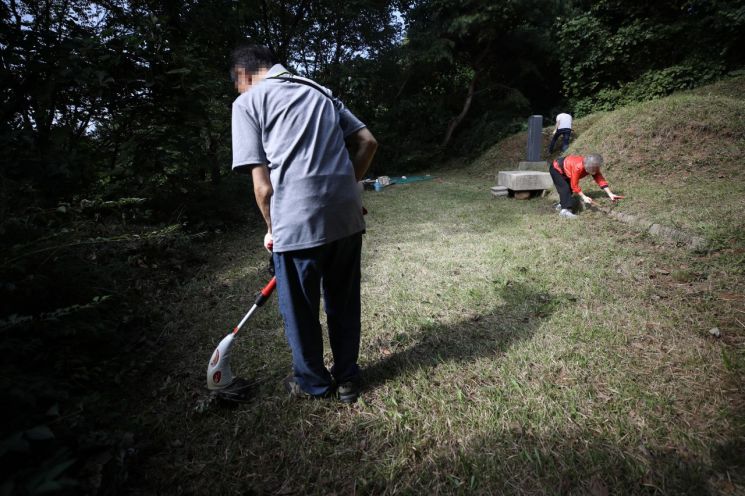
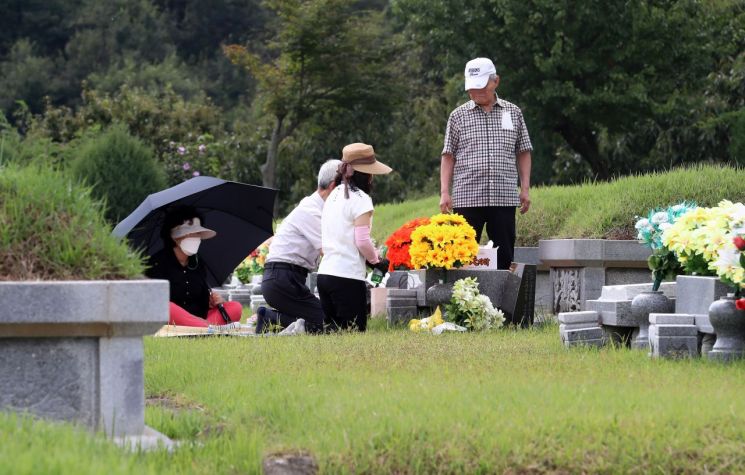
[Asia Economy Reporter Lee Chun-hee] The Chuseok holiday, a traditional Korean festival, has begun. It is the season when people visit their hometowns to trim the grass around their ancestors' graves or pay respects to their ancestors with family members.
However, this period requires special caution as accidents involving bee stings, snake bites, and tick bites are frequent. According to Seoul Asan Medical Center on the 18th, among approximately 66,000 patients treated for bee stings over the past five years, more than a quarter occurred in September. Additionally, September, the harvest season, is a time when infectious diseases caused by ticks are prevalent. If bitten by a chigger mite, one can contract scrub typhus, and if bitten by the small brown tick, known as the "killer tick," one can be infected with Severe Fever with Thrombocytopenia Syndrome (SFTS). With the help of Professor Jung Ji-won from the Department of Infectious Diseases at Seoul Asan Medical Center, we explored ways to prevent bee, snake, and tick bites and how to respond if bitten.
To Avoid Bees, Wear Monotonous Colored Clothes... Prompt Removal of Bee Stingers Is Crucial After Being Stung
To avoid bee stings during grass trimming or ancestral rites, it is advisable to wear clothes in monotonous colors. Also, cover your entire body as much as possible with long pants and long-sleeved shirts. Avoid flashy clothes, clothes that do not fit tightly and flutter in the wind. It is also best to refrain from using perfumes or skin lotions, and especially avoid wearing gold-colored jewelry, as it can attract bees when reflecting sunlight.
If stung by a bee, it is important to remove the stinger quickly. Instead of squeezing the stung area with your hands, it is better to scrape it off with a hard object such as a credit card. After removing the stinger, observe if any unusual symptoms appear. However, if you have allergies to medications, pollen, food, or have asthma, you should visit a hospital immediately.
This is because an allergic reaction called anaphylaxis from a bee sting can cause death within 15 minutes. Especially if you have allergies, the likelihood of anaphylaxis is 3 to 5 times higher than normal, so caution is necessary. Even without a history of allergies, if early symptoms of an allergic reaction such as vomiting, headache, general weakness, tachycardia, difficulty breathing, hives, or chest tightness appear, it is best to call 119 for help.
Be Careful Not to Get Bitten by Snakes... If Bitten, Immobilize with a Stick
To avoid snake bites during grass trimming or ancestral rites, it is good to use a long stick to stir up weeds or grass in advance to check for snakes while moving. Also, since you can be bitten by a snake when off guard, wear protective gear such as helmets and gloves during grass trimming.
If bitten by a snake, immobilize the bitten area with a stick or similar object so it does not move, position the bitten area below the heart, and call 119 for help.
If it is difficult to get help from 119, tie a cloth 3 to 5 cm wide about 5 to 7 cm above the bite toward the heart. However, tighten the cloth only until the pulse at the wrist or ankle is no longer felt, then gradually loosen it until the pulse is strongly felt again, and fix the cloth at that point.
Sucking the bite wound with your mouth after a snake bite is dangerous. Incorrect incisions can damage arteries, and if the rescuer has oral wounds or recent tooth extractions, the venom can enter the rescuer’s body.
To Avoid Ticks, Wear Long Clothes... If Bitten, Do Not Remove but Go to Hospital Immediately
Ticks are mainly active from spring to autumn. During grass trimming or ancestral rites, it is recommended to wear long clothes and long pants that cover the body to minimize skin exposure to avoid tick bites, even if it is hot. Avoid sitting carelessly on grass, and upon returning home, shake off the clothes worn that day and wash them immediately. Also, take a shower or bath to thoroughly wash off any ticks that may be attached to the body.
If bitten by a tick, do not forcibly remove it. Some parts of the tick left on the skin can cause infection. In this case, go to the nearest hospital immediately for treatment.
If bitten by a chigger mite, you can contract scrub typhus. Most symptoms improve within a few days with antibiotic treatment, but if symptoms are severe, hospitalization and antibiotic treatment are recommended. Rarely, shock may occur, or the central nervous system may be affected causing disabilities. Meningitis, interstitial pneumonia, and myocarditis can also develop, and delayed treatment can be life-threatening.
The small brown tick, known as the "killer tick," transmits SFTS. Initial symptoms include unexplained fever over 40 degrees Celsius, fatigue, loss of appetite, vomiting, diarrhea, and abdominal pain. Headache, muscle pain, and swollen lymph nodes may also accompany these symptoms. Severe thrombocytopenia and leukopenia can cause uncontrollable bleeding, and kidney failure and multiple organ failure can lead to death in severe cases.
© The Asia Business Daily(www.asiae.co.kr). All rights reserved.
![Clutching a Stolen Dior Bag, Saying "I Hate Being Poor but Real"... The Grotesque Con of a "Human Knockoff" [Slate]](https://cwcontent.asiae.co.kr/asiaresize/183/2026021902243444107_1771435474.jpg)
















