Online Platform Review Guidelines to be Announced Next Month
Market Dominance Judged by Number of Subscribers and Downloads
Business Model Changes Inevitable Due to Free Subscribers as a Customary Practice
Regulation Applies When Operators Mediate and Operate Like Kakao Mobility
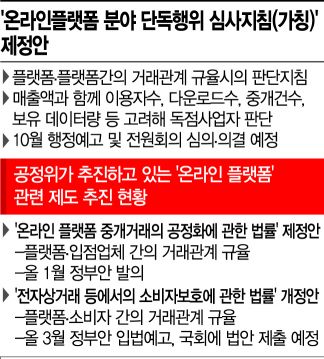
[Sejong=Asia Economy Reporter Joo Sang-don] The Korea Fair Trade Commission (KFTC) plans to clearly establish criteria for determining market-dominant operators in online platforms next month, which is expected to cause significant repercussions. It has become unpredictable how far the government’s sanctions over Kakao’s monopoly controversy will escalate, and substantial changes to the industry’s customary business models relying on free subscribers are inevitable.
The core of the online platform review guidelines to be enacted by the KFTC next month is to clearly present the criteria for determining market-dominant operators. The Monopoly Regulation and Fair Trade Act prohibits abuse of market-dominant positions, and to regulate this, it is necessary first to determine whether a specific operator holds a market-dominant position. The Act presumes an operator to be market-dominant if a single company’s market share exceeds 50%, or if three or fewer companies collectively hold 75% or more of the market share, and it sanctions the ‘abuse of market dominance’ by these operators. Until now, market share was mainly assessed based on sales revenue, but for online platforms, it is difficult to judge actual market share by sales alone. Therefore, going forward, the KFTC plans to comprehensively consider the number of users, downloads, mediation transactions, and data volume held.
A KFTC official stated on the 16th, “The handling of the Google Android operating system (OS) case was somewhat delayed due to three plenary meetings, which also delayed the preparation of the online platform review guidelines. Now that the Google OS case has recently been concluded, we can accelerate the guideline preparation work.”
The KFTC also plans to include typical types of unfair platform practices in the review guidelines. Cases such as ‘self-preferencing,’ where a platform operator participates in the business while also mediating, as with Kakao Mobility, giving preferential treatment to its own services over competitors; obstructing ‘multi-homing,’ where customers use multiple platforms simultaneously; and ‘lowest price guarantee demands,’ requiring competitors to apply prices equal to or lower than the platform’s own, will be listed as major unfair practices. The KFTC’s preparation of these guidelines is regarded as the final piece in regulating platforms, alongside related legislative bills. The KFTC has submitted a bill to the National Assembly on the ‘Fairness in Online Platform Intermediated Transactions Act (On-Platform Act),’ which governs the transactional relationship between platforms and merchants, and is also pushing for amendments to the ‘Consumer Protection Act in Electronic Commerce’ to strengthen regulations against unfair platform practices toward consumers. The last remaining area to regulate is unfair practices that may occur between platforms themselves. Initially, the KFTC announced in its 2021 work plan that it would prepare guidelines on unilateral acts by online platforms in the first half of this year. However, progress on the guidelines has been slow. The On-Platform Act stalled amid jurisdictional disputes with the Korea Communications Commission, and criticism that platform regulation stifles innovation has been considerable.
However, the previously favorable atmosphere toward platforms has recently reversed sharply. The Democratic Party’s dedicated task force on power imbalance issues, the ‘Euljiro Committee,’ held hearings from the 7th to the 10th with leading platform companies in various sectors such as Coupang, Kakao, Baedal Minjok, Yanolja, and Zigbang, along with small business owners and worker groups facing conflicts, to listen to damage cases. Both the ruling and opposition parties are gearing up to raise issues about platform abuses in this year’s National Assembly audit. In particular, Kakao Mobility, the de facto monopoly operator in the taxi-hailing app market, sparked controversy over taxi-hailing fee increases and the introduction of paid memberships for taxi drivers. Ultimately, Kakao announced a coexistence plan including withdrawal from some paid taxi-hailing services and the establishment of a 300 billion KRW mutual growth fund over five years with affiliates to support small business owners, taxi, and designated driver workers, but criticism remains strong. As such, the favorable atmosphere toward strengthening platform regulation has gained momentum, accelerating the KFTC’s efforts in preparing various platform-related bills and review guidelines.
© The Asia Business Daily(www.asiae.co.kr). All rights reserved.
![Clutching a Stolen Dior Bag, Saying "I Hate Being Poor but Real"... The Grotesque Con of a "Human Knockoff" [Slate]](https://cwcontent.asiae.co.kr/asiaresize/183/2026021902243444107_1771435474.jpg)















