Interview with Kwon Ki-hong, Chairman of the Win-Win Growth Committee
Platform Business Issues: Exploitation of Partner Companies and Offline Market Invasion Are Key
Relying Solely on Public Mediation for Conflict Resolution Wastes Social Costs
Win-Win Growth Committee, with Years of Experience, Should Strengthen Dispute Mediation Functions as a Private Institution
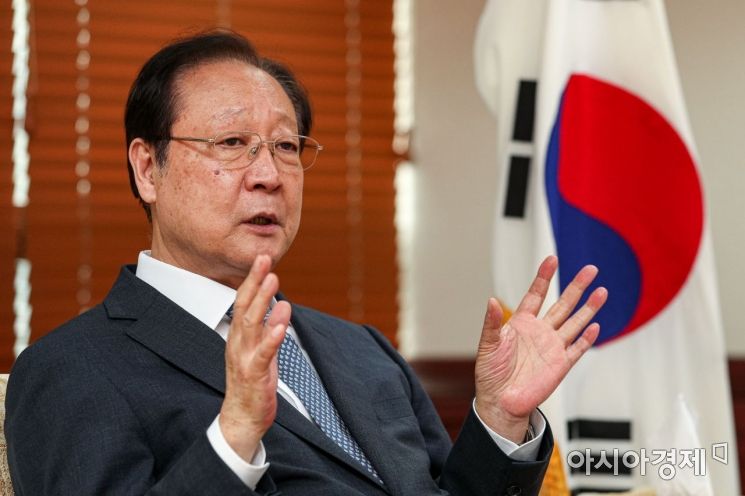 Kwon Ki-hong, Chairman of the Win-Win Growth Committee, is being interviewed at the Win-Win Growth Committee in Guro-gu, Seoul. Photo by Kang Jin-hyung aymsdream@
[Asia Economy Reporter Kim Heeyoon] "As the industrial structure transforms around the 4th Industrial Revolution, online platform businesses are causing various problems, leading to a demand for the role of the Commission for Shared Growth (Dongbanwi). However, it is difficult to address these issues solely through policy measures. Therefore, granting corporate status and establishing an independent secretariat function are necessary."
Kwon Ki-hong, Chairman of the Commission for Shared Growth (age 72), emphasized in an interview with Asia Economy on the 15th that to actively respond to conflicts between online platform companies like Kakao and traditional neighborhood businesses, the role of an institution capable of private-sector dispute mediation is crucial.
Chairman Kwon diagnosed, "The problems of online platform businesses can be seen as viewing partner companies not as collaborators but as subjects of exploitative dependency, and as platforms themselves entering offline industries and encroaching on those markets. While each should be addressed with corresponding regulatory policies, a mechanism to mediate unforeseen conflicts is necessary."
He cited the recent review by the Commission for Shared Growth on designating the designated industries for small and medium enterprises (SMEs), using the example of the designated driver industry. "The designated driver industry largely involves conflicts between offline industries, but fundamentally, conflicts between digital platform businesses like Kakao and existing industries are difficult to resolve through dispute mediation structures based on offline industries," he said. "The basic prerequisite for accelerating the development of new industries ultimately comes down to whether society has the capacity to mediate conflicts with existing industries."
 Recently, noise surrounding Kakao Mobility has not ceased. Some argue that it is urgent to establish measures to curb the reckless business expansion of large online platforms. Photo by Asia Economy DB
Dispute Mediation, Specialized Work of Dongbanwi... Corporate Status Needed to Secure Trust
Chairman Kwon stated, "Relying solely on public mediation for such conflicts wastes too much time and cost. Advanced countries already have various private dispute mediation mechanisms, and currently, the Commission for Shared Growth has accumulated the most experience in mediating disputes between large corporations and SMEs in Korea." Ultimately, securing trust from both large corporations and SMEs in the Commission for Shared Growth is important for private dispute mediation. However, as the Commission operates under the Cooperation Foundation affiliated with the Ministry of SMEs and Startups and lacks independent contracting ability and corporate status, it is difficult to maintain continuous trust," he argued.
Now in its 12th year since establishment, the Commission for Shared Growth is recently advocating for complete independence as a private organization, separate from government-affiliated institutions. Currently, the Commission is installed within the Cooperation Foundation for Large, Small, and Agricultural Enterprises (hereafter Cooperation Foundation), affiliated with the Ministry of SMEs and Startups. It faces restrictions on personnel authority, budget, and business activities. Even when independently deciding to promote support projects for SMEs and small business owners, approval from the Cooperation Foundation or the Ministry is required, making autonomous decision-making difficult.
Currently, two bills focusing on the separation and independence of the Commission for Shared Growth are under discussion in the National Assembly. One is the amendment to the "Act on Promotion of Mutual Growth between Large and Small Enterprises" (Mutual Growth Act) proposed by 14 members of the People Power Party, including Representative Kim Jeong-jae, and the other is the amendment announced in April by 11 members of the Democratic Party, including Representative Lee Dong-joo. Both bills aim to separate the Commission from the Cooperation Foundation, strengthen its function as a private institution, and have the government support its operating expenses, effectively showing bipartisan agreement on the issue.
Concerns over Trade Friction from Independence Are ‘Unfounded’ with No Cases in 10 Years
The Ministry of SMEs and Startups, the supervising ministry, expressed concerns that the Commission’s independence could increase the likelihood of trade friction due to its activities such as designating industries suitable for SMEs being linked with the government. In response, Chairman Kwon said, "The livelihood-type designated industries have already been legislated; the Commission only recommends, while the Ministry reviews, decides, and announces. Over the past 10 years, among 121 designations of suitable industries, there has not been a single case of trade friction." He added, "This indicates that the Commission has handled matters that could cause trade friction very cautiously, and it is hard to accept the argument that the Commission’s independence is difficult due to trade friction that has never occurred."
Chairman Kwon stated, "Not only conflicts between large corporations and small business owners but also the rapid growth of the platform industry and the resulting industrial restructuring have intensified conflicts across various areas between old and new industries. Since the Commission for Shared Growth has the most experience in coordinating and mediating these conflicts, its function and role as a mediator that facilitates private-sector consensus should be strengthened through separate corporate separation."
© The Asia Business Daily(www.asiae.co.kr). All rights reserved.
![Clutching a Stolen Dior Bag, Saying "I Hate Being Poor but Real"... The Grotesque Con of a "Human Knockoff" [Slate]](https://cwcontent.asiae.co.kr/asiaresize/183/2026021902243444107_1771435474.jpg)
















