Interview with Kang Dawit, Chairman of Hanbio Group
Patent Application for Mass Cultivation Technology of Hair Follicle Dermal Papilla Cells
"Will Pave the Way for Autologous Cell Hair Loss Treatment"
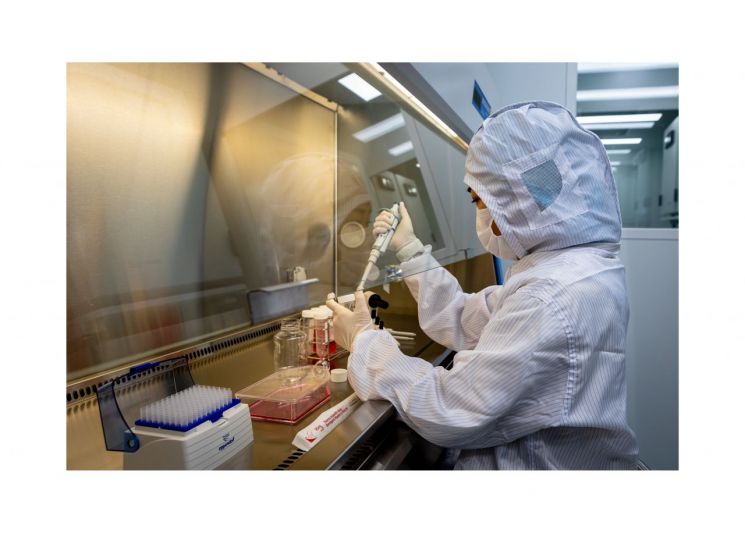 A researcher at Hanmo Bio's Gunpo GMP Plant 1 is conducting a mammary epithelial cell culture experiment. Photo by Hanmo Bio
[Asia Economy Reporter Kim Heeyoon] As the population suffering from hair loss steadily increases, the domestic hair loss market is also expanding. According to statistics from the Health Insurance Review & Assessment Service, the number of hair loss patients in Korea was 233,628 in 2019, showing a 12% increase compared to 208,534 in 2015. Hanbio, a cell-specialized company that has been researching treatment technologies for rare diseases, incurable diseases, and cancer through cell culturing such as stem cells and NK cells, recently challenged the hair loss treatment market with hair papilla cell culturing technology. Kang Dawit, chairman of Hanbio, explained, “Hanbio, which had immune cells as its main business area, focused on the hair loss market based on my personal experience of suffering from hair loss more than anyone else. We sought hair loss treatment solutions through the company’s specialized field of cells and concentrated on developing hair papilla cell technology applying NK immune cells and stem cell culturing technology.”
Hair papilla cells are the core cells located at the very bottom of the hair follicle responsible for hair growth. They are known as the seeds of hair that determine the number and thickness of hair strands. Unlike ordinary cells, they exist in clusters of about 3,000 cells, making them difficult to isolate and culture.
Hanbio’s subsidiary Hanmobio succeeded in mass culturing hair papilla cells and filed a patent for the technology in March. Chairman Kang emphasized, “The core of the patent lies in the chopping isolation technology (HCI), which physically separates hair papilla cells collected from hair follicles, and the mass culturing optimization technology (HMCO), which rapidly cultures the isolated cells in large quantities. Through cell isolation and mass culturing, it is possible to produce up to about 30,000 hairs (90 million cells) from a single hair.”
In June, Hanmobio also obtained a patent for a perforation transplantation technology that implants mass-cultured hair papilla cells into the scalp. The perforation transplantation technique is a surgical method that uses a punch called FUE (Follicular Unit Extractor) to create holes at regular intervals and depths on the scalp to implant the cells. Through this, Hanmobio was recognized for its technological capability to culture and inject the donor’s own hair papilla cells in vitro with the same shape and size as the extracted cells.
 Kang Dawit, chairman of Hanbio, explained that preparations for clinical trials of mammary papilla cell transplantation have been completed and are scheduled to proceed within the year. Once the clinical trials begin, it will be possible to mass-produce approximately 30,000 mammary papilla cells from one mother using patented technology, and then perform transplantation surgery using these cells. Photo by Kim Heeyoon
Having secured mass culturing and transplantation technology for hair papilla cells, Hanmobio started a hair papilla cell storage service last year and completed its GMP Class 1 factory in Gunpo, Gyeonggi Province, which stores consumers’ cells for up to 40 years. Regarding cell acquisition, Chairman Kang stated, “First, at an affiliated hospital, after local anesthesia on the scalp, hair follicles are collected using a follicle extractor down to the hair roots, then placed in a frozen transport container and moved to the laboratory within 24 hours to isolate and extract hair papilla cells. The follicle collection procedure takes about 10 minutes, and including the isolation of hair papilla cells in the lab, it is a simple procedure completed within about 30 minutes.”
The hair papilla cells extracted from the scalp are stored in a nitrogen tank at minus 196 degrees Celsius inside the GMP factory and can be thawed or used for procedures according to the consumer’s wishes. Hanmobio currently stores hair papilla cells for about 400 customers and is in the process of being designated as a regenerative medical institution related to hair papilla cell transplantation technology, with plans to proceed with clinical trials by the end of this year.
The Korean Society for Hair Research estimated that the domestic hair loss-related market size reaches about 4 trillion won. Hanbio plans to focus on solving hair loss problems through hair papilla cells following immune cells and stem cells, aiming for autologous treatment (MY Cell Care) using one’s own cells. Chairman Kang expressed his ambition, saying, “While concentrating on clinical trials for hair papilla cell transplantation technology, we also plan to soon launch hair care products containing hair papilla cell ingredients that help with daily hair management. Since many companies in the U.S. and Europe are showing great interest in hair loss solutions using hair papilla cells, I want to contribute to making Korea a hub for hair loss treatment.”
© The Asia Business Daily(www.asiae.co.kr). All rights reserved.
![Clutching a Stolen Dior Bag, Saying "I Hate Being Poor but Real"... The Grotesque Con of a "Human Knockoff" [Slate]](https://cwcontent.asiae.co.kr/asiaresize/183/2026021902243444107_1771435474.jpg)
















